
Last letters from the living dead man
David Patterson (Spirit) Hatch
THE CLASSIC COLLECTION · 1829
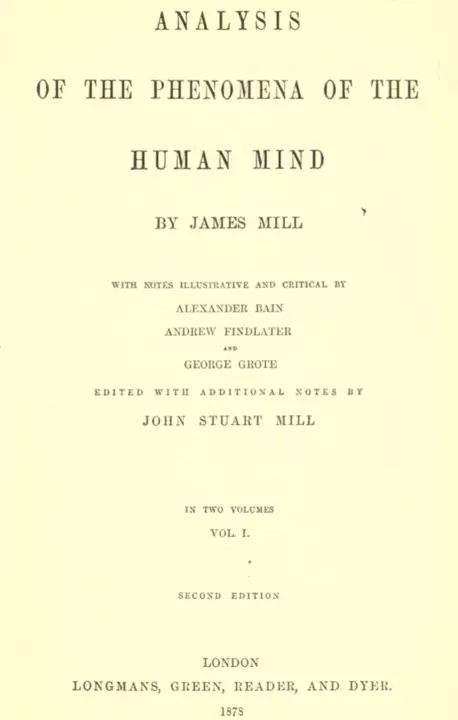
"Analysis of the Phenomena of the Human Mind" by James Mill is a scientific treatise written in the late 19th century. This work focuses on exploring the intricacies of human mental phenomena, aiming to break down complex mental processes into simpler components for better understanding. Mill endeavors to advance the field of psychology by examining feelings, sensations, and the laws that govern mental processes. The opening of the treatise sets the stage for a deep analysis of human sensations, beginning with a discussion on the necessity of understanding the simple elements that make up our more complex mental experiences. Mill outlines his goal to explore how various feelings—resulting from sensory experiences—are interrelated, and he emphasizes the importance of classifying these sensations. He prepares the reader for a methodological breakdown of the senses, such as smell and hearing, illustrating how each operates individually while also forming a holistic understanding of human consciousness as interconnected sensations and experiences. This analytical framework invites readers, particularly those new to philosophical inquiries, to reflect upon their own perceptions systematically.
Introduction adapted from the source catalogue; source summaries may be automatically generated.
Free to read · English · 263,558 words · No account needed
MAKE TIME FOR A GOOD BOOK
On by default. Untick to stop anonymous reading totals. Each page counts after 10 seconds in view. How this works.
Anonymous counting is on unless you have switched it off.
In further prosecution of the analysis:
"How do we become cognizant of the relative positions of two points on the surface of the body? Such two points, considered as coexistent, involve the germinal idea of Space. Such two points disclosed to consciousness by two successive tactual sensations proceeding from them, involve the germinal idea of Time. And the series of muscular sensations by which, when self-produced, these two tactual sensations are separated, involve the germinal idea of Motion. The questions to be considered then are--In what order do these germinal ideas arise? and--How are they developed?
"... Taking for our subject a newly-born infant, let us call the two points on its body between which a relation is to be established, A and Z. Let us assume these points to be anywhere within reach of the hands--say upon the cheek. By the hypothesis, nothing is at present known of these points; either as coexisting in Space, as giving successive sensations in Time, or as being brought into relation by Motion. If, now, the infant moves its arm in such a way as to touch nothing, there is a certain vague reaction upon its consciousness--a sensation of muscular tension. This {157} sensation has the peculiarity of being indefinite in all its commencement; indefinite in its termination; and indefinite in all its intermediate changes. Its strength is proportionate to the degree of muscular contraction. Whence it follows that as the limb starts from a state of rest, in which there is no contraction; and as it can reach a position requiring extreme contraction only by passing through positions requiring intermediate degrees of contraction; and as the degrees of contraction must therefore form a series ascending by infinitesimal increments from zero; the sensations of tension must also form such a series. And the like must be the case with all subsequent movements and their accompanying sensations; seeing that, be it at rest or in action, a muscle cannot pass from any one state to any other without going through all the intermediate states. Thus, then, the infant, on moving its arm backwards and forwards without touching anything, is brought to what we may distinguish as a nascent consciousness--a consciousness not definitely divisible into states; but a consciousness the variations of which pass insensibly into each other, like undulations of greater or less magnitude. And while the states of consciousness are thus incipient--thus indistinctly separated, there can be no clear comparison of them; no thought, properly so called; and consequently no ideas of Motion, Time, or Space, as we understand them. Suppose, now, that the hand touches something. A sudden change in consciousness is produced--a change that is incisive in its commencement, and, when the hand is removed, equally incisive in its termination. In the midst of the continuous feeling of muscular tension, vaguely rising and falling in intensity, there all at once occurs a distinct feeling of another kind. This feeling, beginning and ending abruptly, constitutes a definite state of consciousness; becomes, as it were, a mark in consciousness. By similar experiences other such marks are produced; and in proportion as they are multiplied, there arises a possibility of comparing them, both in respect to their degrees and their relative positions; while at the same {158} time, the feelings of muscular tension being, as it were, divided out into lengths by these superposed marks, become similarly comparable; and so there are acquired materials for a simple order of thought. Observe, also, that while these tactual sensations may, when several things are touched in succession, produce successive marks in consciousness, separated by intervening muscular sensations, they may also become continually coexistent with these muscular sensations; as when the finger is drawn along a surface. And observe further, that when the surface over which the finger is drawn is not a foreign body, but some part of the subject's body, these muscular sensations, and the continuous tactual sensation joined with them, are accompanied by a series of tactual sensations proceeding from that part of the skin over which the finger is drawn. Thus, then, when the infant moves its finger along the surface of its body from A to Z, there are simultaneously impressed upon consciousness three sets of sensations--the varying series of sensations proceeding from the muscles in action; the series of tactual sensations proceeding from the points of the skin successively touched between A and Z; and the continuous sensation of touch from the finger-end.... As subsequent motions of the finger over the surface from A to Z always result in the like simultaneous sets of sensations, these, in course of time, become indissolubly associated. Though the series of tactual sensations, A to Z, being producible by a foreign body moving over the same surface, can be dissociated from the others; and though, if the cheek be withdrawn by a movement of the head, the same motion of the hand, with its accompanying muscular sensations, may occur without any sensation of touch; yet, when these two series are linked by the tactual sensation proceeding from the finger-end, they necessarily proceed together; and become inseparably connected in thought. Whence it obviously results that the series of tactual sensations A to Z, and the series of muscular sensations which invariably accompanies it when self-produced, serve as mutual equivalents; and being {159} two sides of the same experience, suggest each other in consciousness.
Your reading position is saved on this browser. Take it to another device with a library code. Reading pages adapt to text, rather than matching a printed edition.
BEHIND THE BOOK
This eBook is for the use of anyone anywhere in the United States and most other parts of the world at no cost and with almost no restrictions whatsoever. You may copy it, give it away or re-use it under the terms of the Project Gutenberg License included with this eBook or online at www.gutenberg.org. If you are not located in the United States, you will have to check the laws of the country where you are located before using this eBook. Read the source licence.
The original source file, including credits and licence, is retained by this library. Request an original-format copy at no charge. Please include the book title and Project Gutenberg identifier #56441.
KEEP YOUR CURIOSITY GOING
David Patterson (Spirit) Hatch
Coulson Kernahan

Ralph Waldo Emerson
Frances Wright

Edwin Abbott Abbott

Joseph Droz