
Last letters from the living dead man
David Patterson (Spirit) Hatch
THE CLASSIC COLLECTION · 1829
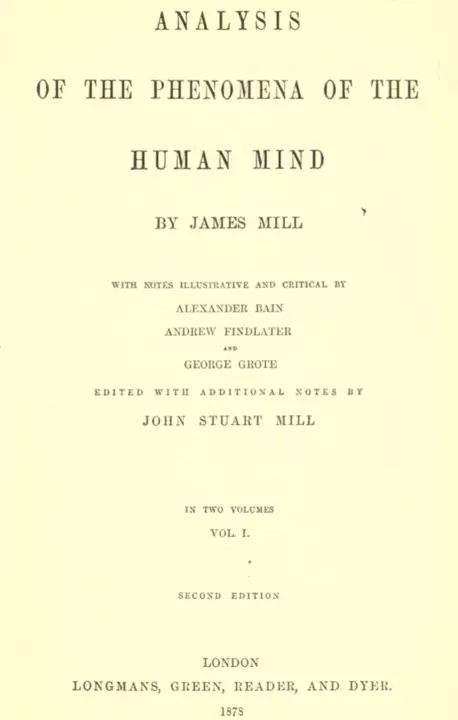
"Analysis of the Phenomena of the Human Mind" by James Mill is a scientific treatise written in the late 19th century. This work focuses on exploring the intricacies of human mental phenomena, aiming to break down complex mental processes into simpler components for better understanding. Mill endeavors to advance the field of psychology by examining feelings, sensations, and the laws that govern mental processes. The opening of the treatise sets the stage for a deep analysis of human sensations, beginning with a discussion on the necessity of understanding the simple elements that make up our more complex mental experiences. Mill outlines his goal to explore how various feelings—resulting from sensory experiences—are interrelated, and he emphasizes the importance of classifying these sensations. He prepares the reader for a methodological breakdown of the senses, such as smell and hearing, illustrating how each operates individually while also forming a holistic understanding of human consciousness as interconnected sensations and experiences. This analytical framework invites readers, particularly those new to philosophical inquiries, to reflect upon their own perceptions systematically.
Introduction adapted from the source catalogue; source summaries may be automatically generated.
Free to read · English · 263,558 words · No account needed
MAKE TIME FOR A GOOD BOOK
On by default. Untick to stop anonymous reading totals. Each page counts after 10 seconds in view. How this works.
Anonymous counting is on unless you have switched it off.
{114} This, indeed, is one great cause of the mistakes, which have been committed, in the examination of abstract ideas. We have shewn that they are all complex, and in the highest degree. Yet the greater number of them have always been treated as simple. Mr. Locke shewed that some of them, which he calls mixed modes, were undoubtedly compounded, as obligation, crime, &c. But they are no otherwise complex, than as power, quality, chance, fate, position, and space, are complex.
It is truly remarkable, how many of the cases of indissoluble association are all united in the idea of SPACE. First of all, with the idea of every object, the idea of position or place, is indissolubly united. {115} Secondly, with the idea of position or place, the idea of extension is indissolubly united. Thirdly, with the idea of extension the idea of infinity is indissolubly united. Fourthly, by the unfortunate ambiguity of the Copula, the idea of existence is indissolubly united with SPACE, as with other abstract terms. What these several ingredients, the ideas of Position, Extension, Infinity, Existence, are composed of, we have already seen. All these, forced into combination, by irresistible association, constitute the idea of SPACE.
As SPACE is a comprehensive word, including all Positions, or the whole of synchronous order; so TIME is a comprehensive word, including all Successions, or the whole of successive order.
The difficulty of the exposition, in this case, consists not in the ideas; for they are clear and certain enough; but in finding expressions which will have even a chance of conveying to readers, who are not familiar with the analysis of mental phenomena, the ideas which it is my object to impart.
As all objects, considered as existing together, are said to exist in SPACE, so all objects considered as existing one after another, are said to exist in TIME.
Objects, however, are said to exist in Time, in two distinguishable cases; either when they are in constant flow; or, when they have, what we call, stability or duration. The constant passage of men, horses, vehicles, &c., in a busy and crowded street, is in Time; the permanence of St. Paul's, in its well-known position, is also in Time. If Time mean the succession of the objects in the one case, it must mean something else in the other. It cannot mean the succession of St. Paul's. But it may mean the idea of St. Paul's, associated with the idea of other successions.
Your reading position is saved on this browser. Take it to another device with a library code. Reading pages adapt to text, rather than matching a printed edition.
BEHIND THE BOOK
This eBook is for the use of anyone anywhere in the United States and most other parts of the world at no cost and with almost no restrictions whatsoever. You may copy it, give it away or re-use it under the terms of the Project Gutenberg License included with this eBook or online at www.gutenberg.org. If you are not located in the United States, you will have to check the laws of the country where you are located before using this eBook. Read the source licence.
The original source file, including credits and licence, is retained by this library. Request an original-format copy at no charge. Please include the book title and Project Gutenberg identifier #56441.
KEEP YOUR CURIOSITY GOING
David Patterson (Spirit) Hatch
Coulson Kernahan

Ralph Waldo Emerson
Frances Wright

Edwin Abbott Abbott

Joseph Droz