
Last letters from the living dead man
David Patterson (Spirit) Hatch
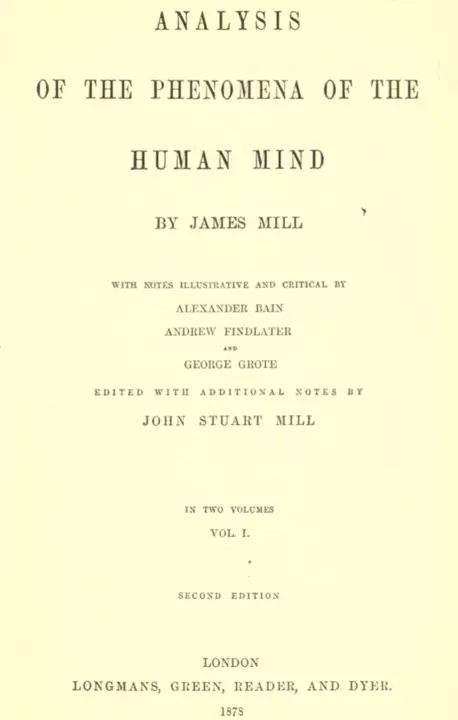
THE CLASSIC COLLECTION · 1829
"Analysis of the Phenomena of the Human Mind" by James Mill is a scientific treatise written in the late 19th century. This work focuses on exploring the intricacies of human mental phenomena, aiming to break down complex mental processes into simpler components for better understanding. Mill endeavors to advance the field of psychology by examining feelings, sensations, and the laws that govern mental processes. The opening of the treatise sets the stage for a deep analysis of human sensations, beginning with a discussion on the necessity of understanding the simple elements that make up our more complex mental experiences. Mill outlines his goal to explore how various feelings—resulting from sensory experiences—are interrelated, and he emphasizes the importance of classifying these sensations. He prepares the reader for a methodological breakdown of the senses, such as smell and hearing, illustrating how each operates individually while also forming a holistic understanding of human consciousness as interconnected sensations and experiences. This analytical framework invites readers, particularly those new to philosophical inquiries, to reflect upon their own perceptions systematically.
Introduction adapted from the source catalogue; source summaries may be automatically generated.
Free to read · English · 263,558 words · No account needed
MAKE TIME FOR A GOOD BOOK
On by default. Untick to stop anonymous reading totals. Each page counts after 10 seconds in view. How this works.
Anonymous counting is on unless you have switched it off.
There is another important peculiarity of these certified or guaranteed possibilities of sensation; namely, that they have reference, not to single sensations, but to sensations joined together in groups. When we think of anything as a material substance, or body, we either have had, or we think that on some given supposition we should have, not some one sensation, but a great and even an indefinite number and variety of sensations, generally belonging to different senses, but so linked together, that the presence of one announces the possible presence at the very same instant of any or all of the rest. In our mind, therefore, not only is this particular Possibility of sensation invested with the quality of permanence when we are not actually feeling any of the sensations at all; but when we are feeling some of them, the remaining sensations of the group are conceived by us in the form of Present Possibilities, which might be realized at the very moment. And as this happens in turn to all of them, the group as a whole presents itself to the mind as permanent, in contrast not solely with the temporariness of my bodily presence, but also with the temporary character of each of the sensations composing the group; in other words, as a kind of permanent substratum, under a set of passing experiences or manifestations: which is another leading character of our idea of substance or matter, as distinguished from sensation.
Let us now take into consideration another of the general characters of our experience, namely, that in addition to fixed groups, we also recognise a fixed Order in our sensations; an Order of succession, which, when ascertained by observation, gives rise to the ideas of Cause and Effect, according to what I hold to be the true theory of that relation, and is on any {445} theory the source of all our knowledge what causes produce what effects. Now, of what nature is this fixed order among our sensations? It is a constancy of antecedence and sequence. But the constant antecedence and sequence do not generally exist between one actual sensation and another. Very few such sequences are presented to us by experience. In almost all the constant sequences which occur in Nature, the antecedence and consequence do not obtain between sensations, but between the groups we have been speaking about, of which a very small portion is actual sensation, the greater part being permanent possibilities of sensation, evidenced to us by a small and variable number of sensations actually present. Hence, our ideas of causation, power, activity, do not become connected in thought with our sensations as actual at all, save in the few physiological cases where these figure by themselves as the antecedents in some uniform sequence. Those ideas become connected, not with sensations, but with groups of possibilities of sensation. The sensations conceived do not, to our habitual thoughts, present themselves as sensations actually experienced, inasmuch as not only any one or any number of them may be supposed absent, but none of them need be present. We find that the modifications which are taking place more or less regularly in our possibilities of sensation, are mostly quite independent of our consciousness, and of our presence or absence. Whether we are asleep or awake the fire goes out, and puts an end to one particular possibility of warmth and light. Whether we are present or absent the corn ripens, and brings a new possibility of food. Hence we speedily learn to think of Nature as made up solely of these groups of possibilities, and the active force in Nature as manifested in the modification of some of these by others. The sensations, though the original foundation of the whole, come to be looked upon as a sort of accident depending on us, and the possibilities as much more real than the actual sensations, nay, as the very realities of which these are only the representations, appearances, or effects. When this state of mind has been arrived at, then, and from that time forward, we are never {446} conscious of a present sensation without instantaneously referring it to some one of the groups of possibilities into which a sensation of that particular description enters; and if we do not yet know to what group to refer it, we at least feel an irresistible conviction that it must belong to some group or other; i.e. that its presence proves the existence, here and now, of a great number and variety of possibilities of sensation, without which it would not have been. The whole set of sensations as possible, form a permanent background to any one or more of them that are, at a given moment, actual; and the possibilities are conceived as standing to the actual sensations in the relation of a cause to its effects, or of canvas to the figures painted on it, or of a root to the trunk, leaves, and flowers, or of a substratum to that which is spread over it, or, in transcendental language, of Matter to Form.
Your reading position is saved on this browser. Take it to another device with a library code. Reading pages adapt to text, rather than matching a printed edition.
BEHIND THE BOOK
This eBook is for the use of anyone anywhere in the United States and most other parts of the world at no cost and with almost no restrictions whatsoever. You may copy it, give it away or re-use it under the terms of the Project Gutenberg License included with this eBook or online at www.gutenberg.org. If you are not located in the United States, you will have to check the laws of the country where you are located before using this eBook. Read the source licence.
The original source file, including credits and licence, is retained by this library. Request an original-format copy at no charge. Please include the book title and Project Gutenberg identifier #56441.
KEEP YOUR CURIOSITY GOING
David Patterson (Spirit) Hatch
Coulson Kernahan

Ralph Waldo Emerson
Frances Wright

Edwin Abbott Abbott

Joseph Droz