
Last letters from the living dead man
David Patterson (Spirit) Hatch
THE CLASSIC COLLECTION · 1829
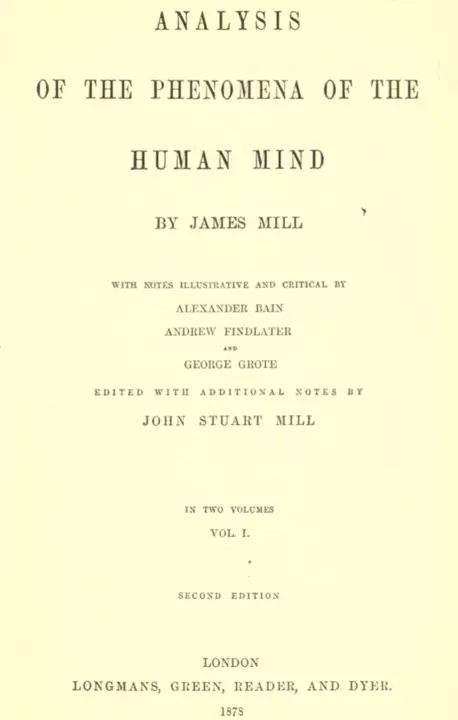
"Analysis of the Phenomena of the Human Mind" by James Mill is a scientific treatise written in the late 19th century. This work focuses on exploring the intricacies of human mental phenomena, aiming to break down complex mental processes into simpler components for better understanding. Mill endeavors to advance the field of psychology by examining feelings, sensations, and the laws that govern mental processes. The opening of the treatise sets the stage for a deep analysis of human sensations, beginning with a discussion on the necessity of understanding the simple elements that make up our more complex mental experiences. Mill outlines his goal to explore how various feelings—resulting from sensory experiences—are interrelated, and he emphasizes the importance of classifying these sensations. He prepares the reader for a methodological breakdown of the senses, such as smell and hearing, illustrating how each operates individually while also forming a holistic understanding of human consciousness as interconnected sensations and experiences. This analytical framework invites readers, particularly those new to philosophical inquiries, to reflect upon their own perceptions systematically.
Introduction adapted from the source catalogue; source summaries may be automatically generated.
Free to read · English · 263,558 words · No account needed
MAKE TIME FOR A GOOD BOOK
On by default. Untick to stop anonymous reading totals. Each page counts after 10 seconds in view. How this works.
Anonymous counting is on unless you have switched it off.
RATIOCINATION is one of the most complicated of all the mental phenomena. And it is worthy of notice, that more was accomplished towards the analysis of it, at an early period in the history of intellectual improvement, than of any other of the complex cases of human consciousness.
It was fully explained by Aristotle, that the simplest case of Ratiocination consists of three propositions, which he called a syllogism. A piece of ratiocination may consist of one, or more syllogisms, to any extent; but every single step is a syllogism.
A ratiocination, then, or syllogism, is first resolved into three propositions. The following may be taken as one of the simplest of all examples. "All men are animals: kings are men: therefore kings are animals."
Next, the Proposition is resolved into its proximate elements. These are three; two Terms, one called the Subject, the other the Predicate, and the Copula. {425} What is the particular nature of each of these elements we have already seen, and here, therefore, need not stay to inquire.
The ancient writers on Logic proceeded in their analysis, no farther than Terms. After this, they only endeavoured to enumerate and classify terms; to enumerate and classify propositions; to enumerate and classify syllogisms; and to give the rules for making correct syllogisms, and detecting incorrect ones. And this, as taught by them, constituted the whole science and art of Logic.
What, under this head, we propose to explain, is--the process of
association involved in the syllogism, and in the belief which is
part of it.
That part of the process which is involved in the two antecedent propositions, called the premises, has been already explained. It is only, therefore, the third proposition, called the conclusion, which further requires exposition.
We have seen, that in the proposition, "All men are animals," Belief is merely the recognition that the meaning of the term, "all men," is included in that of the term "animals," and that the recognition is a case of association. In the proposition also, "kings are men," the belief is merely the recognition, that the individuals named "kings," are part of the many, of whom "men," is the common name. This has already been more than once explained. And now, therefore, remains only to be shewn what further is involved in the third proposition, or conclusion, "kings are animals."
In each of the two preceding propositions, two terms or names are compared. In the last {426} proposition, a third name is compared with both the other two; immediately with the one, and, through that, with the other; the whole, obviously, a complicated case of association.
Your reading position is saved on this browser. Take it to another device with a library code. Reading pages adapt to text, rather than matching a printed edition.
BEHIND THE BOOK
This eBook is for the use of anyone anywhere in the United States and most other parts of the world at no cost and with almost no restrictions whatsoever. You may copy it, give it away or re-use it under the terms of the Project Gutenberg License included with this eBook or online at www.gutenberg.org. If you are not located in the United States, you will have to check the laws of the country where you are located before using this eBook. Read the source licence.
The original source file, including credits and licence, is retained by this library. Request an original-format copy at no charge. Please include the book title and Project Gutenberg identifier #56441.
KEEP YOUR CURIOSITY GOING
David Patterson (Spirit) Hatch
Coulson Kernahan

Ralph Waldo Emerson
Frances Wright

Edwin Abbott Abbott

Joseph Droz