
Last letters from the living dead man
David Patterson (Spirit) Hatch
THE CLASSIC COLLECTION · 1829
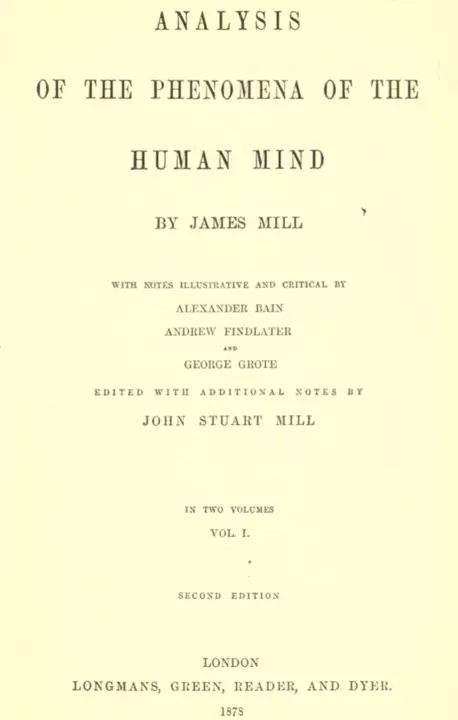
"Analysis of the Phenomena of the Human Mind" by James Mill is a scientific treatise written in the late 19th century. This work focuses on exploring the intricacies of human mental phenomena, aiming to break down complex mental processes into simpler components for better understanding. Mill endeavors to advance the field of psychology by examining feelings, sensations, and the laws that govern mental processes. The opening of the treatise sets the stage for a deep analysis of human sensations, beginning with a discussion on the necessity of understanding the simple elements that make up our more complex mental experiences. Mill outlines his goal to explore how various feelings—resulting from sensory experiences—are interrelated, and he emphasizes the importance of classifying these sensations. He prepares the reader for a methodological breakdown of the senses, such as smell and hearing, illustrating how each operates individually while also forming a holistic understanding of human consciousness as interconnected sensations and experiences. This analytical framework invites readers, particularly those new to philosophical inquiries, to reflect upon their own perceptions systematically.
Introduction adapted from the source catalogue; source summaries may be automatically generated.
Free to read · English · 263,558 words · No account needed
MAKE TIME FOR A GOOD BOOK
On by default. Untick to stop anonymous reading totals. Each page counts after 10 seconds in view. How this works.
Anonymous counting is on unless you have switched it off.
It is to the author of the present volumes that the honour belongs of being the reviver and second founder of the Association psychology. Great as is this merit, it was but one among many services which he rendered to his generation and to mankind. When {xiii} the literary and philosophical history of this century comes to be written as it deserves to be, very few are the names figuring in it to whom as high a place will be awarded as to James Mill. In the vigour and penetration of his intellect he has had few superiors in the history of thought: in the wide compass of the human interests which he cared for and served, he was almost equally remarkable: and the energy and determination of his character, giving effect to as single-minded an ardour for the improvement of mankind and of human life as I believe has ever existed, make his life a memorable example. All his work as a thinker was devoted to the service of mankind, either by the direct improvement of their beliefs and sentiments, or by warring against the various influences which he regarded as obstacles to their progress: and while he put as much conscientious thought and labour into everything he did, as if he had never done anything else, the subjects on which he wrote took as wide a range as if he had written without any labour at all. That the same man should have been the author of the History of India and of the present treatise, is of itself sufficiently significant. The former of those works, which by most men would have been thought a sufficient achievement for a whole literary life, may be said without exaggeration to have been the commencement of rational thinking on the subject of India: and by that, and his subsequent {xiv} labours as an administrator of Indian interests under the East India Company, he effected a great amount of good, and laid the foundation of much more, to the many millions of Asiatics for whose bad or good government his country is responsible. The same great work is full of far-reaching ideas on the practical interests of the world; and while forming an important chapter in the history and philosophy of civilization (a subject which had not then been so scientifically studied as it has been since) it is one of the most valuable contributions yet made even to the English history of the period it embraces. If, in addition to the History and to the present treatise, all the author's minor writings were collected; the outline treatises on nearly all the great branches of moral and political science which he drew up for the Supplement to the Encyclopædia Britannica, and his countless contributions to many periodical works; although advanced thinkers have outgrown some of his opinions, and include, on many subjects, in their speculations, a wider range of considerations than his, every one would be astonished at the variety of his topics, and the abundance of the knowledge he exhibited respecting them all. One of his minor services was, that he was the first to put together in a compact and systematic form, and in a manner, adapted to learners, the principles of Political Economy as renovated by the genius of Ricardo: whose great {xv} work, it may be mentioned by the way, would probably never have seen the light, if his intimate and attached friend Mr. Mill had not encouraged and urged him, first to commit to paper his profound thoughts, and afterwards to send them forth to the world. Many other cases might be mentioned in which Mr. Mill's private and personal influence was a means of doing good, hardly inferior to his public exertions. Though, like all who value their time for higher purposes, he went little into what is called society, he helped, encouraged, and not seldom prompted, many of the men who were most useful in their generation: from his obscure privacy he was during many years of his life the soul of what is now called the advanced Liberal party; and such was the effect of his conversation, and of the tone of his character, on those who were within reach of its influence, that many, then young, who have since made themselves honoured in the world by a valuable career, look back to their intercourse with him as having had a considerable share in deciding their course through life. The most distinguished of them all, Mr. Grote, has put on record, in a recent publication, his sense of these obligations, in terms equally honourable to both. As a converser, Mr. Mill has had few equals; as an argumentative converser, in modern tunes probably none. All his mental resources seemed to be at his command at any moment, and were then freely {xvi} employed in removing difficulties which in his writings for the public he often did not think it worth while to notice. To a logical acumen which has always been acknowledged, he united a clear appreciation of the practical side of things, for which he did not always receive credit from those who had no personal knowledge of him, but which made a deep impression on those who were acquainted with the official correspondence of the East India Company conducted by him. The moral qualities which shone in his conversation were, if possible, more valuable to those who had the privilege of sharing it, than even the intellectual. They were precisely such as young men of cultivated intellect, with good aspirations but a character not yet thoroughly formed, are likely to derive most benefit from. A deeply rooted trust in the general progress of the human race, joined with a good sense which made him never build unreasonable or exaggerated hopes on any one event or contingency; an habitual estimate of men according to their real worth as sources of good to their fellow-creatures, and an unaffected contempt for the weaknesses or temptations that divert them from that object, making those with whom he conversed feel how painful it would be to them to be counted by him among such backsliders; a sustained earnestness, in which neither vanity nor personal ambition had any part, and which spread from him by a sympathetic contagion to those {xvii} who had sufficient moral preparation to value and seek the opportunity; this was the mixture of qualities which made his conversation almost unrivalled in its salutary moral effect. He has been accused of asperity, and there was asperity in some few of his writings; but no party spirit, personal rivalry, or wounded amour-propre ever stirred it up. Even when he had received direct personal offence, he was the most placable of men. The bitterest and ablest attack ever publicly made on him was that which was the immediate cause of the introduction of Mr. Macaulay into public life. He felt it keenly at the time, but with a quite impersonal feeling, as he would have felt any thing that he thought unjustly said against any opinion or cause which was dear to him; and within a very few years afterwards he was on terms of personal friendship with its author, as Lord Macaulay himself, in a very creditable passage of the preface to his collected Essays, has, in feeling terms, commemorated.
Your reading position is saved on this browser. Take it to another device with a library code. Reading pages adapt to text, rather than matching a printed edition.
BEHIND THE BOOK
This eBook is for the use of anyone anywhere in the United States and most other parts of the world at no cost and with almost no restrictions whatsoever. You may copy it, give it away or re-use it under the terms of the Project Gutenberg License included with this eBook or online at www.gutenberg.org. If you are not located in the United States, you will have to check the laws of the country where you are located before using this eBook. Read the source licence.
The original source file, including credits and licence, is retained by this library. Request an original-format copy at no charge. Please include the book title and Project Gutenberg identifier #56441.
KEEP YOUR CURIOSITY GOING
David Patterson (Spirit) Hatch
Coulson Kernahan

Ralph Waldo Emerson
Frances Wright

Edwin Abbott Abbott

Joseph Droz