
Last letters from the living dead man
David Patterson (Spirit) Hatch
THE CLASSIC COLLECTION · 1829
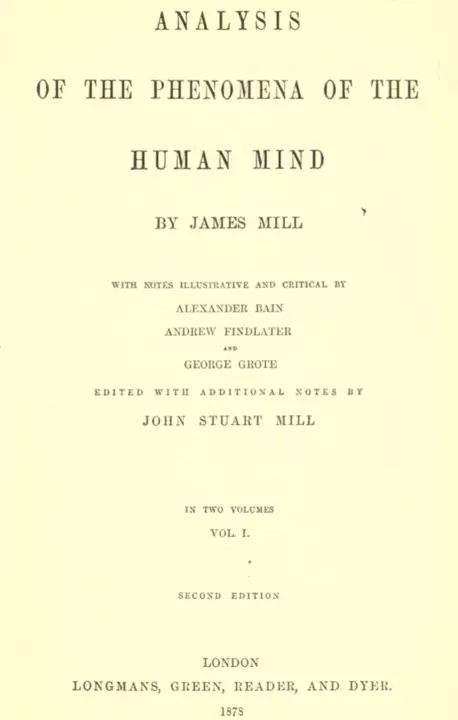
"Analysis of the Phenomena of the Human Mind" by James Mill is a scientific treatise written in the late 19th century. This work focuses on exploring the intricacies of human mental phenomena, aiming to break down complex mental processes into simpler components for better understanding. Mill endeavors to advance the field of psychology by examining feelings, sensations, and the laws that govern mental processes. The opening of the treatise sets the stage for a deep analysis of human sensations, beginning with a discussion on the necessity of understanding the simple elements that make up our more complex mental experiences. Mill outlines his goal to explore how various feelings—resulting from sensory experiences—are interrelated, and he emphasizes the importance of classifying these sensations. He prepares the reader for a methodological breakdown of the senses, such as smell and hearing, illustrating how each operates individually while also forming a holistic understanding of human consciousness as interconnected sensations and experiences. This analytical framework invites readers, particularly those new to philosophical inquiries, to reflect upon their own perceptions systematically.
Introduction adapted from the source catalogue; source summaries may be automatically generated.
Free to read · English · 263,558 words · No account needed
MAKE TIME FOR A GOOD BOOK
On by default. Untick to stop anonymous reading totals. Each page counts after 10 seconds in view. How this works.
Anonymous counting is on unless you have switched it off.
Besides, this supposition of a momentary belief in ghosts breaking in upon and interrupting an habitual and permanent belief that there are no ghosts, jars considerably with the {409} doctrine it is brought to support, that belief is an inseparable association. According to that doctrine, here are two inseparable associations, which yet are so far from exclusively possessing the mind, that they alternate with one another, each Inseparable implying the separation of the other Inseparable. The association of darkness with the absence of ghosts must be anything but inseparable, if there only needs the presence of darkness to revive the contrary association. Yet an association so very much short of inseparable, is accompanied, at least in the absence of darkness, by a full belief. Darkness is in this case associated with two incompatible ideas, the idea of ghosts and that of their absence, but with neither of them inseparably, and in consequence the two associations alternately prevail, as the surrounding circumstances favour the one or the other; agreeably to the laws of Compound Association laid down with great perspicuity and reach of thought by Mr. Bain in his systematic treatise.
To the argument, that the inseparable associations which create optical and other illusions, do not, when opposed by reason, generate the false belief, the author's answer would probably be some such as the following. When the rational thinker succeeds in resisting the belief, he does so by more or less completely overcoming the inseparableness of the association. Associations may be conquered by the formation of counter-associations. Mankind had formerly an inseparable association between sunset and the motion of the sun, and this in separable association compelled them to believe that in the phenomenon of sunset the sun moves and the earth is at rest. But Copernicus, Galileo, and after them, all astronomers, found evidence, that the earth moves and the sun is at rest: in other words, certain experiences, and certain reasonings from those experiences, took place in their minds, the tendency of which was to associate sunset with the ideas of the earth in motion and the sun at rest. This was a counter-association, which could not coexist, at least at the same instant, with the previous association connecting sunset with the sun in motion and the earth at rest. But for a long time the new {410} associating influences could not be powerful enough to get the better of the old association, and change the belief which it implied. A belief which has become habitual, is seldom overcome but by a slow process. However, the experiences and mental processes that tended to form the new association still went on; there was a conflict between the old association and the causes which tended to produce a new one; until, by the long continuance and frequent repetition of those causes, the old association, gradually undermined, ceased to be inseparable, and it became possible to associate the idea of sunset with that of the earth moving and the sun at rest; whereby the previous idea of the sun moving and the earth at rest was excluded for the time, and as the new association grew in strength, was at last thrown out altogether. The argument should go on to say that after a still further prolongation of the new experiences and reasonings, the old association became impossible and the new one inseparable; for, until it became inseparable, there could, according to the theory, be no belief. And this, in truth, does sometimes happen. There are instances in the history of science, even down to the present day, in which something which was once believed to be impossible, and its opposite to be necessary, was first seen to be possible, next to be true, and finally came to be considered as necessarily true, and its opposite (once deemed necessary) as impossible, and even inconceivable; insomuch that it is thought by some that what was reputed an impossibility, might have been known to be a necessity. In such cases, the quality of inseparableness has passed, in those minds at least, from the old association to the new one. But in much the greatest number of cases the change does not proceed so far, and both associations remain equally possible. The case which furnished our last instance is an example. Astronomers, and all educated persons, now associate sunset with motion confined to the earth, and firmly believe this to be what really takes place; but they have not formed this association with such exclusiveness and intensity as to have become unable to associate sunset with motion of the sun. On the contrary, the visible appearance still suggests {411} motion of the sun, and many people, though aware of the truth, find that they cannot by any effort make themselves see sunset any otherwise than as the sinking of the sun below the earth. My own experience is different: I find that I can represent the phenomenon to myself in either light; I can, according to the manner in which I direct my thoughts, see sunset either as the earth tilting above the sun, or as the sun dipping below the earth: in the same manner as when a railway train in motion passes another at rest, we are able, if we prevent our eyes from resting on any third object, to imagine the motion as being either in the one train or in the other. How, then, can it be said that there is an inseparable association of sunset with the one mode of representation, and a consequent inability to associate it with the other? It is associated with both, and the one of the two associations which is nearest to being inseparable is that which belief does not accompany. The difference between different people in the ability to represent to themselves the phenomenon under either aspect, depends rather on the degree of exercise which they have given to their imagination in trying to frame mental pictures conformable to the two hypotheses, than upon those considerations of reason and evidence which yet may determine their belief.
Your reading position is saved on this browser. Take it to another device with a library code. Reading pages adapt to text, rather than matching a printed edition.
BEHIND THE BOOK
This eBook is for the use of anyone anywhere in the United States and most other parts of the world at no cost and with almost no restrictions whatsoever. You may copy it, give it away or re-use it under the terms of the Project Gutenberg License included with this eBook or online at www.gutenberg.org. If you are not located in the United States, you will have to check the laws of the country where you are located before using this eBook. Read the source licence.
The original source file, including credits and licence, is retained by this library. Request an original-format copy at no charge. Please include the book title and Project Gutenberg identifier #56441.
KEEP YOUR CURIOSITY GOING
David Patterson (Spirit) Hatch
Coulson Kernahan

Ralph Waldo Emerson
Frances Wright

Edwin Abbott Abbott

Joseph Droz