
Last letters from the living dead man
David Patterson (Spirit) Hatch
THE CLASSIC COLLECTION · 1829
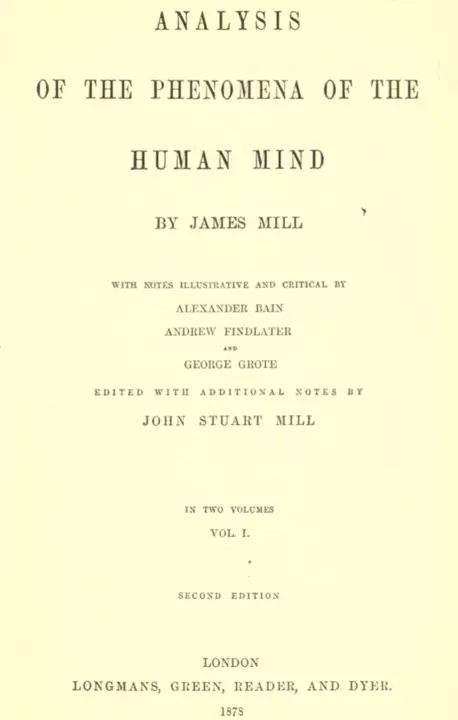
"Analysis of the Phenomena of the Human Mind" by James Mill is a scientific treatise written in the late 19th century. This work focuses on exploring the intricacies of human mental phenomena, aiming to break down complex mental processes into simpler components for better understanding. Mill endeavors to advance the field of psychology by examining feelings, sensations, and the laws that govern mental processes. The opening of the treatise sets the stage for a deep analysis of human sensations, beginning with a discussion on the necessity of understanding the simple elements that make up our more complex mental experiences. Mill outlines his goal to explore how various feelings—resulting from sensory experiences—are interrelated, and he emphasizes the importance of classifying these sensations. He prepares the reader for a methodological breakdown of the senses, such as smell and hearing, illustrating how each operates individually while also forming a holistic understanding of human consciousness as interconnected sensations and experiences. This analytical framework invites readers, particularly those new to philosophical inquiries, to reflect upon their own perceptions systematically.
Introduction adapted from the source catalogue; source summaries may be automatically generated.
Free to read · English · 263,558 words · No account needed
MAKE TIME FOR A GOOD BOOK
On by default. Untick to stop anonymous reading totals. Each page counts after 10 seconds in view. How this works.
Anonymous counting is on unless you have switched it off.
The distinction now drawn, (substantially what is exemplified at length in the chapter referred to,) is confirmed by what happens on occasions when memory and imagination are confounded. When a fact is long past, and all but forgotten, {402} the oblivion overtakes the evidentiary collaterals, the marks of continuity that link together what has been one actual state to what has been another actual state. I remember having had the idea or purpose to say or to do something on a certain occasion; but I do not remember whether I actually did or said the thing. The memory of the occasion is incomplete; the links are snapped that connect that idea with my remembered acting at the time referred to; it is not in its place in that authenticated series; and it is not associated with the collateral circumstances that always attend an actual transaction. On the other hand, as is well remarked in the chapter quoted, imagination may simulate remembered reality, when there is wanting the real memory that would people the occasion with authentic circumstances, and when the imagination has been excited and exercised so as to include in its compass the collaterals that go with an experience in the actual.--B.]
[Editor's footnote 108: The analysis of Belief presented in this chapter, brings out the conclusion that all cases of Belief are simply cases of indissoluble association: that there is no generic distinction, but only a difference in the strength of the association, between a case of belief and a case of mere imagination: that to believe a succession or coexistence between two facts is only to have the ideas of the two facts so strongly and closely associated, that we cannot help having the one idea when we have the other.
If this can be proved, it is the greatest of all the triumphs of the Association Psychology. To first appearance, no two things can be more distinct than thinking of two things together, and believing that they are joined together in the outward world. Nevertheless, that the latter state of mind is only an extreme case of the former, is, as we see, the deliberate doctrine of the author of the Analysis; and it has also in its favour the high psychological authority of Mr. Herbert Spencer. Mr. Bain, in the preceding note, as well as in his systematic work, looks at the phenomenon from another side, and pronounces that what constitutes Belief is the power which an {403} idea has obtained over the Will. It is well known and understood that a mere idea may take such possession of the mind as to exercise an irresistible control over the active faculties, even independently of Volition, and sometimes in opposition to it. This, which Mr. Bain calls the power of a Fixed Idea, is exemplified in the cases of what is called fascination: the impulse which a person looking from a precipice sometimes feels to throw himself down it; and the cases of crimes said to have been committed by persons who abhor them, because that very horror has filled their minds with an intense and irrepressible idea of the act. Since an idea is sometimes able to overpower volition, it is no wonder that an idea should determine volition; as it does whenever we, under the influence of the idea of a pleasure or of a pain, will that which obtains for us the pleasure or averts the pain. In this voluntary action, our conduct is grounded upon a relation between means and an end; (that is, upon a constant conjunction of facts in the way of causation, ultimately resolvable into a case of resemblance and contiguity): in common and unanalytical language, upon certain laws of nature on which we rely. Our reliance is the consequence of an association formed in our minds between the supposed cause and its effect, resulting either from personal experience of their conjunction, from the teachings of other people, or from accidental appearances. Now, according to Mr. Bain, when this association between the means and the end, the end calling up the idea of the means, arrives at the point of giving to the idea thus called up a command over the Will, it constitutes Belief. We believe a thing, when we are ready to act on the faith of it; to face the practical consequences of taking it for granted: and therein lies the distinction between believing two facts to be conjoined, and merely thinking of them together. Thus far Mr. Bain: and with this I fully agree. But something is still wanting to the completeness of the analysis. The theory as stated, distinguishes two antecedents, by a difference not between themselves, but between their consequents. But when the consequents differ, the antecedents cannot be the same. An association {404} of ideas is or is not a Belief, according as it has or has not the power of leading us to voluntary action: this is undeniable: but when there is a difference in the effects there must be a difference in the cause: the association which leads to action must be, in some respect or other, different from that which stops at thought. The question, therefore, raised, and, as they think, resolved, by the author of the Analysis and by Mr. Spencer, still demands an answer. Does the difference between the two cases consist in this, that in the one case the association is dissoluble, in the other it is so much more closely riveted, by repetition, or by the intensity of the associated feelings, as to be no longer dissoluble? This is the question we are compelled to face.
Your reading position is saved on this browser. Take it to another device with a library code. Reading pages adapt to text, rather than matching a printed edition.
BEHIND THE BOOK
This eBook is for the use of anyone anywhere in the United States and most other parts of the world at no cost and with almost no restrictions whatsoever. You may copy it, give it away or re-use it under the terms of the Project Gutenberg License included with this eBook or online at www.gutenberg.org. If you are not located in the United States, you will have to check the laws of the country where you are located before using this eBook. Read the source licence.
The original source file, including credits and licence, is retained by this library. Request an original-format copy at no charge. Please include the book title and Project Gutenberg identifier #56441.
KEEP YOUR CURIOSITY GOING
David Patterson (Spirit) Hatch
Coulson Kernahan

Ralph Waldo Emerson
Frances Wright

Edwin Abbott Abbott

Joseph Droz