
Last letters from the living dead man
David Patterson (Spirit) Hatch
THE CLASSIC COLLECTION · 1829
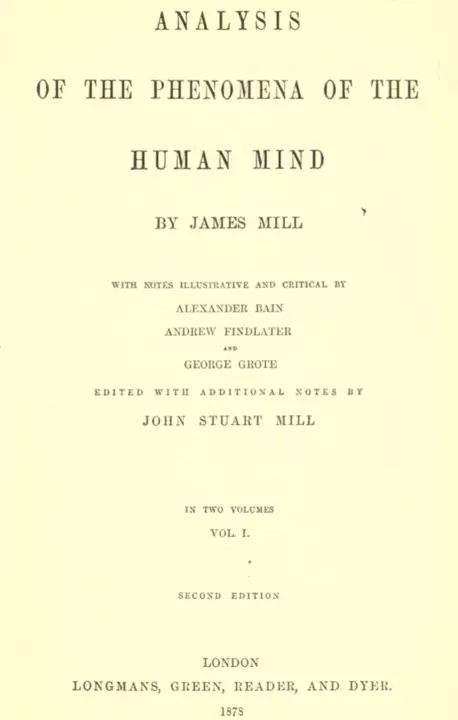
"Analysis of the Phenomena of the Human Mind" by James Mill is a scientific treatise written in the late 19th century. This work focuses on exploring the intricacies of human mental phenomena, aiming to break down complex mental processes into simpler components for better understanding. Mill endeavors to advance the field of psychology by examining feelings, sensations, and the laws that govern mental processes. The opening of the treatise sets the stage for a deep analysis of human sensations, beginning with a discussion on the necessity of understanding the simple elements that make up our more complex mental experiences. Mill outlines his goal to explore how various feelings—resulting from sensory experiences—are interrelated, and he emphasizes the importance of classifying these sensations. He prepares the reader for a methodological breakdown of the senses, such as smell and hearing, illustrating how each operates individually while also forming a holistic understanding of human consciousness as interconnected sensations and experiences. This analytical framework invites readers, particularly those new to philosophical inquiries, to reflect upon their own perceptions systematically.
Introduction adapted from the source catalogue; source summaries may be automatically generated.
Free to read · English · 263,558 words · No account needed
MAKE TIME FOR A GOOD BOOK
On by default. Untick to stop anonymous reading totals. Each page counts after 10 seconds in view. How this works.
Anonymous counting is on unless you have switched it off.
This is a case of Belief, which deserves the greatest possible attention. It is acknowledged, on all hands, that we know nothing of objects; but the sensations {350} we have from them. There is a cause, however, of those sensations, and to that we give the name object: or, rather, there is a cluster of causes, corresponding with the cluster of sensations. Thus, when I see, and handle, and smell, and taste the rose, there is a cause of the sensation red, a cause of the sensation soft, a cause of the sensation round, a cause of the smell, and a cause of the taste; and all these causes are united in the rose. But what is the rose, beside the colour, the form, and so on? Not knowing what it is, but supposing it to be something, we invent a name to stand for it. We call it a substratum. This substratum, when closely examined, is not distinguishable from Cause. It is the cause of the qualities; that is, the cause of the causes of our sensations. The association, then, is this. To each of the sensations we have from a particular object, we annex in our imagination, a cause; and to these several causes we annex a cause, common to all, and mark it with the name substratum.
This curious case of association we now proceed to develop. The word cause, means the antecedent of a consequent, where the connection is constant. This has been established on such perfect evidence, that it is a received principle of philosophy. More of the evidence of this important principle will appear as we go on. Here we shall take the proposition for granted.
Not only are we, during the whole period of our lives, witnesses of an incessant train of events; that is, of antecedents and consequents, between which, for the greater part, the order is constant; but these constant conjunctions are, of all things in the world, what we are {351} the most deeply interested in observing; for, on the knowledge of them, all our power of obtaining good and avoiding evil depends. From this, it necessarily follows, that between none of our ideas is the association more intimate and intense, than between antecedent and consequent, in the order of events. Whenever we perceive an event, the mind instantly flies to its antecedent. I hear words in the street; event: some one, of course, is making them; antecedent. My house is broken, and my goods are gone; event: a thief has taken them; antecedent. This is that remarkable case of association, in which the combination is inseparable; a case of so much importance in explaining some of the more mysterious phenomena of thought. Other instances of this remarkable phenomenon, to which we have already had occasion to advert, are, the sight of an object, and the ideas of its distance, its extension, and figure; the idea of colour, and the idea of extension; the idea of an object, and the idea of position and unity; the idea of one of my sensations, and the idea of myself. In no instance is this inseparable association more perfect, or its consequences more important, than in that between an event, and its antecedent. We cannot think of the one without thinking of the other. The two ideas are forced upon us at the same time; and by no effort of ours can they be disjoined. So necessarily, from the first moment of experience, are we employed in observing the constant conjunctions of events; and so deeply are we interested, in looking out for, and knowing the constant antecedent of every event, that the association becomes part of our being. The perception, or the idea, of an event, instantly brings up {352} the idea of its constant antecedent; definite and clear, if the antecedent is known; and indefinite and obscure, if it is unknown. Still, the idea of an event, of a change, without the idea of its cause, is impossible. That a cause means, and can mean nothing to the human mind, but constant antecedent, is no longer a point in dispute.[99]
Your reading position is saved on this browser. Take it to another device with a library code. Reading pages adapt to text, rather than matching a printed edition.
BEHIND THE BOOK
This eBook is for the use of anyone anywhere in the United States and most other parts of the world at no cost and with almost no restrictions whatsoever. You may copy it, give it away or re-use it under the terms of the Project Gutenberg License included with this eBook or online at www.gutenberg.org. If you are not located in the United States, you will have to check the laws of the country where you are located before using this eBook. Read the source licence.
The original source file, including credits and licence, is retained by this library. Request an original-format copy at no charge. Please include the book title and Project Gutenberg identifier #56441.
KEEP YOUR CURIOSITY GOING
David Patterson (Spirit) Hatch
Coulson Kernahan

Ralph Waldo Emerson
Frances Wright

Edwin Abbott Abbott

Joseph Droz