
Last letters from the living dead man
David Patterson (Spirit) Hatch
THE CLASSIC COLLECTION · 1829
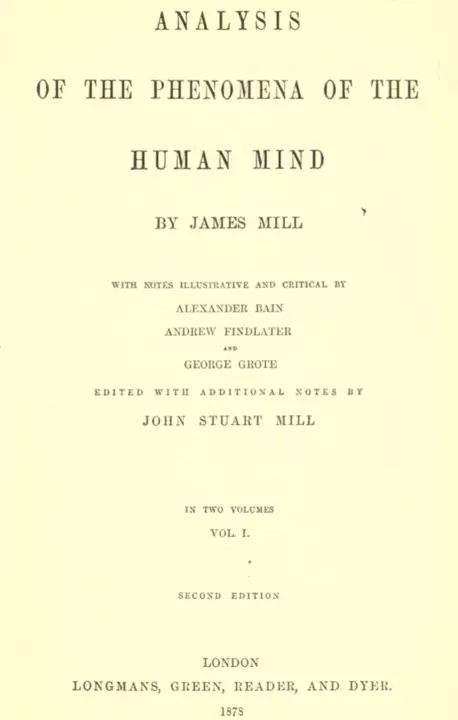
"Analysis of the Phenomena of the Human Mind" by James Mill is a scientific treatise written in the late 19th century. This work focuses on exploring the intricacies of human mental phenomena, aiming to break down complex mental processes into simpler components for better understanding. Mill endeavors to advance the field of psychology by examining feelings, sensations, and the laws that govern mental processes. The opening of the treatise sets the stage for a deep analysis of human sensations, beginning with a discussion on the necessity of understanding the simple elements that make up our more complex mental experiences. Mill outlines his goal to explore how various feelings—resulting from sensory experiences—are interrelated, and he emphasizes the importance of classifying these sensations. He prepares the reader for a methodological breakdown of the senses, such as smell and hearing, illustrating how each operates individually while also forming a holistic understanding of human consciousness as interconnected sensations and experiences. This analytical framework invites readers, particularly those new to philosophical inquiries, to reflect upon their own perceptions systematically.
Introduction adapted from the source catalogue; source summaries may be automatically generated.
Free to read · English · 263,558 words · No account needed
MAKE TIME FOR A GOOD BOOK
On by default. Untick to stop anonymous reading totals. Each page counts after 10 seconds in view. How this works.
Anonymous counting is on unless you have switched it off.
I pass now from Sokrates to Plato. It is true, as we read in the Analysis, (p. 271) that Plato "was so deeply struck with the importance of Classification, that he seems to have regarded it as the sum of all philosophy." But what Plato thus admired was not the Classification that he found prevalent around him, such as this chapter of the Analysis depicts. Here Plato perfectly agreed with Sokrates. Among his immortal dialogues, several of the very best are devoted to the illustration of the Sokratic point of view: to the cross-examination and exposure of the minds around him, instructed as well as vulgar, in respect to the general terms familiarly used in speech. The Platonic questions and answers are framed to shew how little the respondents understand beneath those current generalities on which every one talks with confidence and fluency--and how little they can avoid contradiction or inconsistency, when their class-terms are confronted with particulars. In fact, Plato goes so far as to intimate that these uncertified classifications,-- generated in each man's mind by merely learning the application of words, and imbibed unconsciously, without special teaching, through the contagion of ordinary society--are rather worse than ignorance: inasmuch as they are accompanied by a false persuasion of knowledge. It would be (in the opinion of Plato) a comparative improvement, if this state of mental confusion, creating a false persuasion of knowledge, were broken up; and if there were substituted in place thereof positive ignorance, together with the naked and painful consciousness of being really ignorant. Only in this way could the mind of the learner be stimulated to active effort in the acquisition of genuine knowledge.[i]
[Footnote i: Plato, Sophistes, p. 230--231. Symposion, p. 204 A,
Menon p. 84, A. D.]
Accordingly, when it is said that Plato was "deeply struck {280} with the importance of Classification," we must understand the phrase as applying to Classification, not as he found it prevalent, but as he idealized it. And the scheme that he imagined was not merely different from that which he found, but in direct repugnance to it. He denounced altogether the aggregate of individuals; he declared the class-constituent to reside in a reality apart from them, separate and self-existent--the Idea or Form. He enjoined the student of philosophy to fix his contemplation on these Class-Ideas, the real Realities, in their own luminous region: and for that purpose, to turn his back upon the phenomenal particulars, which were mere transitory, shadowy, incoherent projections of these Ideas[j]--and from the study of which no true knowledge could be obtained. Of the two statements in the Analysis--(p. 271) that "Plato never dreamed of the mystical visions of his successors," and that "his error (respecting Classification) lay in misconceiving the One; which he took, not for the aggregate, but something pervading the aggregate"--neither one nor the other appears to me accurate. In regard to the second of the two, indeed, you may find various passages of Plato which, if construed separately, would countenance it: for Plato does not always talk Realism--nor always consistently with himself. But still his capital and peculiar theory was, Realism. The Platonic One was not something pervading the aggregate of particulars, but an independent and immutable reality, apart from the aggregate: and Plato, when he thus conceived {281} the One, illustrating it by the vast hypotheses embodied in the Republic, Phædon, Phædrus, Symposion, Menon, &c., is the true originator of those "mystical visions" against which the Analysis justly protests. Such visions were doubtless suggested to Plato by "his deep sense of the importance of Classification:" but they are his own, though continued and amplified, without his decorative genius, by Neo-Platonic successors. His theory of classification was the first ever propounded; and that theory was Realism. The doctrine here ascribed to him by Mr. James Mill is much more Aristotelian than Platonic. The main issue raised by Aristotle against Plato was, upon the essential separation, and separate objective existence, of the Abstract and Universal: Plato affirmed it, Aristotle denied it.[k] Aristotle recognised no reality apart from the Particular, to which the Universal was attached as a predicate, either essential or accidental to its subject. The Aristotelian Universal may thus be called, in relation to a body of similar particulars, not the aggregate but something pervading the aggregate. But this is not Plato's view: it is the negation of the Platonic Realism.
Your reading position is saved on this browser. Take it to another device with a library code. Reading pages adapt to text, rather than matching a printed edition.
BEHIND THE BOOK
This eBook is for the use of anyone anywhere in the United States and most other parts of the world at no cost and with almost no restrictions whatsoever. You may copy it, give it away or re-use it under the terms of the Project Gutenberg License included with this eBook or online at www.gutenberg.org. If you are not located in the United States, you will have to check the laws of the country where you are located before using this eBook. Read the source licence.
The original source file, including credits and licence, is retained by this library. Request an original-format copy at no charge. Please include the book title and Project Gutenberg identifier #56441.
KEEP YOUR CURIOSITY GOING
David Patterson (Spirit) Hatch
Coulson Kernahan

Ralph Waldo Emerson
Frances Wright

Edwin Abbott Abbott

Joseph Droz