
Last letters from the living dead man
David Patterson (Spirit) Hatch
THE CLASSIC COLLECTION · 1829
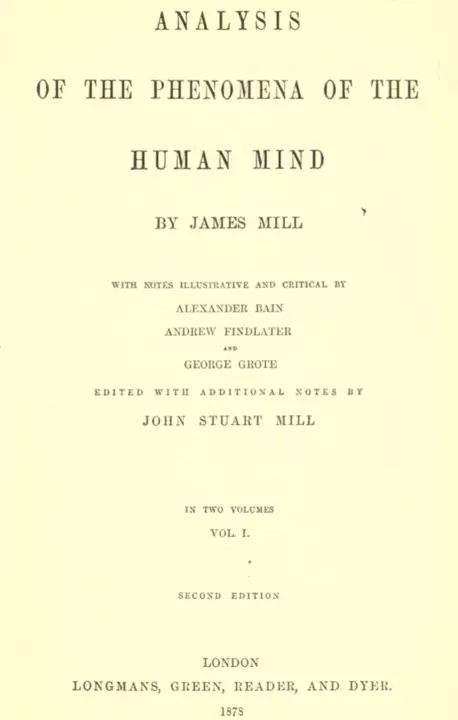
"Analysis of the Phenomena of the Human Mind" by James Mill is a scientific treatise written in the late 19th century. This work focuses on exploring the intricacies of human mental phenomena, aiming to break down complex mental processes into simpler components for better understanding. Mill endeavors to advance the field of psychology by examining feelings, sensations, and the laws that govern mental processes. The opening of the treatise sets the stage for a deep analysis of human sensations, beginning with a discussion on the necessity of understanding the simple elements that make up our more complex mental experiences. Mill outlines his goal to explore how various feelings—resulting from sensory experiences—are interrelated, and he emphasizes the importance of classifying these sensations. He prepares the reader for a methodological breakdown of the senses, such as smell and hearing, illustrating how each operates individually while also forming a holistic understanding of human consciousness as interconnected sensations and experiences. This analytical framework invites readers, particularly those new to philosophical inquiries, to reflect upon their own perceptions systematically.
Introduction adapted from the source catalogue; source summaries may be automatically generated.
Free to read · English · 263,558 words · No account needed
MAKE TIME FOR A GOOD BOOK
On by default. Untick to stop anonymous reading totals. Each page counts after 10 seconds in view. How this works.
Anonymous counting is on unless you have switched it off.
One other question, respecting classification, may still seem to require solution; namely, what it is by which we are determined in placing such and such things together in a class in preference to others; what, in other words, is the principle of Classification? I answer, that, as it is for the purpose of naming, of naming with greater facility, that we form classes at all; so it is in furtherance of that same facility that such and such things only are included in one class, such and such in another. Experience teaches what sort of grouping answers the purposes of naming best; under the suggestions of that experience, the application of a general word is tacitly and without much of reflection regulated; and by this process, and no other, it is, that Classification is performed. It is the aggregation of an indefinite number of individuals, by their association with a particular name.
It may seem that this answer is still very general {269} and that to make the explanation sufficient, the suggestions by which experience recommends this or that classification should be particularized. For the purpose of the present chapter, however, namely, to shew that the business of Classification is merely a process of naming, and is all resolvable into association, the observation, though general, is full and satisfactory. The detail of the purposes to be answered by general terms belongs more properly to the next head of Discourse, and as far as the development of the mental phenomena seems to require it, will there be presented.
It may still be useful to advert to the three principal cases into which Classification may be resolved; 1, that of objects considered as synchronical; 2, that of objects considered as successive; 3, that of feelings. The first is exemplified in the common classes of sensible objects, as men, horses, trees, and so on; and requires no further explanation. The second is exemplified in the classes of events, denoted by such words, as Birth, Death, Snowing, Thundering, Freezing, Flying, Creeping. By these words there is always denoted one antecedent and one consequent, generally more, sometimes a long train of them. And it is obvious that each of them is, at once, the name of each instance individually, and of all taken generally together. Thus, Freezing, is not the name of an individual instance of freezing only, but of that and of all other instances of Freezing. The same is the case with other words of a still more general, and thence more obscure signification, as Gravitation, Attraction, Motion, Force, &c.; which words have this additional source of confusion, that they are {270} ambiguous, being both abstract and concrete. When we say that there is a third case of classification, relating to Feelings, it does not mean that the two former do not relate to feelings: for when we say, that we classify objects, as men, horses, &c.;--or events, as the sequences named births, deaths, and so on;--it is obvious that our operation is about our own feelings, and nothing else; as the objects, and their successions, are, to us, the feelings merely which we thus designate. But as there are feelings which we do thus designate; and feelings which we do not; it is convenient, for the purpose of teaching, to treat of them apart. The Feelings, of this latter kind, which we classify, are either single feelings, or trains. Thus, Pain is the name of a single feeling, and the name both of an individual instance, and of indefinite instances, forming a most extensive class. Memory is the name not of a single feeling or idea, but of a train; and it is the name not only of a single instance, but of all instances of such a train, that is, of a class. The same is the case with Belief. It is the name of a train consisting of a certain number of links; and it is the name not only of an individual instance of such trains, but of all instances, forming an extensive class. Imagination is another instance of the same sort of classification. So also is Judgment, and Reasoning, and Doubting, and we might name many more.
Your reading position is saved on this browser. Take it to another device with a library code. Reading pages adapt to text, rather than matching a printed edition.
BEHIND THE BOOK
This eBook is for the use of anyone anywhere in the United States and most other parts of the world at no cost and with almost no restrictions whatsoever. You may copy it, give it away or re-use it under the terms of the Project Gutenberg License included with this eBook or online at www.gutenberg.org. If you are not located in the United States, you will have to check the laws of the country where you are located before using this eBook. Read the source licence.
The original source file, including credits and licence, is retained by this library. Request an original-format copy at no charge. Please include the book title and Project Gutenberg identifier #56441.
KEEP YOUR CURIOSITY GOING
David Patterson (Spirit) Hatch
Coulson Kernahan

Ralph Waldo Emerson
Frances Wright

Edwin Abbott Abbott

Joseph Droz