
Last letters from the living dead man
David Patterson (Spirit) Hatch
THE CLASSIC COLLECTION · 1829
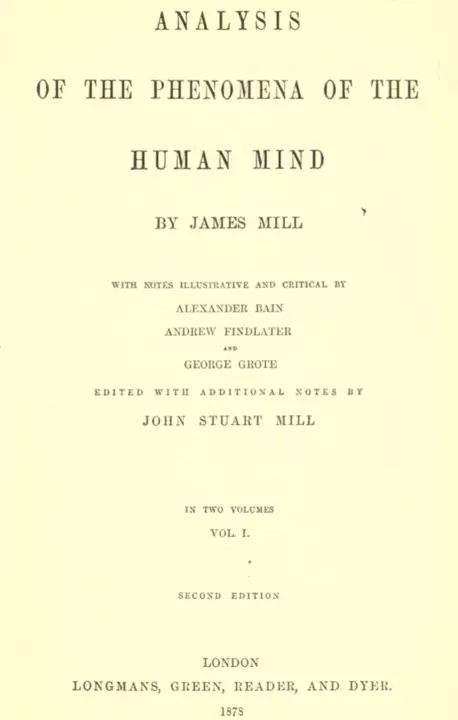
"Analysis of the Phenomena of the Human Mind" by James Mill is a scientific treatise written in the late 19th century. This work focuses on exploring the intricacies of human mental phenomena, aiming to break down complex mental processes into simpler components for better understanding. Mill endeavors to advance the field of psychology by examining feelings, sensations, and the laws that govern mental processes. The opening of the treatise sets the stage for a deep analysis of human sensations, beginning with a discussion on the necessity of understanding the simple elements that make up our more complex mental experiences. Mill outlines his goal to explore how various feelings—resulting from sensory experiences—are interrelated, and he emphasizes the importance of classifying these sensations. He prepares the reader for a methodological breakdown of the senses, such as smell and hearing, illustrating how each operates individually while also forming a holistic understanding of human consciousness as interconnected sensations and experiences. This analytical framework invites readers, particularly those new to philosophical inquiries, to reflect upon their own perceptions systematically.
Introduction adapted from the source catalogue; source summaries may be automatically generated.
Free to read · English · 263,558 words · No account needed
MAKE TIME FOR A GOOD BOOK
On by default. Untick to stop anonymous reading totals. Each page counts after 10 seconds in view. How this works.
Anonymous counting is on unless you have switched it off.
We have compound names for many actions. Thus we may say, "he hurt John," or "he did hurt to John," "he gave a lecture to John," or, "he lectured John." The reason why a preposition is required before the patient, in the case of the compound name of the action, and not of the single name, is, that the word which stands with respect to the verb in the {209} immediate relation of the recipient or patient of the action, is not the man, but the thing done. Thus, in the phrase, "he did hurt to John," it is not John which is done, but hurt: in the phrase, "he gave a lecture to John," it is not John who is given, but a lecture. There are here as it were, two patients, lecture, the primary, John, the secondary; juxta-position marks the connexion of the primary; but a preposition is necessary, to mark that of the secondary.
The following phrases seem to admit of a similar explanation. "He reminded him of his promise;" "he accused him of perjury;" "he deprived him of his wife:" the secondary patients being "promise," "perjury," "wife." He reminded him of his promise (hav(ed) his promise); the promise being the thing had or conceived in the reminding: accused him of perjury; perjury being the thing had in the accusation, the matter of the accusation: deprived him of his wife; his wife being the matter of the deprivation; the thing hav(ed) in it.[61]
[Findlater's footnote 61: The ingenious speculations of Mr. Tooke did great service to the cause of philology in England, by awakening a very general interest in the subject. But his knowledge of the cognate languages was far too circumscribed to warrant his sweeping inductions. In his day, in fact, the accesses had not yet been opened up to this new mine, nor the right veins struck that have since yielded such rich results. Accordingly nearly all Tooke's derivations are now discredited, and among others his account of prepositions. One or two English prepositions, of comparatively recent formation, seem to be formed from nouns; as among Ang. Sax. gemang or ongemang, gemang meaning "mixture;" and against, Ang. Sax. on-gegen in which gegen, from its use in cognate dialects, appears to be {210} a noun, though its primary meaning is not very clear. These however still involve a preposition which has to be accounted for. Between, again, is by twain, "near two;" and except, save, during were originally participles in the case absolute; "except this" was originally "this excepted," Lat. hoc excepto. But the simple prepositions in, of, by belong to the radical elements of language, and are more independent of nouns and verbs than nouns and verbs are of them. Comparative philology, which did not exist in Tooke's days, has shewn, that, besides predicative roots, as they are called--that is syllables expressive of some action or property, such as "to go," "to eat," "to be bright," "to speak," &c., which form the bases of nouns, adjectives, and verbs--there was a class of roots denoting simply relations in space, that is, place or direction (here or this, there or that, up, down, away, &c.). It is easy to see how the audible marks of such notions, at first, doubtless, vague enough, would be rendered precise and intelligible by gesticulations; or perhaps the gesticulations were the original signs, and the words mere involuntary exclamations accompanying them, and in time taking their place. These syllables have been called local, demonstrative, or pronominal roots, and play a most important part in language. They are joined to other roots to form derivatives of various kinds; and it is of them that the inflexional endings of nouns and verbs are built up. Singly or in combination, they constitute the pronouns, personal as well as demonstrative. Abstract as are now the meanings of I, he, they were once patent to the senses; ma was an emphatic "here," calling attention to the speaker; sa or ta, "there, that," something different from both speaker and hearer. Most of the prepositions originated in roots of this class. The roots of some of them, at least, are identical with those of pronouns; others express direction, and thus imply motion. Thus up means, "(motion) from below to above;" in the root FR (as in for, from), which is represented in Sans. Gr. and Lat. by PR (pro), the ground idea is, motion or removal from the speaker, in the front direction. Of is the Gothic af, Old Ger. aba or apa, Sans. apa, Gr. [Greek: a)po\] {211} Lat. a or ab. It is not easy to determine the precise physical relation primarily expressed by this particle; probably "proceeding from," or "descending or depending from." If there is any connection between of and have, it is more likely that have is derived from of than the reverse. That not a few verbs have this kind of origin, is now recognised; the English utter from out is a signal example.
Your reading position is saved on this browser. Take it to another device with a library code. Reading pages adapt to text, rather than matching a printed edition.
BEHIND THE BOOK
This eBook is for the use of anyone anywhere in the United States and most other parts of the world at no cost and with almost no restrictions whatsoever. You may copy it, give it away or re-use it under the terms of the Project Gutenberg License included with this eBook or online at www.gutenberg.org. If you are not located in the United States, you will have to check the laws of the country where you are located before using this eBook. Read the source licence.
The original source file, including credits and licence, is retained by this library. Request an original-format copy at no charge. Please include the book title and Project Gutenberg identifier #56441.
KEEP YOUR CURIOSITY GOING
David Patterson (Spirit) Hatch
Coulson Kernahan

Ralph Waldo Emerson
Frances Wright

Edwin Abbott Abbott

Joseph Droz