
Last letters from the living dead man
David Patterson (Spirit) Hatch
THE CLASSIC COLLECTION · 1829
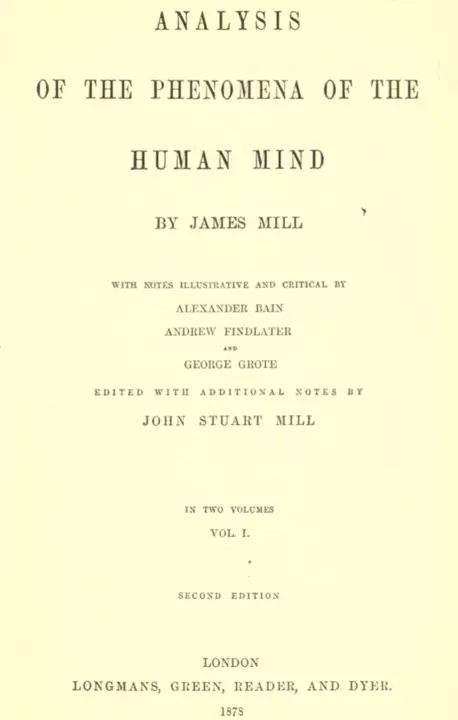
"Analysis of the Phenomena of the Human Mind" by James Mill is a scientific treatise written in the late 19th century. This work focuses on exploring the intricacies of human mental phenomena, aiming to break down complex mental processes into simpler components for better understanding. Mill endeavors to advance the field of psychology by examining feelings, sensations, and the laws that govern mental processes. The opening of the treatise sets the stage for a deep analysis of human sensations, beginning with a discussion on the necessity of understanding the simple elements that make up our more complex mental experiences. Mill outlines his goal to explore how various feelings—resulting from sensory experiences—are interrelated, and he emphasizes the importance of classifying these sensations. He prepares the reader for a methodological breakdown of the senses, such as smell and hearing, illustrating how each operates individually while also forming a holistic understanding of human consciousness as interconnected sensations and experiences. This analytical framework invites readers, particularly those new to philosophical inquiries, to reflect upon their own perceptions systematically.
Introduction adapted from the source catalogue; source summaries may be automatically generated.
Free to read · English · 263,558 words · No account needed
MAKE TIME FOR A GOOD BOOK
On by default. Untick to stop anonymous reading totals. Each page counts after 10 seconds in view. How this works.
Anonymous counting is on unless you have switched it off.
The instances, in which the more complicated formations of the mind are the subjects of this double Predication, are those which, from the importance of their consequences, deserve the greatest degree of attention. Thus, when we say "virtue exalts," both existing, and exalting, are predicated of virtue. When we say that "passion impels," both existence, and impulsion, are predicated of passion. When we say that "Time generates," and "Space contains all things," we affirm existence of space and time, by the same expression by which we affirm of the one, that it generates; of the other, that it contains. This constancy of Predication, forcing the same constancy in the junction of the ideas, furnishes a remarkable instance of that important case of association, of which we took notice above, where, by frequency of association, two ideas become so joined, that the one constantly rises, and cannot be prevented from rising, in combination with the other. Thus it is, {178} that Time forces itself upon us as an object. So it is with Space. We cannot think of Space, we cannot think of Time, without thinking of them as existent. With the ideas of space and time, the idea of EXISTENCE, as it is predicated of objects, is so associated, by the use of the Substantive Verb as the copula in predication, that we cannot disjoin them. The same would have been the case with Chance, and Fate, and Nature; if our religious education did not counteract the association. It was precisely the same, among the Greeks and Romans, whose religious education had not that effect.[53] [54]
[Findlater's footnote 53: The account of predication above given is in conformity with the phenomena of the family of languages known as the Indo-European. Logicians, in fact, in treating of this subject have had almost exclusive regard to Greek and Latin and the literary languages of modern Europe, which are all of one type. It might therefore be presumed that the theory thus formed would be found not to fit in all its parts when applied to languages of an altogether different structure. The mental process must doubtless be the same in all; but the words that express the several parts may be used in new and unprecedented ways. Were naturalists to construct a scheme of the animal organism without ever having seen any other animals than those of the vertebrate type, the theory would certainly fail in generality; certain organs or functions would be set down as essential to animal existence which acquaintance with other classes of creatures shows can be quite well dispensed with. Similarly, the current theory of predication, when viewed in the light of a wider and deeper knowledge of the organism of speech, seems to attach an exaggerated importance to the peculiar predicative power presumed to be inherent in verbs, and especially in the verb of existence. It is now a well known fact that in the monosyllabic class of languages, in which a third part of the human race express their thoughts, there is no distinction among the parts of speech. In Chinese, for example, the word ta expresses indifferently great, greatness, to be great, to make great or magnify, greatly. It is only position that determines in each case how the word is to be understood; thus traditional convention assigns to ta fu the meaning of "a great man," and to fu ta that of "the man is great." Being habituated to the constant use of the verb is in such a case as the latter, we are apt to suppose that the expression derives its predicative force from its suggesting the verb of existence, which the mind instinctively and necessarily supplies for itself. How little ground there is for this presumed necessity, has been conclusively shown by the late Mr. Garnett, in his profound and exhaustive essay on the Nature and Analysis of the Verb. Speaking of the theory that makes the essential difference between the verb and other parts of speech to reside in the verb substantive, which is to be supplied by the mind in all cases where the functions of the verb proper are to be called into requisition, he observes: "This theory presupposes the existence of a verb substantive in the languages in question, and consciousness of that existence and of the force and capabilities of the element in those who speak them. Unfortunately the Spanish grammarians, to whom we are indebted for what knowledge we possess of the Philippine dialects, unanimously concur in stating that there is no verb substantive either in Tagalá, Pampanga, or Bisaya, nor any means of supplying the place of one, except the employment of pronouns and particles. Mariner makes a similar remark respecting the Tonga language; and we may venture to affirm that there is not such a thing as a true verb substantive in any one member of the great Polynesian family.
Your reading position is saved on this browser. Take it to another device with a library code. Reading pages adapt to text, rather than matching a printed edition.
BEHIND THE BOOK
This eBook is for the use of anyone anywhere in the United States and most other parts of the world at no cost and with almost no restrictions whatsoever. You may copy it, give it away or re-use it under the terms of the Project Gutenberg License included with this eBook or online at www.gutenberg.org. If you are not located in the United States, you will have to check the laws of the country where you are located before using this eBook. Read the source licence.
The original source file, including credits and licence, is retained by this library. Request an original-format copy at no charge. Please include the book title and Project Gutenberg identifier #56441.
KEEP YOUR CURIOSITY GOING
David Patterson (Spirit) Hatch
Coulson Kernahan

Ralph Waldo Emerson
Frances Wright

Edwin Abbott Abbott

Joseph Droz