
Last letters from the living dead man
David Patterson (Spirit) Hatch
THE CLASSIC COLLECTION · 1829
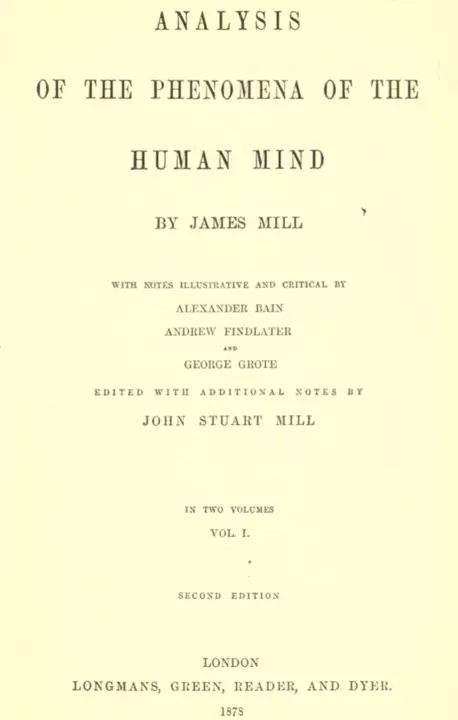
"Analysis of the Phenomena of the Human Mind" by James Mill is a scientific treatise written in the late 19th century. This work focuses on exploring the intricacies of human mental phenomena, aiming to break down complex mental processes into simpler components for better understanding. Mill endeavors to advance the field of psychology by examining feelings, sensations, and the laws that govern mental processes. The opening of the treatise sets the stage for a deep analysis of human sensations, beginning with a discussion on the necessity of understanding the simple elements that make up our more complex mental experiences. Mill outlines his goal to explore how various feelings—resulting from sensory experiences—are interrelated, and he emphasizes the importance of classifying these sensations. He prepares the reader for a methodological breakdown of the senses, such as smell and hearing, illustrating how each operates individually while also forming a holistic understanding of human consciousness as interconnected sensations and experiences. This analytical framework invites readers, particularly those new to philosophical inquiries, to reflect upon their own perceptions systematically.
Introduction adapted from the source catalogue; source summaries may be automatically generated.
Free to read · English · 263,558 words · No account needed
MAKE TIME FOR A GOOD BOOK
On by default. Untick to stop anonymous reading totals. Each page counts after 10 seconds in view. How this works.
Anonymous counting is on unless you have switched it off.
5. In applying the names of actions to the proper subjects of them, there are three Modes of the action, one or other of which is always implied. The first is, when the action has no reference to any thing previously spoken of. The second is, when it has a reference to something previously spoken of. The third is, when it has a reference to some state of the will of {155} the speaker or person spoken of. These diversities of mode are connoted by the Moods of the verb. The Indicative is used when no reference is made to any thing which precedes: the Subjunctive, when a reference is made to something which precedes: and the Optative, and Imperative, when the reference is to the state of the will of the speaker or the person spoken of.
Such are the contrivances to make the marks or names of action, by their connotative powers, a more and more effectual instrument of notation. Accurately speaking, they are adjectives, so fashioned as to connote, a threefold distinction of agents, with a twofold distinction of their number, a threefold distinction of the manner of the action, and a threefold distinction of its time; and, along with all this another important particular, about to be explained, namely, the COPULA in PREDICATION.[47]
[Editor's footnote 47: The imperfection of this theory of Verbs is sufficiently apparent. They are, says the author, a particular kind of Adjectives. Adjectives, according to the preceding Section, are words employed to enable us, without inconvenient multiplication of names, to subdivide great classes into smaller ones. Can it be said, or would it have been said by the author, that the only, or the principal reason for having Verbs, is to enable us to subdivide classes of objects with the greatest economy of names?
Neither is it strictly accurate to say that Verbs are always marks of motion, or of action, even including, as the author does, by an extension of the meaning of those terms, every process which is attended with a feeling of effort. Many verbs, of the kind which grammarians call neuter or intransitive verbs, express rest, or inaction: as sit, lie, and in some cases, stand. It is true however that the verbs first invented, as far as we know anything of them, expressed forms of motion, and the principal function of verbs still is to affirm or deny action. Or, to speak yet more generally, it is by means of verbs that we predicate events. Events, or changes, are the most important facts, to us, in the surrounding world. Verbs are the resource which language affords for predicating events. They are not the names of events; all names of events are substantives, as sunrise, disaster, or *infinitives, as to rise, and infinitives are logically substantives. But it is by means of verbs that we assert, or give information of, events; as, The sun rises, or, Disaster has occurred. There is, however, a class of neuter verbs already referred to, which do not predicate events, but states of an unchanging object, as lie, sit, remain, exist. It would be incorrect, therefore, to give a definition of Verbs which should limit them to the expression of events. I am inclined to think that the distinction between nouns and verbs is not logical, but merely grammatical, and that every word, whatever be its meaning, must be reputed a verb, which is so constructed grammatically that it can only be used as the predicate of a proposition. Any meaning whatever is, in strictness, capable of being thrown into this form: but it is only certain meanings, chiefly actions or events, which there is, in general, any motive for putting into this particular shape.--Ed.]
Your reading position is saved on this browser. Take it to another device with a library code. Reading pages adapt to text, rather than matching a printed edition.
BEHIND THE BOOK
This eBook is for the use of anyone anywhere in the United States and most other parts of the world at no cost and with almost no restrictions whatsoever. You may copy it, give it away or re-use it under the terms of the Project Gutenberg License included with this eBook or online at www.gutenberg.org. If you are not located in the United States, you will have to check the laws of the country where you are located before using this eBook. Read the source licence.
The original source file, including credits and licence, is retained by this library. Request an original-format copy at no charge. Please include the book title and Project Gutenberg identifier #56441.
KEEP YOUR CURIOSITY GOING
David Patterson (Spirit) Hatch
Coulson Kernahan

Ralph Waldo Emerson
Frances Wright

Edwin Abbott Abbott

Joseph Droz