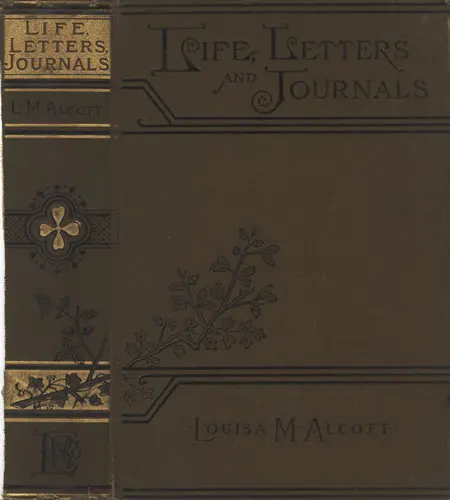
Louisa May Alcott : Her Life, Letters, and Journals
Louisa May Alcott
THE CLASSIC COLLECTION · 1869
"An Old-Fashioned Girl" by Louisa May Alcott is a novel first published in 1869. The story follows Polly Milton, a simple country girl who visits her wealthy friend Fanny Shaw's sophisticated Boston family. Overwhelmed by their fashionable lifestyle and troubled by their lack of affection, Polly's warmth and old-fashioned values gradually transform the Shaw household. Years later, Polly returns as a music teacher, navigating friendship, romance, and the family's financial troubles while staying true to her principles.
Introduction adapted from the source catalogue; source summaries may be automatically generated.
Free to read · English · 102,383 words · No account needed
MAKE TIME FOR A GOOD BOOK
On by default. Untick to stop anonymous reading totals. Each page counts after 10 seconds in view. How this works.
Anonymous counting is on unless you have switched it off.
“He's an awful boy, my dear; and if you have anything to do with him, he'll torment you to death. Boys are all horrid; but he's the horridest one I ever saw.”
Fanny went to a fashionable school, where the young ladies were so busy with their French, German, and Italian, that there was no time for good English. Feeling her confidence much shaken in the youth, Polly privately resolved to let him alone, and changed the conversation, by saying, as she looked admiringly about the large, handsome room, “How splendid it is! I never slept in a bed with curtains before, or had such a fine toilet-table as this.”
“I'm glad you like it; but don't, for mercy sake, say such things before the other girls!” replied Fanny, wishing Polly would wear ear-rings, as every one else did.
“Why not?” asked the country mouse of the city mouse, wondering what harm there was in liking other people's pretty things, and saying so. “Oh, they laugh at everything the least bit odd, and that is n't pleasant.” Fanny did n't say “countrified,” but she meant it, and Polly felt uncomfortable. So she shook out her little black silk apron with a thoughtful face, and resolved not to allude to her own home, if she could help it.
“I'm so poorly, mamma says I need n't go to school regularly, while you are here, only two or three times a week, just to keep up my music and French. You can go too, if you like; papa said so. Do, it's such fun!” cried Fanny, quite surprising her friend by this unexpected fondness for school.
“I should be afraid, if all the girls dress as finely as you do, and know as much,” said Polly, beginning to feel shy at the thought.
“La, child! you need n't mind that. I'll take care of you, and fix you up, so you won't look odd.”
“Am I odd?” asked Polly, struck by the word and hoping it did n't mean
anything very bad.
“You are a dear, and ever so much prettier than you were last summer, only you've been brought up differently from us; so your ways ain't like ours, you see,” began Fanny, finding it rather hard to explain.
“How different?” asked Polly again, for she liked to understand things.
“Well, you dress like a little girl, for one thing.”
“I am a little girl; so why should n't I?” and Polly looked at her simple blue merino frock, stout boots, and short hair, with a puzzled air.
Your reading position is saved on this browser. Take it to another device with a library code. Reading pages adapt to text, rather than matching a printed edition.
Louisa May Alcott
Louisa May Alcott
Louisa May Alcott
Louisa May Alcott
BEHIND THE BOOK
This eBook is for the use of anyone anywhere in the United States and most other parts of the world at no cost and with almost no restrictions whatsoever. You may copy it, give it away or re-use it under the terms of the Project Gutenberg License included with this eBook or online at www.gutenberg.org. If you are not located in the United States, you will have to check the laws of the country where you are located before using this eBook. Read the source licence.
The original source file, including credits and licence, is retained by this library. Request an original-format copy at no charge. Please include the book title and Project Gutenberg identifier #2787.
KEEP YOUR CURIOSITY GOING
Cécile Tormay

Moritz Busch
Coulson Kernahan
John L. Ransom

Maurice Baring
Frances Wright