THE CLASSIC COLLECTION✦The Stone AgeCLASSIC FREE BOOKS
The Stone Age
Clement Wood
THE CLASSIC COLLECTION · 1924
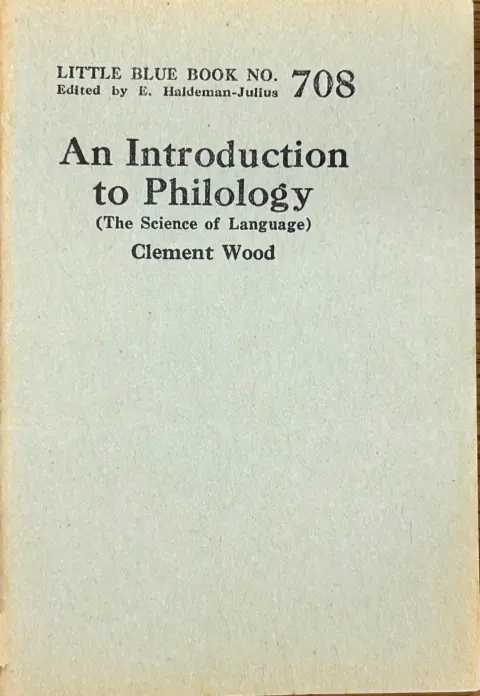
An introduction to philology by Clement Wood. Explore this classic work in a free online edition. Subjects include Philology. Read the locally hosted text below, adjust the reading display, and continue where you left off.
Introduction adapted from the source catalogue; source summaries may be automatically generated.
Free to read · English · 14,816 words · No account needed
MAKE TIME FOR A GOOD BOOK
On by default. Untick to stop anonymous reading totals. Each page counts after 10 seconds in view. How this works.
Anonymous counting is on unless you have switched it off.
Among unique English perversions, in addition to Shotover, are Leighton Beau-desert to Leighton Buzzard, Burgh Walter to Bridgewater, and Beau Chef to Beachy (Head). Chemin Couvert became, in Arkansas, Smackover. Even Bunker, in Bunker Hill, was once Bon coeur. There is more approval for the transformation of the amazing Indian Quah-Tah-Wah-Am-Quah-Duavic to French Petamkediac, and later English Tom Kedgwick. In similar fashion Gramercy Square, New York, was not originally French but Dutch for crooked lane, De Kromme Zee.
Personal Names.
Most Englishmen of the Anglo-Saxon period were content with a single name. A frequent element is Aelf-, elf or fairy, as in Aelfgar, Aelfhelm, Aelfred. Aethel-, meaning noble (Germ. Edelman, nobleman) appears in Aethelbald, Aethelred. Ead-, association with eadig, happy, appeared in Eadgar, Eadgyth, Eadmund, Eadweard, Eadwine. Other elements are bald, bold; ecg, edge; god, good; wig, battle; sie, victory; wulf, wolf, as prefixes: and, as suffixes, heard, strong; here, army; mund, hand; roed, counsel; wine, friend. Less pretentious are such names as Brand, sword; Cytel, kettle; Wulf, Hild (a), Hengest, Horsa, Hudda, perhaps pet forms of longer names. These survive, often greatly disguised, in such modern names as Baldwin (Bealdwine), Harold (Herewald), Bardell (Beorhtwulf), Elmer (Aelfmaer), Herbert (Herebearht), Herrick (Hereric), Hubert, Hubbard, Hobart, Hibbert, Hibbard (Hygeeorht), Wyman (Wigmund), Kemp (Cempa, warrior), Cob (Cobba), Froude (Froda, prudent), Tucker (Tuccao), etc.
After the Norman Conquest, the names most widely used were John, William, Thomas, Richard, Robert, in the order given. John (Lat. Johannes), found in other languages Ital. Giovanni (from which Zany), Fr. Jean, Welsh Evan, Scotch Ian, Breton Yves, Russian Ivan, Dan. and Dutch Hans, is responsible also for Shawn, Jane, Joan, Jones, Johnson, Jennings, etc. Thomas, also Scriptural in origin, owed its popularity to pilgrimages to the shrine of St. Thomas a Becket. We have from it Thoms, Thomson, etc., and from the ending, a French clipped form, Macey, Massie, Machin, Masson, etc. The other three names are Teutonic. William, M. H. G. Willehelm, helm of resolution, had in French two forms, Guillaume and the one with the initial W-. From these comes the parallel forms Gautier and Walter, Guy and Wyatt. Williams, Wills, Williamson, Wilson, Wilkins, Willett, Gilliam, come from it. Robert was O. H. G. Hruodbert, fame-bright; Richard was Richart, powerful. From these came Rick, Hick, Dick, Rob, Hob, Dob, Bob; also Ricketts, Hicks, Hixon, Dix, Dixon, Rich, Ritchie, Hitch, Higgs, Bigg, Robb, Ditch, Robbins, Robson, Robinson, Hobbs, Hobson, Dobbs, Dodson, etc.
Along with this went the relative infrequency of Arthur, Charles, and George. Their popularity was later, from the royal houses of Stuart and Hanover, and from Arthur, Duke of Wellington. Similarly Frederick’s vogue came from Frederick the Great.
Your reading position is saved on this browser. Take it to another device with a library code. Reading pages adapt to text, rather than matching a printed edition.
Clement Wood
Clement Wood
Clement Wood
Clement Wood
BEHIND THE BOOK
This eBook is for the use of anyone anywhere in the United States and most other parts of the world at no cost and with almost no restrictions whatsoever. You may copy it, give it away or re-use it under the terms of the Project Gutenberg License included with this eBook or online at www.gutenberg.org. If you are not located in the United States, you will have to check the laws of the country where you are located before using this eBook. Read the source licence.
The original source file, including credits and licence, is retained by this library. Request an original-format copy at no charge. Please include the book title and Project Gutenberg identifier #78985.
KEEP YOUR CURIOSITY GOING

Charles G. (Charles Griffith) Ross
Hannah Webster Foster

Emily Lawless
Edwin Hamlin Carr

Charles De Lano Hine
Andrew Ure