THE CLASSIC COLLECTION✦The Stone AgeCLASSIC FREE BOOKS
The Stone Age
Clement Wood
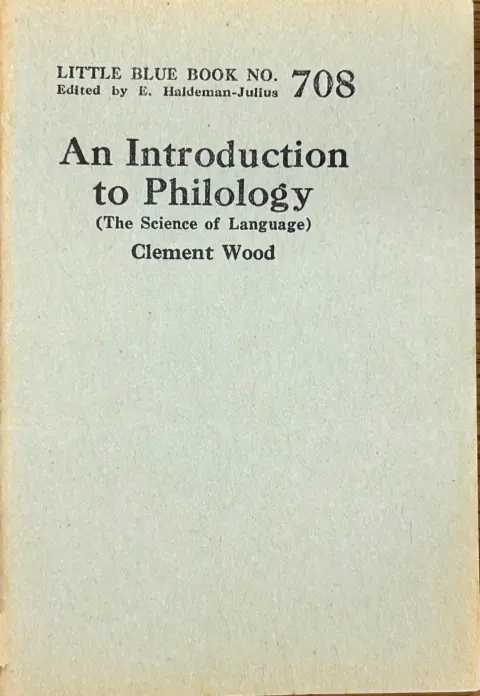
THE CLASSIC COLLECTION · 1924
An introduction to philology by Clement Wood. Explore this classic work in a free online edition. Subjects include Philology. Read the locally hosted text below, adjust the reading display, and continue where you left off.
Introduction adapted from the source catalogue; source summaries may be automatically generated.
Free to read · English · 14,816 words · No account needed
MAKE TIME FOR A GOOD BOOK
On by default. Untick to stop anonymous reading totals. Each page counts after 10 seconds in view. How this works.
Anonymous counting is on unless you have switched it off.
Language grows in an unbelievably haphazard manner. First, of course, came specific names; much later from these were chosen terms to describe collective and then abstract things. Many languages today show a queer absence of collective and abstract terms, such as we regard as indispensable. The aboriginal Tasmanians, as Jespersen points out, had no terms whatever for abstract things. They had names for each species of gum-tree, wattle-tree, etc., but no class name for tree. They had no names for general conceptions, such as hard, soft, warm, cold, long, short, etc. The Society Islanders, in like manner, can talk of a dog’s tail, sheep’s tail, etc., but have no general name for tail.
To the contrary, modern cultured languages pass through a period where they glory in a great number of general terms of slightly different meaning, many of which later on die a natural death. Thus the English language speaks of a flock of birds or sheep, a drove of cattle or swine, a herd of cattle, a bevy of quail, a covey of partridges, a swarm of bees, a school of fish, and (in slang) a bunch of men. A similar lack of proper generalization appears in cow-byre, horse-stable, dog-kennel, pig-sty, dove-cote, falcon-mews, rabbit-hutch. The wealth of terms such as horse, mare, filly, stallion, foal, colt; cow, calf, heifer, bull, steer, ox; calf, colt, lamb, puppy, fawn, kid, cub, shoat, farrow, cygnet, duckling, parr, smolt, for offspring, and cow, mare, ewe, doe, bitch, heifer, sow, hen, goose, duck, for females points to the time when animals, for breeding and hunting, had much greater importance in man’s eyes than today. We have rooster, cock, cockerel, chantecleer, hen, pullet, chicken, chick, but no class name for the family; we have no class name for the group led by Mr. Bull and Mrs. Cow. Sea-life has given rise to a large number of unrelated words descriptive of boats, such as ship, boat, brig, sloop, schooner, wherry, shallop, dinghy, punt.
Your reading position is saved on this browser. Take it to another device with a library code. Reading pages adapt to text, rather than matching a printed edition.
Clement Wood
Clement Wood
Clement Wood
Clement Wood
BEHIND THE BOOK
This eBook is for the use of anyone anywhere in the United States and most other parts of the world at no cost and with almost no restrictions whatsoever. You may copy it, give it away or re-use it under the terms of the Project Gutenberg License included with this eBook or online at www.gutenberg.org. If you are not located in the United States, you will have to check the laws of the country where you are located before using this eBook. Read the source licence.
The original source file, including credits and licence, is retained by this library. Request an original-format copy at no charge. Please include the book title and Project Gutenberg identifier #78985.
KEEP YOUR CURIOSITY GOING

Charles G. (Charles Griffith) Ross
Hannah Webster Foster

Emily Lawless
Edwin Hamlin Carr

Charles De Lano Hine
Andrew Ure