THE CLASSIC COLLECTION✦The Stone AgeCLASSIC FREE BOOKS
The Stone Age
Clement Wood
THE CLASSIC COLLECTION · 1924
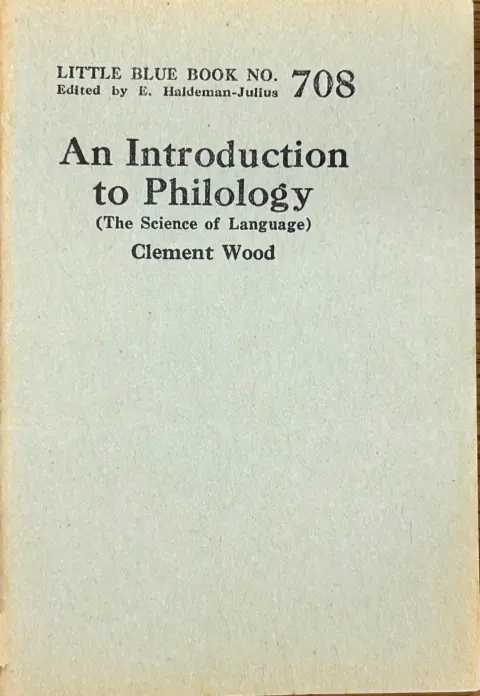
An introduction to philology by Clement Wood. Explore this classic work in a free online edition. Subjects include Philology. Read the locally hosted text below, adjust the reading display, and continue where you left off.
Introduction adapted from the source catalogue; source summaries may be automatically generated.
Free to read · English · 14,816 words · No account needed
MAKE TIME FOR A GOOD BOOK
On by default. Untick to stop anonymous reading totals. Each page counts after 10 seconds in view. How this works.
Anonymous counting is on unless you have switched it off.
A few of the native English words have survived practically without change of form or meaning: among these are oft, and, in, word, full, from, for, to, God. At times there has been a slight change in sound or meaning, as in ofer, over; thaet, that; aer, ere; aefter, after. More often the change has been greater. Take the word wanton. This combines the old privative prefix wan, without, and an altered form of the past participle togan of the O. E. (Old English) verb teon, to train or rear. Thus wanton meant without training, and was applied first to children; its meaning today has a far wider application. These changes followed definite rules. The O. E. k sound, represented by the letter c, under certain conditions regularly became ch, as in choose, from ceosan; rich, from rice; much, from mycel. In the same way O. E. sc became regularly sh, as in should, from sceolde; shame, from sceamu; shadow, from sceadu. The vowels show changes as symmetrical: thus the long a sound in ath, tacn, aras, stan, lar, swa, mar, gast, becomes long o in oath, token, arose, stone, lore, so, more, ghost. Other vowels illustrate changes as regular.
The meaning in most cases showed a gradual alteration. Thus wadan, to advance, became wade, to advance in water; stingan, to pierce, became sting, when a bee pierces; spillan, to destroy, became spill, to waste liquid; craeft, force, became craft, cunning. The first two of these indicate how a word of general meaning is limited to a more specific meaning, as the language sharpens in its ability to convey ideas; spill shows a general tendency for words to become lighter and less impressive in meaning, as time corrupts their force; craft points to the historic fact that cunning succeeded force in the dealings of men. Mod, courage, weakens to mood, a state of feeling; wif, woman, is limited to wife, married woman; deor, beast, to deer, a particular wild beast; hamm, the back of the leg, is generally restricted to the leg of a beast used for food, especially of pork, although the old meaning is still slightly alive. Ceorl, freeman, was degraded to churl, a boorish fellow, by the conquering Normans. At times the Christian religion caused the alteration, as when it appropriated feond, enemy, and made fiend, devil; bletsian, to consecrate by blood (compare blood, bleed), has become bless. At times the general degradation of ideas caused the change. Thus cnafa, boy (compare German Knabe) grew to knave. Queer alterations have taken place, in such pairs of words as beam and tree. Beam, originally meaning tree (Ger. Baum, tree) means now a hewn product of the tree; treo, once applied to wood cut for use (compare single-tree, whiffle-tree, etc.) today in tree applies to the source of the wood. Bread and loaf have similarly exchanged their meanings: the old meaning of loaf appears disguised in lord (hlaford, bread-warden or guardian) and lady (hlaefdige, bread-kneader).
Your reading position is saved on this browser. Take it to another device with a library code. Reading pages adapt to text, rather than matching a printed edition.
Clement Wood
Clement Wood
Clement Wood
Clement Wood
BEHIND THE BOOK
This eBook is for the use of anyone anywhere in the United States and most other parts of the world at no cost and with almost no restrictions whatsoever. You may copy it, give it away or re-use it under the terms of the Project Gutenberg License included with this eBook or online at www.gutenberg.org. If you are not located in the United States, you will have to check the laws of the country where you are located before using this eBook. Read the source licence.
The original source file, including credits and licence, is retained by this library. Request an original-format copy at no charge. Please include the book title and Project Gutenberg identifier #78985.
KEEP YOUR CURIOSITY GOING

Charles G. (Charles Griffith) Ross
Hannah Webster Foster

Emily Lawless
Edwin Hamlin Carr

Charles De Lano Hine
Andrew Ure