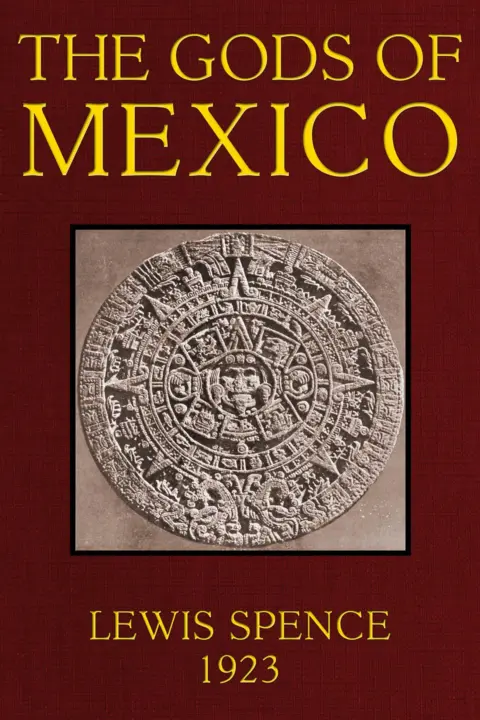
The gods of Mexico
Lewis Spence
THE CLASSIC COLLECTION · 1921
"An Introduction to Mythology" by Lewis Spence is a scholarly examination of mythological principles, likely written in the early 20th century. This comprehensive work explores the evolution, classification, and significance of myths within the context of primitive religion and culture, presenting an overview of the scientific approaches to mythology. Spence aims to illuminate the historical progression of mythic study and its modern applications by synthesizing various theories and presenting definitions that clarify key concepts. The opening of the text introduces the reader to the foundational aspects of mythology, explaining its purpose in understanding the early religious and scientific experiences of humanity. It lays out important definitions distinguishing myths from folklore and legends, suggesting that myths function as explanations for physical and social phenomena. Spence outlines how mythology intersects with folklore, illustrating that myths serve as primitive attempts at rationalizing the universe, while also highlighting significant changes in myth interpretation and classification over time as societies evolve.
Introduction adapted from the source catalogue; source summaries may be automatically generated.
Free to read · English · 115,570 words · No account needed
MAKE TIME FOR A GOOD BOOK
On by default. Untick to stop anonymous reading totals. Each page counts after 10 seconds in view. How this works.
Anonymous counting is on unless you have switched it off.
Mr Payne in his History of the New World called America has an admirable passage about the fetish. He says: "The spirits, then, whom the savage believes to share the world with him, are considered to be substantial beings, consisting of flesh and blood like man himself; and like him nourished by food and drink. They are therefore not immortal: like man, they are liable to death by violence or starvation. They are also subject to that alternation of want and abundance which occupies so large a space in human experience. In this circumstance, coupled with the fact that some of these spirits are conceived as injurious or evil, others as benevolent or good, we have the key of primitive theology. Man seeks to keep the good or benevolent spirits alive, to satisfy their wants, and to give them pleasure, in the hope of interesting them by this means in the success of his own enterprises: and for this purpose he provides them with food and drink. Hunting peoples, who have no gods, occasionally sacrifice food to the spirits, in order to obtain success in the chase: thus the Veddah of Ceylon place on the ground offerings of blood and burnt flesh for the Vedde-Yakko (spirit of the chase), promising further offerings of the same kind when the game is caught If the spirit accepts these offerings, he is understood to appear to them in dreams, telling them where to hunt. Some low agricultural and cattle-keeping tribes, who have not attained the conception of gods, place pieces of manioc-root and ears of maize on branches of trees, to propitiate the spirits. These sacrifices of the Veddah illustrate in its simplest form the principle which lies at the root of all. The spirits for whom they are intended are beings of animal nature, chiefly differing from other animals in that they are naturally invisible, but have the power of assuming various forms, and of moving swiftly through the air from place to place. Air, perhaps, rather than earth, is conceived to be their proper element: it is at any rate certain that food-offerings, in order to reach them, must be committed to the air. There are only two methods of doing this, libation and combustion: the former adapted to liquids, the latter to solids. Liquids are poured on the ground, on a stone, or into a bowl or other receptacle, and pass into the air by simple evaporation. Solids are burnt, and pass into the air in the form of smoke. In offering to the spirits food in the form of blood, the Veddah follows the universal logic of primitive savagery. Man once consumed his game warm and raw. Fatigued with the chase, emaciated perhaps by previous fasting, the savage slays his victim, drinks of the hot blood, feels himself at once invigorated, and makes his meal upon its flesh at leisure. The rest of the blood, spilled on the ground, quickly dries up. The savage, who has but one solution for most physical phenomena, concludes that the spirits have drunk it. Blood, therefore, is their natural food. In this, repugnant as it is to modern prejudices, the savage sees nothing revolting or unnatural. Blood, which is in truth only the material of flesh, is to him a perfectly natural food; scarcely less so, perhaps, than milk, which is nothing but blood filtered through a gland. Henceforth, a part of the blood of all animals that man slays, wild or domestic, will be poured out for the spirits, or for the gods who succeed them. Ultimately, when man abandons the practice, once universal, of feeding on blood, all the blood of a slaughtered animal is poured out as the share of the invisible powers. Sometimes, in a later stage, when sacrifice is more fully developed, clotted blood is collected when the carcase is cold, and wrapped in a cloth; this is placed in a basket and suspended in the air. Such was the practice of the advanced Indians of Nicaragua, between the lake and the ocean, emigrants from Mexico, when sacrificing, after the chase, to the teomazat and teotoste, or gods of the deer and rabbit respectively. It is equally in accordance with primitive logic to offer to the spirits a portion of the flesh. The invisible powers must have their share of all that man delights in: at a later period offerings are made them of fermented liquors, narcotics, perfumes, and the material of clothing and ornaments. From the solid parts of the slain animal those are selected which are most easily volatilised. A portion of the fat, ultimately all the fat which adheres to the internal organs of the slain animal, is therefore burnt, and reaches the nostrils of the spirits in the form of a grateful savour. At a later period, when man depends for flesh food on domesticated animals, such offerings are reserved for gods of the first rank: and hence in Peru the chief deities, who alone were thus honoured, obtained the distinctive name of huira-cocha (fat sacrifices)."
Your reading position is saved on this browser. Take it to another device with a library code. Reading pages adapt to text, rather than matching a printed edition.
BEHIND THE BOOK
This eBook is for the use of anyone anywhere in the United States and most other parts of the world at no cost and with almost no restrictions whatsoever. You may copy it, give it away or re-use it under the terms of the Project Gutenberg License included with this eBook or online at www.gutenberg.org. If you are not located in the United States, you will have to check the laws of the country where you are located before using this eBook. Read the source licence.
The original source file, including credits and licence, is retained by this library. Request an original-format copy at no charge. Please include the book title and Project Gutenberg identifier #45048.
KEEP YOUR CURIOSITY GOING

Maurice Baring
Francis Greenleaf Allinson & Anne C. E. (Anne Crosby Emery) Allinson
Stuart Dodgson Collingwood
Percy Keese Fitzhugh
Mary Macleod & Edmund Spenser

Cooke Don-Carlos