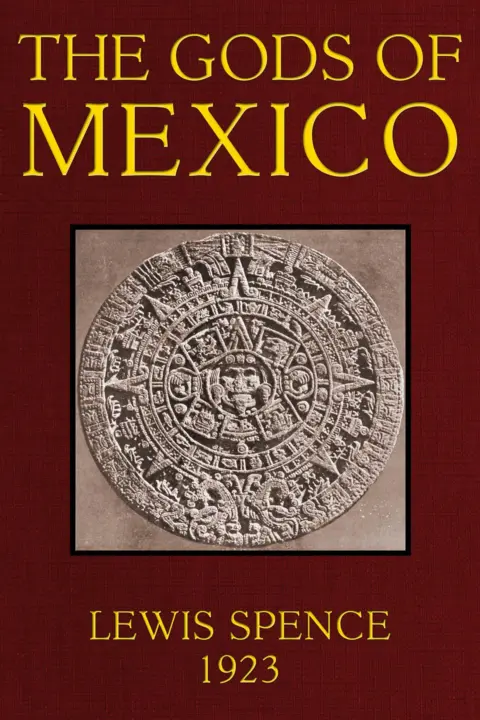
The gods of Mexico
Lewis Spence
THE CLASSIC COLLECTION · 1921
"An Introduction to Mythology" by Lewis Spence is a scholarly examination of mythological principles, likely written in the early 20th century. This comprehensive work explores the evolution, classification, and significance of myths within the context of primitive religion and culture, presenting an overview of the scientific approaches to mythology. Spence aims to illuminate the historical progression of mythic study and its modern applications by synthesizing various theories and presenting definitions that clarify key concepts. The opening of the text introduces the reader to the foundational aspects of mythology, explaining its purpose in understanding the early religious and scientific experiences of humanity. It lays out important definitions distinguishing myths from folklore and legends, suggesting that myths function as explanations for physical and social phenomena. Spence outlines how mythology intersects with folklore, illustrating that myths serve as primitive attempts at rationalizing the universe, while also highlighting significant changes in myth interpretation and classification over time as societies evolve.
Introduction adapted from the source catalogue; source summaries may be automatically generated.
Free to read · English · 115,570 words · No account needed
MAKE TIME FOR A GOOD BOOK
On by default. Untick to stop anonymous reading totals. Each page counts after 10 seconds in view. How this works.
Anonymous counting is on unless you have switched it off.
[2] Iris, daughter of Thaumas and the ocean nymph Electra, was the personification of the rainbow and messenger of the Greek gods, especially of Zeus and Hera.
[3] Müller, A Scientific System of Mythology, 1838.
[4] Cow. A 'shelly-coat cow' was, in Scots parlance, a bogy. It is thought that the shells on such an animal are a reminiscence of the scale armour of the vikings, whose memory was a terror to the Scottish peasantry. To 'cow' is, of course, much the same as to 'bully.'
[5] Grimace.
[6] That is, "These shall surround the bier."
[7] Thus, according to Müller, the name Athene, unintelligible in its Greek form, at once becomes explicable when compared with the Sanskrit Ahana, 'the dawn.'
[8] His views will be found stated in Selected Essays and Lectures
upon Language.
[9] See his Comparative Grammar, English translation by Eastwick (3rd
ed.), 1862.
[10] See "The Lesson of Jupiter," Nineteenth Century for October 1885: "To understand the origin and meaning of the names of the Greek gods and to enter into the original intention of the fables told of each, we must take into account the collateral evidence supplied by Latin, German, Sanskrit, and Zend philology." See also Lectures on Language,2nd ser., p. 406.
[11] See his Nebelsagen (1879) and Das Räthsel der Sphinx (1889).
[12] Apart from its philological efforts, the work of Müller his disciples is of permanent value, and his critics undoubtedly did a disservice to mythological science when they condemned it root and branch. The training of no student of mythology can be complete if it lacks a consideration of Müller's works, which, of course, must be perused in the light of the comparative failure of his linguistic hypotheses.
[13] Lang in Ency. Brit., (11th ed.), art. "Mythology."
[14] Ibid.
[15] Modern Mythology, pp. 55, 63.
[16] Primitive Culture(London, 1871), p. 282.
[17] Primitive Culture(London, 1871), pp. 283, 284.
[18] Ibid., p. 284.
[19] Primitive Culture (London, 1871), p. 320.
[20] Primitive Culture(London, 1871), p. 320.
[21] Ibid., pp. 415, 416.
[22] This appears to the author a suitable term for those bodies of myth which deal exclusively with the lives and adventures of the gods, and differ therefore so strikingly from all other classes of myth.
Your reading position is saved on this browser. Take it to another device with a library code. Reading pages adapt to text, rather than matching a printed edition.
BEHIND THE BOOK
This eBook is for the use of anyone anywhere in the United States and most other parts of the world at no cost and with almost no restrictions whatsoever. You may copy it, give it away or re-use it under the terms of the Project Gutenberg License included with this eBook or online at www.gutenberg.org. If you are not located in the United States, you will have to check the laws of the country where you are located before using this eBook. Read the source licence.
The original source file, including credits and licence, is retained by this library. Request an original-format copy at no charge. Please include the book title and Project Gutenberg identifier #45048.
KEEP YOUR CURIOSITY GOING

Maurice Baring
Francis Greenleaf Allinson & Anne C. E. (Anne Crosby Emery) Allinson
Stuart Dodgson Collingwood
Percy Keese Fitzhugh
Mary Macleod & Edmund Spenser

Cooke Don-Carlos