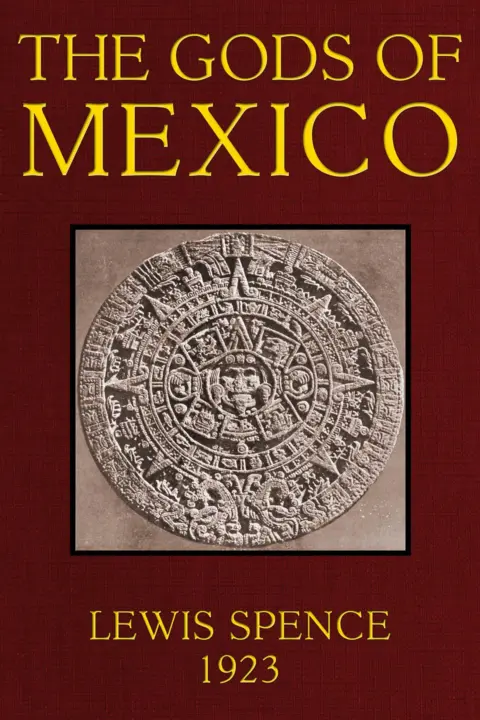
The gods of Mexico
Lewis Spence
THE CLASSIC COLLECTION · 1921
"An Introduction to Mythology" by Lewis Spence is a scholarly examination of mythological principles, likely written in the early 20th century. This comprehensive work explores the evolution, classification, and significance of myths within the context of primitive religion and culture, presenting an overview of the scientific approaches to mythology. Spence aims to illuminate the historical progression of mythic study and its modern applications by synthesizing various theories and presenting definitions that clarify key concepts. The opening of the text introduces the reader to the foundational aspects of mythology, explaining its purpose in understanding the early religious and scientific experiences of humanity. It lays out important definitions distinguishing myths from folklore and legends, suggesting that myths function as explanations for physical and social phenomena. Spence outlines how mythology intersects with folklore, illustrating that myths serve as primitive attempts at rationalizing the universe, while also highlighting significant changes in myth interpretation and classification over time as societies evolve.
Introduction adapted from the source catalogue; source summaries may be automatically generated.
Free to read · English · 115,570 words · No account needed
MAKE TIME FOR A GOOD BOOK
On by default. Untick to stop anonymous reading totals. Each page counts after 10 seconds in view. How this works.
Anonymous counting is on unless you have switched it off.
Dr F. B. Jevons in his Introduction to the History of Religion avows himself a disciple of Lang so far as his views upon myth are concerned. He too believes that the religious feeling in myth is conspicuously absent, but that the consideration of myth cannot be excluded from the history of religion. He says (p. 250): "Myths are not like psalms or hymns, lyrical expressions of religious emotion; they are not like creeds or dogmas, statements of things which must be believed: they are narratives. They are not history, they are tales told about gods and heroes, and they all have two characteristics: on the one hand, they are to us obviously or demonstrably untrue and often irrational; on the other hand, they were to their first audience so reasonable as to appear truths which were self-evident." Some myths, he thinks, "explain nothing and point no moral; they are tales told for the sake of telling and repeated for the pleasure of hearing, like fairy-tales." What, then, he asks, is the difference between myths that 'explain' phenomena and those which obviously do not? He considers that totems aroused curiosity and necessitated explanations, and that when the beliefs were dead and forgotten the stories invented to account for them would appear no longer as reasons or explanations, but as statements of facts which occurred 'once upon a time.' These stories were often appropriated to the wrong persons, and we have also yet to learn why they were grouped together, a point Dr Jevons considers as of first-rate importance, because "they would not have survived if they had not been combined together. We cannot suppose that they were first dissevered from the beliefs on which they originally depended for their existence, and then were subsequently combined so as to obtain a renewed existence, because they would probably have perished in the interval. We must therefore suppose that they were combined into tales ere yet the beliefs or institutions which gave them their first lease of life had perished. This means that the various parts of one institution, for instance, must have had each its separate explanation, and that these explanations were combined into one whole, the unity of which corresponded to the unity of the institution," (P. 254.) These contentions are confirmed, Jevons thinks, by certain ceremonies obviously representing the details of certain myths. "They afford instances of myths which from the beginning were tales and not merely single incidents; a single rite might consist of a series of acts, each of which demanded its own explanation; and the unity of the rite might produce a unity of interest and action in the resulting myth." (P. 254.) Stories designed to explain phenomena would provide a groundwork for a rich embroidery of incidents. The person who could remember these and could tell them effectively would not have to seek an audience, and semi-consciously he might substitute for part of the story an analogous incident.[32] "Tales with a permanent human interest would easily spread beyond the limits of the original audience." Myth is not religion; it is not the source of religion, it is "one of the spheres of human activity in which religion may manifest itself, one of the departments of human reason which religion may penetrate, suffuse, and inspire." The religious consciousness rejected the repugnant elements of myth, and perhaps the whole primitive hypothesis upon which myth was based. "The result would be twofold: the imagination would be more and more excluded from the region of speculation which produced the ordinary myths of early peoples; and more and more restricted to the path of religious meditation." (P. 266.) These are all conclusions which we cannot admit. Myth is not any less religious in character because associated with an early instead of a later form of religion, or because it was discarded in later times! In an important passage Dr Jevons declares with a great deal of truth that: "The extraordinary notion that mythology is religion is the outcome of the erroneous and misleading practice of reading modern ideas into ancient religions. It is but one form of the fallacy that mythology was to the antique religions what dogma is to the modern--with the superadded fallacy that dogma is the source, instead of the expression, of religious conviction. Mythology is primitive science, primitive philosophy, an important constituent of primitive history, the source of primitive poetry, but it is not primitive religion. It is not necessarily or usually even religious. It is not the proper or even the ordinary vehicle for the expression of the religious spirit." Where the sensitiveness of the religious spirit "was great only those pieces of primitive science survived which were capable of being informed" by it.
Your reading position is saved on this browser. Take it to another device with a library code. Reading pages adapt to text, rather than matching a printed edition.
BEHIND THE BOOK
This eBook is for the use of anyone anywhere in the United States and most other parts of the world at no cost and with almost no restrictions whatsoever. You may copy it, give it away or re-use it under the terms of the Project Gutenberg License included with this eBook or online at www.gutenberg.org. If you are not located in the United States, you will have to check the laws of the country where you are located before using this eBook. Read the source licence.
The original source file, including credits and licence, is retained by this library. Request an original-format copy at no charge. Please include the book title and Project Gutenberg identifier #45048.
KEEP YOUR CURIOSITY GOING

Maurice Baring
Francis Greenleaf Allinson & Anne C. E. (Anne Crosby Emery) Allinson
Stuart Dodgson Collingwood
Percy Keese Fitzhugh
Mary Macleod & Edmund Spenser

Cooke Don-Carlos