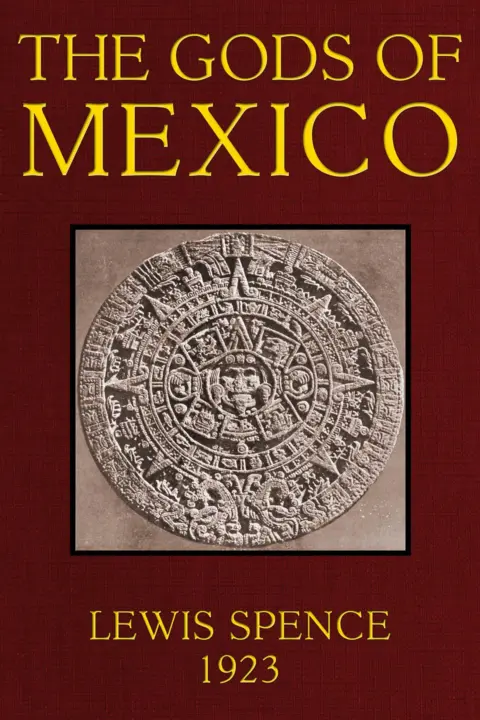
The gods of Mexico
Lewis Spence
THE CLASSIC COLLECTION · 1921
"An Introduction to Mythology" by Lewis Spence is a scholarly examination of mythological principles, likely written in the early 20th century. This comprehensive work explores the evolution, classification, and significance of myths within the context of primitive religion and culture, presenting an overview of the scientific approaches to mythology. Spence aims to illuminate the historical progression of mythic study and its modern applications by synthesizing various theories and presenting definitions that clarify key concepts. The opening of the text introduces the reader to the foundational aspects of mythology, explaining its purpose in understanding the early religious and scientific experiences of humanity. It lays out important definitions distinguishing myths from folklore and legends, suggesting that myths function as explanations for physical and social phenomena. Spence outlines how mythology intersects with folklore, illustrating that myths serve as primitive attempts at rationalizing the universe, while also highlighting significant changes in myth interpretation and classification over time as societies evolve.
Introduction adapted from the source catalogue; source summaries may be automatically generated.
Free to read · English · 115,570 words · No account needed
MAKE TIME FOR A GOOD BOOK
On by default. Untick to stop anonymous reading totals. Each page counts after 10 seconds in view. How this works.
Anonymous counting is on unless you have switched it off.
QUEENSFERRY (Scotland), ceremony of Burry Man at, 135-137
Quetzalcoatl, as agricultural god, 129; in creation myth, 171; as
Mexican wind-god, 264-299
Qui-oki, Nottoway god, 305
RA, Egyptian solar deity, 114, 115; as creator in form of Khepera, 163; chief of Egyptian heaven, 199; described, 285 Ragnorök, Norse day of doom, 261 Raini, Mundruku creator, 183 Ramayana, the, Hindu epic, 256 et seq. Rama, 256 Reinach, Salomon, his works, 84-85, 109 Religion, definitions of, 14; pre-animistic, 23; sacred and frivolous in, 67; difference between myth and, 68; primitive, two great types of, 82 Religion of the Semites, Robertson Smith's, 61, 83 Religious sentiment, survival of, 70 Researches into the Early History of Mankind, Tylor's, 55 Revue de l'histoire des religions, Tiele's, 65 Rex Nemorensis (King of the Wood), 79 Rhadamanthus, one of the tribunal of the Greek Underworld, 206; ruler of Elysian Fields, 207 Rhea, wife of Cronus, 18, 134, 276, 277 "Rígsmál," Norse mythic book, 262 Rig-Veda, Indian sacred book, creation myth in, 159-160 Rites, myths of, classified, 157 Ritual, and myth, 89, 238 et seq.; movements, 239; in folk-belief, 239-240 River Chaco Indians of South America, creation myth of, 183 Romans, their myth of origin of heroes, 149; soul myth of, 152; fire myth of, 152; place of reward of, 153; moon myth of, 156 Round Table, King Arthur's, as the sun, 122 Rudra, Hindu deity, 132, 291; swallows universe, 163 Rumanians, dismemberment myth of, 146 Russians, dismemberment myth of, 146 Rustem, as sun-hero, 122
SABITU, Assyrian sea-goddess, 252, 254
Sacred, idea of the, 33; sacred stones, 27
Sahagun, Father Bernardino, Spanish historian of Mexico, 263-264
Samoyede fetishes, 104-105
Satapatha Brahmana, Hindu sacred book, creation myth
in, 160 et seq.
Saturn, Milton on, 277; Keats on, 276-277
Savage and civilized myths compared, 71-72
Savage and irrational element in myth, 15, 16, 45, 51; Tiele
on, 65; Lang on, 67
Scandinavian creation myth, 170, 193-194
Schelling, Friedrich, on myth and national development, 46
Science, early, and myth, 20 et seq.
Science of Fairy Tales, Hartland's, 92
Science of Language, Sayce's, 223
Scotland, Faust legend variant in, 228-233; fisher beliefs of, 234;
boat-language of fishers of, 235; taboo of animal names in, 235;
May-time ceremonies in, 240 et seq.
Sea-gods, 125
Secondary myth, 90; frequently arises out of ritual, 238
Serpent, horned, in American myth, 307
Servius, his allegorical interpretation of the golden bough, 78
Shaddai, or Shedi ('my demon'), early form of Yahweh, 74
Shamans, of Chinooks, 303-304
Shamash, Babylonian god, 250, 288
Sheol, Hebrew Hades, 203-204
Shesu-Heru, 198
Shintoism in the Kojiki and Nihongi, 260
Shropshire Folklore, Burne's, 226
Shu, Egyptian god, 165; birth of, 163
Sidhe (fairy folk) in Irish myth, 295
Siegfried, 122
Sif, Norse goddess, wife of Thor, 294
Sigfusson, Sæmund, Norse historian, 261
Sigu, deity of Arawak Indians,
Sigurd, as sun-hero, 122
Sin, Scandinavian deity, 123
Sin, Babylonian moon-god, 288
Sir John Rowll's Cursing, mythological allusions in, 44-45
Sita, Hindu goddess, 256
Siva, Hindu deity, 291
Skasa-it (Robin) in myths of Chinook Indians, 302
Skrymir, Norse giant, 45
Sky, Egyptian ideas regarding, 165
Sky-god, and Lang's 'All-Father' deities, 74 n.; European, 89;
Sky-Father, 133
Slavonic place of the dead, 207-209
Smith, Professor G. Elliot, theories of, 36-37. 95-100
Smith, William Robertson, his theories regarding myth, 61-64;
on the non-religious character of myth, 61
Snorri Sturlason, Norse mythologist, 260
Socrates, on the analysis of divine names, 42
Solar myth, 36; Lang on, 54; its groundwork, 120-122
'Solar' theory, its mythological merits, 120
Solomon Islanders, death myth of, 151
Soma, 256, 291
"Song of Thrym, The," Norse mythic book, 262
Soul, early beliefs about, 22 et seq.; conception of, 59;
conception of, not essential to idea of god, 72; myths of,
classified, 151-152; search for, among the Chinooks, 303-304;
belief regarding, among Araucanian Indians, 313
South America, star myths of, 140-142; creation myths of, 177-179
Southern Cross (constellation), in South American myth, 141;
different conceptions of, 184
Southern Indians, death myth of, 151
Spencer, Herbert, his definition of religion, 14; his system of
mythology, 59; refutation of his theories by Lang, 60
Spirit, Tylor on, 59, 102; idea of, 102-104; distinction between,
and god, 128; idea of, connected with wind or breath, 298
Staden, Hans, on Tupi-Guarani beliefs, 183
Star myths, 140-142; classified, 156
Stars, personification of, 202
Stratification of myth, theory of, 81-82
Studies in Ancient History, McLennan's, 59
Subterranean passage, legend of, 227-228
Sun-gods, 118-122; in Peru, 119; later phases of, 119; in Egyptian
mythology, 119-120; animistic and anthropomorphic ideas of, 120;
myths classified, 155; worship in Mexico, 299-300; in America, 305
Supernaturalism, Marett's definition of, 24
Surya, Hindu deity, 289
Susa-no-o, Japanese deity, 260
Sym Skynar, 45
Symbolik und Mythologie, Creuzer's, 46
Synonymy, factor in formation of myth, 48
Your reading position is saved on this browser. Take it to another device with a library code. Reading pages adapt to text, rather than matching a printed edition.
BEHIND THE BOOK
This eBook is for the use of anyone anywhere in the United States and most other parts of the world at no cost and with almost no restrictions whatsoever. You may copy it, give it away or re-use it under the terms of the Project Gutenberg License included with this eBook or online at www.gutenberg.org. If you are not located in the United States, you will have to check the laws of the country where you are located before using this eBook. Read the source licence.
The original source file, including credits and licence, is retained by this library. Request an original-format copy at no charge. Please include the book title and Project Gutenberg identifier #45048.
KEEP YOUR CURIOSITY GOING

Maurice Baring
Francis Greenleaf Allinson & Anne C. E. (Anne Crosby Emery) Allinson
Stuart Dodgson Collingwood
Percy Keese Fitzhugh
Mary Macleod & Edmund Spenser

Cooke Don-Carlos