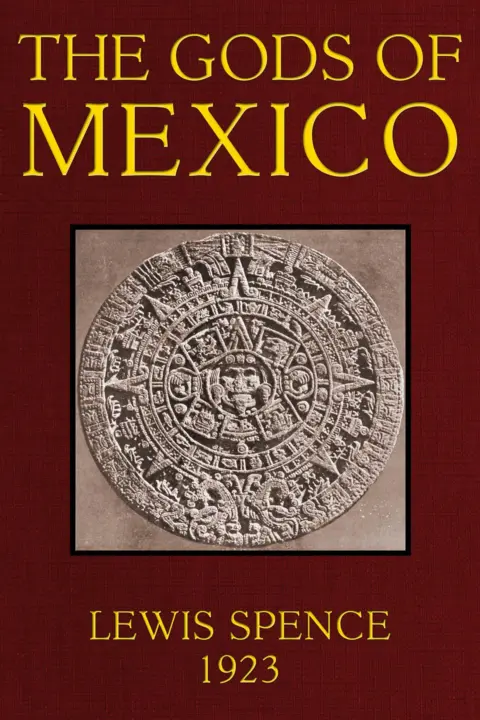
The gods of Mexico
Lewis Spence
THE CLASSIC COLLECTION · 1921
"An Introduction to Mythology" by Lewis Spence is a scholarly examination of mythological principles, likely written in the early 20th century. This comprehensive work explores the evolution, classification, and significance of myths within the context of primitive religion and culture, presenting an overview of the scientific approaches to mythology. Spence aims to illuminate the historical progression of mythic study and its modern applications by synthesizing various theories and presenting definitions that clarify key concepts. The opening of the text introduces the reader to the foundational aspects of mythology, explaining its purpose in understanding the early religious and scientific experiences of humanity. It lays out important definitions distinguishing myths from folklore and legends, suggesting that myths function as explanations for physical and social phenomena. Spence outlines how mythology intersects with folklore, illustrating that myths serve as primitive attempts at rationalizing the universe, while also highlighting significant changes in myth interpretation and classification over time as societies evolve.
Introduction adapted from the source catalogue; source summaries may be automatically generated.
Free to read · English · 115,570 words · No account needed
MAKE TIME FOR A GOOD BOOK
On by default. Untick to stop anonymous reading totals. Each page counts after 10 seconds in view. How this works.
Anonymous counting is on unless you have switched it off.
Faerie Queene, mythological references in Spenser's, 278 Farnell, Lewis, his criticism of The Golden Bough, 81-83 Father May, May Day character in Brie, 136 Fauna, Latin rural deity, 135 Faunus, Latin rural deity, 135 Faust, Scottish, 228-233 Fetish, definition of, 24 et seq.; difference between god and, 25; development of, 104-108; air the element of, 106-107; work of, 108; sale of, 108; religious ideas connected with, lack force and permanence, 108; hunting, 116-117; sacrifice to, 116 Fetishism, in Greece, 20; nature of, 24 et seq.; and evolution of idea of god, 104, 107 Fiji Islanders, death myth of, 151 Finns, forest-god of, 76; dismemberment myth among, 146; creation myth of, 147; food of the dead myth of, 155 Fire-gods, 130-131 Fire myths, 139; preponderance of American examples in, 139; classification of, 152; myths of fire-stealing, 140, 149 Fire-stick, 94 Fisher beliefs of Scotland, 234 Fish-gods of America, 314-315 Fladdahuan (Hebrides), sacred stone in, 27 Flint-gods, 26 Flood myths, 36, 37; classified, 153; Babylonian, 252-253; Araucanian, 310-311 Folklore, definition of, 12 et seq.; and myth, 221 et seq.; complementary process in, 233 Folklore as an Historical Science, Gomme's, 14 n., 15 n., 90, 221, 233 Folk-tale, definition of, 12; appropriated by mythologists, 92; and history, 92; dependence of, upon custom and superstition, 93 Fomorians, mythical Irish race of Titans, 294 Food of the dead, 37; myths of, classified, 155; the eating of, 304 Frazer, Sir J. G., definition of religion, 14; his Golden Bough,75; his method founded on that of Mannhardt, 75; his thesis, 75-77; criticism of, by Lang, 77-81 Freya, Teutonic goddess, 262, 292 Funeral practices of the Araucanian Indians, 313-314; of Pehuenche Indians, 314
GÆA, Greek earth-goddess, 18, 134, 283 Gallinomero (Californian) Indians, place of punishment of, 154 Gandharvas, Hindu deities, 291 Ganesa, Hindu god, 291 Garnega, St, in Sir John Rowll's Cursing, 44 Garog, in Sir John Rowll's Cursing, 44 Garonhia, Iroquois Indian deity, 305 Garuda, Hindu deity, 256 Gaul, gods of, 294 Gayatri, Hindu deity, 256 Gayomart, Persian Adam, 169 Gehenna, Hebrew Hell, 203-206 Gelfion, in Scandinavian myth, 260 Gender-terminations, effect of, in beliefs regarding natural phenomena, 52; anthropological school regards, as early survivals, 53 German Myths, Mannhardt's, 53 Germany, myths of, 90 Ghastly Priest, The, Lang's essay on, 75-81 Gilgamesh epic, 248-255; astrological aspect of, 254-255 Glooskap, central figure of New England Indian legends, 270 et seq. God, idea of, not animistic, 72; conception of soul not essential to idea of, 72; original idea of, as 'magnified non-natural man,' 73-74; idea of, developed from deified king, 97 Gods, in animal shape, 19; dialectical misunderstandings alter nomenclature of, 30; grouping of, into a pantheon, 30; alien, identified with national, 34; as elements, 41-42; developed from the dead, 42; graves of, 42; names of, no guide to their nature, 52; of vegetation, 75; totems attached to, 109; compact with the, 112-113; of the chase, later secondary position of, 113; agricultural, 113, 129; departmental, 116, 117, 118; of the sea, 125; idea of, as dwelling in the sky, 219 Gods of Egypt, The, Budge's, 165 n. Gog, in Sir John Rowll's Cursing, 44 Goibnin, Celtic smith-god, 263, 295-296 Golden bough of myth situated in the Arician grove, 76; Virgil on, 77-78; Servius on, 77-78; Virgil's idea of, equated by Lang with mystic sword of romance, 77, 81; human sacrifice and, 78, Proserpine and, 78; temple of, 78; what is the? 80-81 Golden Bough, The, Frazer's, 75 et seq.; criticism of, by Lewis Farnell, 81 Gomme, Sir G. Laurence, on traditional narrative, 91; his standpoint, 90-92; on folklore and myth, 221-222; on restoration of myth, 233-234 Gorgon's head, Shelley's poem on, 279 Govannon, Celtic smith-god, 263. See also Goibniu Græco-Roman myth, 282-285 Grannos, Celtic (Gaulish) god, 294 Great Mother, cowrie-shell as, 99 Greeks, mysteries of, 19; early religion of, 93; myth of birth of gods of, 144; beast myth among, 144-145; dualistic myth of, 145; dismemberment myth of, 146; creation myth of, 146; origin of man myth among, 148; myth of origin of heroes among, 149; fire-stealing myth of, 149; culture myth of, 150; taboo myth of, 150; death myth of, 151; soul myth of, 152; flood myth of, 153; place of reward of, 153; place of punishment of, 154, 206-207; myth of journey through Underworld of, 154; food of the dead myth among, 155; sun myth of, 155; moon myth of, 156; star myth of, 156; myth to account for rites among, 157; ideas of Elysian fields among, 207 Green George, St George's Day character in Carinthia, 136 Grimm, J. L. K., 90 Grimm, W. K., 90 Grubb, W. Barbrook, on Lengua Indian creation myth, 180-181 Guaracy, Tupi Indian sun-god, 184 Guatemalans, place of punishment of, 154 Gucumatz in Kiche Popol Vuh, 265 Guecubu, demon of Araucanians of Chile, 310 Gulcheman, Araucanian Indian place of the dead, 313 Gwion Bach, British god, 296 Gwydion, British deity, 296 Gylfi in Scandinavian myth, 260
Your reading position is saved on this browser. Take it to another device with a library code. Reading pages adapt to text, rather than matching a printed edition.
BEHIND THE BOOK
This eBook is for the use of anyone anywhere in the United States and most other parts of the world at no cost and with almost no restrictions whatsoever. You may copy it, give it away or re-use it under the terms of the Project Gutenberg License included with this eBook or online at www.gutenberg.org. If you are not located in the United States, you will have to check the laws of the country where you are located before using this eBook. Read the source licence.
The original source file, including credits and licence, is retained by this library. Request an original-format copy at no charge. Please include the book title and Project Gutenberg identifier #45048.
KEEP YOUR CURIOSITY GOING

Maurice Baring
Francis Greenleaf Allinson & Anne C. E. (Anne Crosby Emery) Allinson
Stuart Dodgson Collingwood
Percy Keese Fitzhugh
Mary Macleod & Edmund Spenser

Cooke Don-Carlos