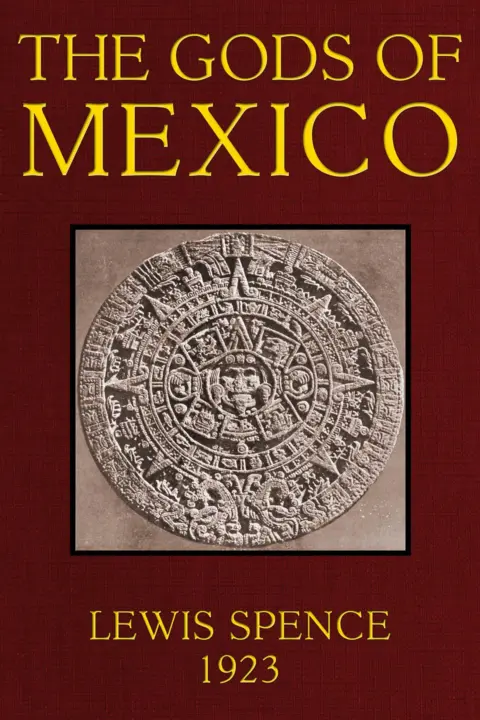
The gods of Mexico
Lewis Spence
THE CLASSIC COLLECTION · 1921
"An Introduction to Mythology" by Lewis Spence is a scholarly examination of mythological principles, likely written in the early 20th century. This comprehensive work explores the evolution, classification, and significance of myths within the context of primitive religion and culture, presenting an overview of the scientific approaches to mythology. Spence aims to illuminate the historical progression of mythic study and its modern applications by synthesizing various theories and presenting definitions that clarify key concepts. The opening of the text introduces the reader to the foundational aspects of mythology, explaining its purpose in understanding the early religious and scientific experiences of humanity. It lays out important definitions distinguishing myths from folklore and legends, suggesting that myths function as explanations for physical and social phenomena. Spence outlines how mythology intersects with folklore, illustrating that myths serve as primitive attempts at rationalizing the universe, while also highlighting significant changes in myth interpretation and classification over time as societies evolve.
Introduction adapted from the source catalogue; source summaries may be automatically generated.
Free to read · English · 115,570 words · No account needed
MAKE TIME FOR A GOOD BOOK
On by default. Untick to stop anonymous reading totals. Each page counts after 10 seconds in view. How this works.
Anonymous counting is on unless you have switched it off.
After they had departed, an old woman called Tempuleague came to the grave in the shape of a whale, and transported the soul of the deceased to the Otherworld. Probably the Araucanians of the Chilean coast were acquainted with the spermaceti, or southern variety of whale, and regarded it as the only method of locomotion for a spirit across the great waters, or it is probable that they borrowed the conception from the Peruvians of the coast, who regarded the sea as the most powerful among the gods, and called it Mama-cocha or 'Mother Sea.' The whale was a general object of worship all along the Peruvian coast, while each of the Peruvian coastal districts worshipped the particular species of fish that was taken there in the greatest abundance. This fish-worship was not mere superstition, and it was very elaborate, the fish-ancestor of each variety or 'tribe' of fish holding a special place in the heavens in the form of a constellation. The Collao tribes to the south, on the shores of Lake Titicaca, some fifty miles or so from the Chilean frontier, also worshipped a fish-god; so that in all likelihood the fish-goddess of the Araucanians was originally borrowed from the Collao, who were probably ethnologically akin to the Araucanian tribes. This theory is confirmed by the nature of the fish-deity worshipped by the Collao; its name was Copacahuana, 'valuable stone to be looked upon,' the idol being carved from a bluish-green stone, with the body of a fish surmounted by a rude human head. This deity, like Tempuleague, was female.
The deceased, however, must pay a toll to another old woman, of malicious character, for permission to pass a narrow strait on the road; otherwise she would deprive him of an eye.
The life after death was very similar to earthly existence, but without fatigue or satiety. Husbands had the same wives as on earth, but had no children, as the Otherworld was inhabited by the spirits of the dead alone.
Certain vestiges of sun- and moon-worship were known among some tribes, who called the sun Anti, and the moon Kayan; but recognition of these luminaries as deities was intermittent and probably seasonal.
[1] See p. 32.
[2] Commerce of the Prairies, vol. ii, p. 235.
[3] Heart, Trans. Am. Phil. Soc., vol. iii, p. 216.
[4] Prehistoric Man, vol. i, p. 276 (London, 1876).
[5] Myths of the New World, p. 101 (1896).
[6] Abipones, vol. ii, p. 101 (London, 1822).
[7] Amer. Urreligionen, pp. 265, 272 (Basel, 1855).
[8] History of Chile, vol. ii, p. 85 (1809).
[9] Molina, op. cit., vol. ii, p. 87.
[10] Hawkins, Sketch of the Creek Country, p. 80 (Savannah, 1848).
Your reading position is saved on this browser. Take it to another device with a library code. Reading pages adapt to text, rather than matching a printed edition.
BEHIND THE BOOK
This eBook is for the use of anyone anywhere in the United States and most other parts of the world at no cost and with almost no restrictions whatsoever. You may copy it, give it away or re-use it under the terms of the Project Gutenberg License included with this eBook or online at www.gutenberg.org. If you are not located in the United States, you will have to check the laws of the country where you are located before using this eBook. Read the source licence.
The original source file, including credits and licence, is retained by this library. Request an original-format copy at no charge. Please include the book title and Project Gutenberg identifier #45048.
KEEP YOUR CURIOSITY GOING

Maurice Baring
Francis Greenleaf Allinson & Anne C. E. (Anne Crosby Emery) Allinson
Stuart Dodgson Collingwood
Percy Keese Fitzhugh
Mary Macleod & Edmund Spenser

Cooke Don-Carlos