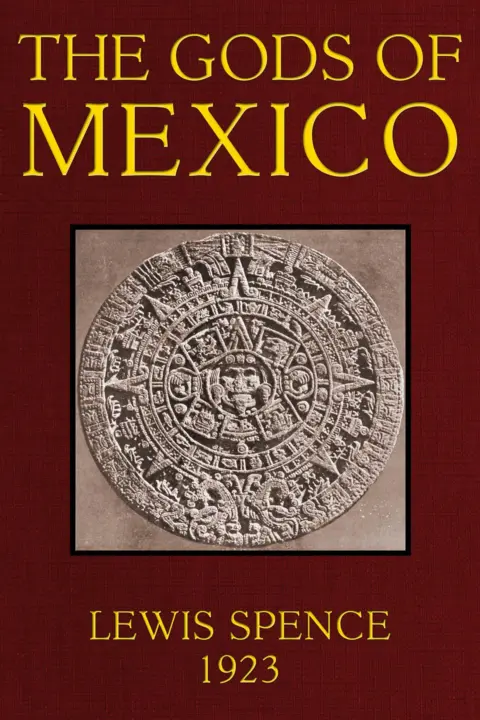
The gods of Mexico
Lewis Spence
THE CLASSIC COLLECTION · 1921
"An Introduction to Mythology" by Lewis Spence is a scholarly examination of mythological principles, likely written in the early 20th century. This comprehensive work explores the evolution, classification, and significance of myths within the context of primitive religion and culture, presenting an overview of the scientific approaches to mythology. Spence aims to illuminate the historical progression of mythic study and its modern applications by synthesizing various theories and presenting definitions that clarify key concepts. The opening of the text introduces the reader to the foundational aspects of mythology, explaining its purpose in understanding the early religious and scientific experiences of humanity. It lays out important definitions distinguishing myths from folklore and legends, suggesting that myths function as explanations for physical and social phenomena. Spence outlines how mythology intersects with folklore, illustrating that myths serve as primitive attempts at rationalizing the universe, while also highlighting significant changes in myth interpretation and classification over time as societies evolve.
Introduction adapted from the source catalogue; source summaries may be automatically generated.
Free to read · English · 115,570 words · No account needed
MAKE TIME FOR A GOOD BOOK
On by default. Untick to stop anonymous reading totals. Each page counts after 10 seconds in view. How this works.
Anonymous counting is on unless you have switched it off.
Vukub-Cakix noticed them alight in the tapal-tree, which he regarded as his own especial property. They began to pluck its fruit, and this so irritated him that he was about to attack them when Hun-Apu discharged a dart from a blowpipe at him, striking him in the mouth and causing him to topple to the earth from the tree into which he had climbed. He succeeded, however, in tearing off Hun-Apu's arm, which he hung over his fire at home. This use of 'sympathetic magic,' of course, caused the hero-god great pain, so in order to recover the arm he begged the assistance of two magicians, probably the father- and mother-gods. These disguised themselves as physicians, and pretending that they desired to cure Vukub-Cakix, extracted his teeth. With the teeth his power departed from him and he died. The giant's wife had been basting Hun-Apu's arm at the fire, but seizing it the hero-god gave it to the magicians, who replaced it upon his shoulder. Zipacna and Cabrakan, who personified the earthquake, were next reduced. Four hundred young men (the stars) requested Zipacna to dig the foundations of a new house for them, intending to bury him alive while occupied in the task; but when they had erected their dwelling above him he reared his mighty bulk beneath it and shot them into Heaven, where they have since remained. Zipacna, however, tumbling down a ravine, was killed by Hun-Apu and Xbalanque by having a mountain thrown upon him. Cabrakan was next destroyed, partly by poison and partly by overstraining himself by throwing mountains at the instigation of the heavenly brothers.
The father- and mother-gods had two sons, Hunhun-Apu and Vukub-Hunapu, who were much devoted to the game of ball, the national pastime of the peoples of Mexico and Central America. The noise they made while playing attracted the attention of the lords of the Underworld, who sent them a challenge to a game. The challenge was accepted, and Hunhun-Apu and his brother took their way to the grim territory of Xibalba, where they were received by its rulers Hun-Came and Vukub-Came. It would seem from what follows that the condition of affairs in Xibalba closely resembled those of some of the secret societies still in vogue among the Indians all over North America. The brothers were subjected to numerous tests, at all of which they failed, and they were then sacrificed by having their hearts torn out. Hunhun-Apu's head was placed among the branches of a tree from which calabashes sprouted in such a manner that the gory trophy could not be distinguished from the fruit. Although the inhabitants of Xibalba were forbidden to approach the tree, Xquiq, daughter of one of its high officials, did so. By magical influence Hunhun-Apu became the father of her children, and when her father discovered her disgrace she was given up to the owls, the messengers of Xibalba, to be slain. She bribed them, and succeeded in escaping to the earth, where she sought out the dwelling of Xmucane, mother of Hunhun-Apu, and gave birth to Hun-Apu and Xbalanque, who overthrew Vukub-Cakix. These children were persecuted by two other sons of Hunhun-Apu, also living with their grandmother, but by magic they turned their tormentors into monkeys, and thus rid themselves of them. By the aid of a rat they discovered a set of implements for the ball game which had belonged to their father and uncle, and they engaged in the pastime. The lords of Xibalba, hearing them at play, once more sent a challenge, which was again accepted. But, more astute than their forbears, ere they reached the confines of Xibalba, Hun-Apu created from a hair on his leg a small insect called Xan. This, preceding the brothers, found the lords of Xibalba sitting among a number of wooden figures. It bit them, and when they spoke to one another concerning the insect's onslaught, the brothers discovered their names. When Hun-Apu and Xbalanque arrived they were thus enabled to salute each of the Xibalbans by his name, and they passed all the other tests successfully. They were shut up for the night in the House of Gloom with certain torches which they must keep alight all night, but they affixed red feathers to the torches, and thus cheated the Xibalbans. In the House of Bats, Camazotz, the chief of the bats, cut off the head of Hun-Apu, but a friendly tortoise passing by affixed itself to the body in place of the head. Xbalanque then played ball with the Xibalbans, and hit the ball close to the ring, whereupon a rabbit concealed near it leaped out and ran away. The Xibalbans, taking it for the ball, pursued it, and Xbalanque, observing Hun-Apu's head suspended in the ball court, hung up the tortoise in its place, and affixed Hun-Apu's head to his body and resuscitated him. The hero-gods then sacrificed themselves, but returned after a space of five days. Disguised as magicians, they performed many miracles, resurrecting people, burning houses and restoring them again, and so forth. Hun-Came and Vukub-Came considered the resurrection trick so clever that they desired to have it performed upon themselves. The heroes sacrificed them, but did not revive them. This completed the subjugation of Xibalba, the people being reduced to a subservient condition. The aristocratic privilege of the ball game was withdrawn from them, and they were doomed to keep bees and make pots and perform suchlike ignoble work. Post-mortem honours were paid to Hunhun-Apu and Vukub-Hunapu, who became the sun and moon respectively, while the four hundred youths slain by Zipacna remained in Heaven as the stars.
Your reading position is saved on this browser. Take it to another device with a library code. Reading pages adapt to text, rather than matching a printed edition.
BEHIND THE BOOK
This eBook is for the use of anyone anywhere in the United States and most other parts of the world at no cost and with almost no restrictions whatsoever. You may copy it, give it away or re-use it under the terms of the Project Gutenberg License included with this eBook or online at www.gutenberg.org. If you are not located in the United States, you will have to check the laws of the country where you are located before using this eBook. Read the source licence.
The original source file, including credits and licence, is retained by this library. Request an original-format copy at no charge. Please include the book title and Project Gutenberg identifier #45048.
KEEP YOUR CURIOSITY GOING

Maurice Baring
Francis Greenleaf Allinson & Anne C. E. (Anne Crosby Emery) Allinson
Stuart Dodgson Collingwood
Percy Keese Fitzhugh
Mary Macleod & Edmund Spenser

Cooke Don-Carlos