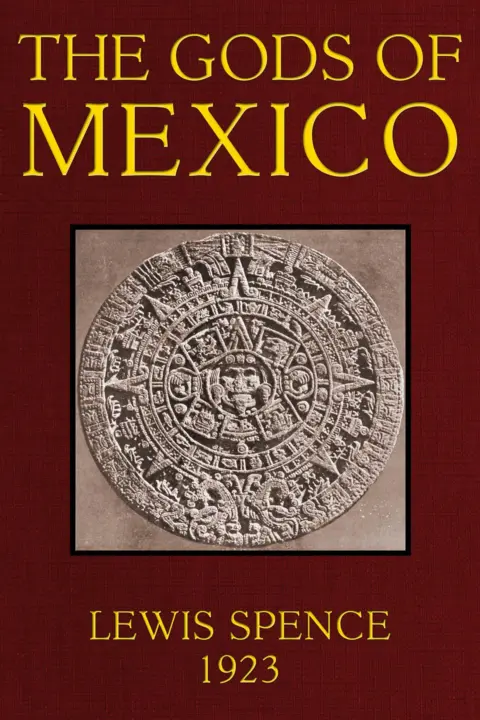
The gods of Mexico
Lewis Spence
THE CLASSIC COLLECTION · 1921
"An Introduction to Mythology" by Lewis Spence is a scholarly examination of mythological principles, likely written in the early 20th century. This comprehensive work explores the evolution, classification, and significance of myths within the context of primitive religion and culture, presenting an overview of the scientific approaches to mythology. Spence aims to illuminate the historical progression of mythic study and its modern applications by synthesizing various theories and presenting definitions that clarify key concepts. The opening of the text introduces the reader to the foundational aspects of mythology, explaining its purpose in understanding the early religious and scientific experiences of humanity. It lays out important definitions distinguishing myths from folklore and legends, suggesting that myths function as explanations for physical and social phenomena. Spence outlines how mythology intersects with folklore, illustrating that myths serve as primitive attempts at rationalizing the universe, while also highlighting significant changes in myth interpretation and classification over time as societies evolve.
Introduction adapted from the source catalogue; source summaries may be automatically generated.
Free to read · English · 115,570 words · No account needed
MAKE TIME FOR A GOOD BOOK
On by default. Untick to stop anonymous reading totals. Each page counts after 10 seconds in view. How this works.
Anonymous counting is on unless you have switched it off.
The Teutons of the North do not appear to have possessed any very ancient written records of their mythology. The Prose, or Younger, Edda is a miscellaneous group of writings collected by Snorri Sturlason (1178-1241), who completed the work about 1222. The name 'Edda' does not appear to have been originally bestowed upon it by its author, and Scandinavian scholars find some difficulty in explaining it. It was, it is thought, composed by different hands between the years 1140 and 1160. It is divided into four parts, with a preface, which, after the fashion of that period, purports to furnish the reader with a history of human affairs from the beginning. The second part, "Gylfaginning," or "The Delusion of Gylfi," is a valuable compendium of early Scandinavian myth. It deals, in the first place, with the adventures of the mythical king Gylfi and the giantess Gelfion, the manner of creation of the island of Zealand, and the invasion of Sweden by the Æsir or divine beings, captained by Odin. The third part, the "Bragaræthur," or "Sayings of Bragi," contains mythical poems attributed to Bragi, the god of poetry. The remainder of the Younger Edda deals with the poetic art, and therefore does not fall to be described here. Sturlason's collection is fortified by another work called the Ynglinga Saga, which describes how the hero-gods of the Scandinavian race advanced from the Black Sea northward through Russia and westward through Esthonia, overrunning the south of Scandinavia and founding kingdoms there. Of this work three important manuscripts are still extant, the Wurm Manuscript, the Codex Regius, and, most important of all, the Upsala Codex, probably written about the year 1300.
The Elder Edda, or the Poetic Edda, discovered by Bishop Sveinsson in 1643, was attributed by him to Sæmund Sigfusson, a royal Norwegian who flourished in Iceland from about 1055 to 1132. He was mistaken, for the fragmentary poems it contains are probably rather earlier. They deal with the myths of early Scandinavian civilization, and are composed in a simple and archaic form of Icelandic. Who composed them we do not know, but they were almost certainly collected from oral tradition. The most important and interesting of these ancient poems is the "Völuspá" or prophecy of the Völva, or Sybil, who from her lofty seat addresses Odin, singing of the primeval times before even the gods were created, of the origin of the Jötunn of men and dwarfs, and of the last dreadful doom in the 'twilight of the gods' at Ragnorök. The whole composition is intensely mystical in both atmosphere and wording, shows knowledge of a cosmology different from that of later Scandinavian times, and is on the whole extremely difficult to understand. Next we have "Hávamál" ("Lesson of the High One"), a collection of saws and proverbs, containing a series of stories told by Odin to his own discomfiture. This is true matter of mythology, and is the sort of material which strengthens the theory of Lang and others that myth possesses no religious significance, that it is exoteric to religion, the truth, of course, being that the above is only one type of myth--the secular as opposed to the sacred. The cosmogony and chronology of the Scandinavian religion are set forth in the "Vafprúthnismál," or "Lesson of Vafprúthnir," a giant who is visited by Odin in disguise and catechized by him. Many burlesque stories of the gods are also told in "The Journey of Skirnir," "The Lay of Hoarbeard," and "The Brewing of Ægir." In the "Song of Thrym" we are told how a giant of that name stole the hammer of Thor, refusing to restore it unless the goddess Freya was given him to wife, and how Thor, dressed in female garments, took her place, slew the giant, and recovered his hammer. A myth which recounts how the caste system arose in Scandinavia is met with in "Rígsmál," which tells how the god Hemisdal, taking the human name of Rig, bestowed the power of procreation on the two dwarfs Ai and Edda, who became the parents of the race of thralls or bondsmen. A like gift he bestowed on Afi and Ama, who became the parents of the caste of churls. He himself brought up Jarl, the first freeman, instructing him in the arts of war and wisdom. The rest of the Poetic Edda is concerned with pseudo-history, and, among other things, with the long and important series of lays relating to the two heroic families of the Volsungs and the Nibelungs. These, however, are not so much myth as hero-story. The principal manuscript of the Poetic Edda is the Codex Regius in the royal library at Copenhagen, written on forty-five leaves of vellum, probably between 1260 and 1280.
Your reading position is saved on this browser. Take it to another device with a library code. Reading pages adapt to text, rather than matching a printed edition.
BEHIND THE BOOK
This eBook is for the use of anyone anywhere in the United States and most other parts of the world at no cost and with almost no restrictions whatsoever. You may copy it, give it away or re-use it under the terms of the Project Gutenberg License included with this eBook or online at www.gutenberg.org. If you are not located in the United States, you will have to check the laws of the country where you are located before using this eBook. Read the source licence.
The original source file, including credits and licence, is retained by this library. Request an original-format copy at no charge. Please include the book title and Project Gutenberg identifier #45048.
KEEP YOUR CURIOSITY GOING

Maurice Baring
Francis Greenleaf Allinson & Anne C. E. (Anne Crosby Emery) Allinson
Stuart Dodgson Collingwood
Percy Keese Fitzhugh
Mary Macleod & Edmund Spenser

Cooke Don-Carlos