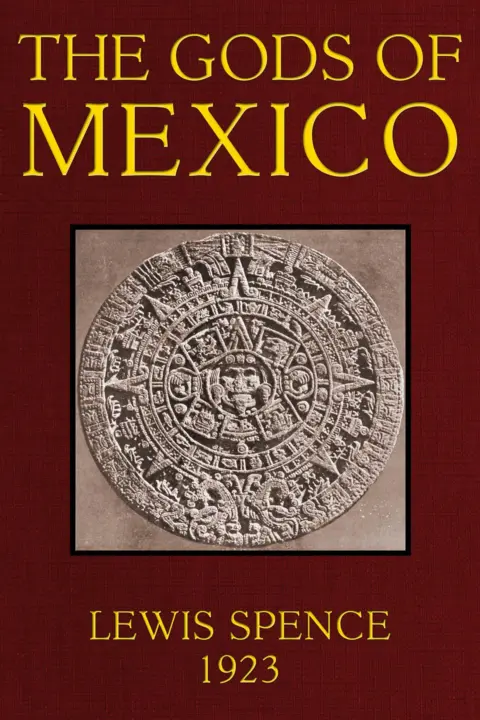
The gods of Mexico
Lewis Spence
THE CLASSIC COLLECTION · 1921
"An Introduction to Mythology" by Lewis Spence is a scholarly examination of mythological principles, likely written in the early 20th century. This comprehensive work explores the evolution, classification, and significance of myths within the context of primitive religion and culture, presenting an overview of the scientific approaches to mythology. Spence aims to illuminate the historical progression of mythic study and its modern applications by synthesizing various theories and presenting definitions that clarify key concepts. The opening of the text introduces the reader to the foundational aspects of mythology, explaining its purpose in understanding the early religious and scientific experiences of humanity. It lays out important definitions distinguishing myths from folklore and legends, suggesting that myths function as explanations for physical and social phenomena. Spence outlines how mythology intersects with folklore, illustrating that myths serve as primitive attempts at rationalizing the universe, while also highlighting significant changes in myth interpretation and classification over time as societies evolve.
Introduction adapted from the source catalogue; source summaries may be automatically generated.
Free to read · English · 115,570 words · No account needed
MAKE TIME FOR A GOOD BOOK
On by default. Untick to stop anonymous reading totals. Each page counts after 10 seconds in view. How this works.
Anonymous counting is on unless you have switched it off.
The piece of earth from which the new world is constructed is fished out of the waters of the deluge by an animal in some North American Indian myths, and perhaps in the original form of the Hebrew myth.
(1) A god finding himself in a primeval abyss, where he has been since the beginning of time, utters his name. This act causes him to 'live.'
(2) He next creates, by a magical act, a foundation upon which to stand, probably the earth.
(3) From his mouth he brings objects which reproduce
themselves.
(4) He creates two other deities, male and female, who in
turn propagate other gods.
(5) Vegetation and creeping things are formed on the earth.
(6) Man is then created from the tears which fall from the
original deity.
(1) Primeval deities dwell in an abyss.
(2) New gods arrive (?) and quarrel with them.
(3) Two of the primeval deities are slain, but the third, a female, creates monsters and gives battle to the new-comers, and is annihilated.
(4) The new gods create the earth and firmament from her
corpse.
(5) Their champion is decapitated, and from his blood and bones springs the race of mankind.
(1) From nothingness an atom is formed.
(2) In the course of ages it splits into a male and female principle which again split in two.
(3) From the co-operation of these four elements springs a being whose body is broken up into the constituents of a universe, and the worms from its decomposing corpse become men.
(1) There exists a yawning abyss, bordered on one side
by a realm of mist and cold, on the other by a region of
fire.
(2) A giant is brought into being through the melting of the congealing vapour in the place of cold by a spark of fire from the region of Muspelheim.
(3) This being becomes the progenitor of a race of giants.
(4) He has a cow which, by licking a brine-covered rock,
produces the father of the gods.
(5) These gods slay the giant and all his progeny save two, and manufacture the earth from his corpse.
(6) Alternatively the gods lift the earth out of the
primeval waters.
(7) The dwarfs fashion two figures out of trees, and the gods give them life and understanding.
(1) Two principles, creative and destructive, are alluded
to.
(2) The latter dwells in an abyss.
(3) Atomic life originates through the spoken words of the
creative principle.
(4) Man passes from the abyss to the earth-circle.
(1) Male and female elements separate from the original
atom.
(2) These form an ovoid body containing germs from which
heaven and earth are formed.
(3) A species of reed-shoot appears between them and is
transformed into a god.
Your reading position is saved on this browser. Take it to another device with a library code. Reading pages adapt to text, rather than matching a printed edition.
BEHIND THE BOOK
This eBook is for the use of anyone anywhere in the United States and most other parts of the world at no cost and with almost no restrictions whatsoever. You may copy it, give it away or re-use it under the terms of the Project Gutenberg License included with this eBook or online at www.gutenberg.org. If you are not located in the United States, you will have to check the laws of the country where you are located before using this eBook. Read the source licence.
The original source file, including credits and licence, is retained by this library. Request an original-format copy at no charge. Please include the book title and Project Gutenberg identifier #45048.
KEEP YOUR CURIOSITY GOING

Maurice Baring
Francis Greenleaf Allinson & Anne C. E. (Anne Crosby Emery) Allinson
Stuart Dodgson Collingwood
Percy Keese Fitzhugh
Mary Macleod & Edmund Spenser

Cooke Don-Carlos