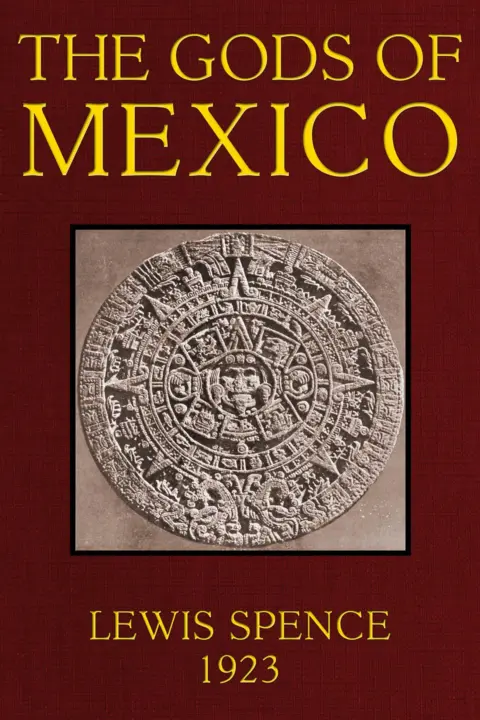
The gods of Mexico
Lewis Spence
THE CLASSIC COLLECTION · 1921
"An Introduction to Mythology" by Lewis Spence is a scholarly examination of mythological principles, likely written in the early 20th century. This comprehensive work explores the evolution, classification, and significance of myths within the context of primitive religion and culture, presenting an overview of the scientific approaches to mythology. Spence aims to illuminate the historical progression of mythic study and its modern applications by synthesizing various theories and presenting definitions that clarify key concepts. The opening of the text introduces the reader to the foundational aspects of mythology, explaining its purpose in understanding the early religious and scientific experiences of humanity. It lays out important definitions distinguishing myths from folklore and legends, suggesting that myths function as explanations for physical and social phenomena. Spence outlines how mythology intersects with folklore, illustrating that myths serve as primitive attempts at rationalizing the universe, while also highlighting significant changes in myth interpretation and classification over time as societies evolve.
Introduction adapted from the source catalogue; source summaries may be automatically generated.
Free to read · English · 115,570 words · No account needed
MAKE TIME FOR A GOOD BOOK
On by default. Untick to stop anonymous reading totals. Each page counts after 10 seconds in view. How this works.
Anonymous counting is on unless you have switched it off.
Although not in any way denying the circulation of myth and its dissemination, we do not think that the theory of complete and wholesale borrowing from advanced races by savage peoples is confirmed by actual research. There are, it is admitted, well-authenticated examples of the colouring of savage myth by civilized cosmogonies; but these examples are easily distinguished by the practised student of myth, as they lack the fundamentals of barbarian myth--simplicity, 'savagery,' in short, that aboriginal artlessness and primitiveness which mark all early and unsophisticated religious thought. Unlike primitive myths, they possess the idea of the creation of something from nothing (that is, they do not describe re-creation instead of creation). Of creation myths exhibiting cultured influence there are very few, and when one creation tale resembles another a great deal of proof should be forthcoming before it is inferred that one has sophisticated the other or that both proceed from a common story.[8]
How absurd it is to credit all or most barbarian theology with an alien origin is seen from the Popol Vuh, already quoted, an aboriginal composition of the Kiche Indians of Guatemala. This work was written by a Christianized native of Guatemala some time in the seventeenth century, and was copied (in the Kiche language, in which it was originally written) by a Dominican friar, Francisco Ximenez, who added a Spanish translation and scholia. The Abbé Brasseur de Bourbourg, a profound student of American archæology and languages,[9] deplored, in a letter to the Duc de Valmy,[10] the supposed loss of the Popol Vuh which he was aware had been made use of early in the nineteenth century by a certain Don Felix Cabrera. Dr C. Scherzer, an Austrian scholar, thus made aware of its value, paid a visit to the republic of Guatemala in 1854 or 1855, and was successful in tracing the missing manuscript in the library of the University of San Carlos in the city of Guatemala. It was afterward ascertained that its scholiast, Ximenez, had deposited it in the library of his convent at Chichicastenango, whence it passed to the San Carlos library in 1830. Scherzer made a copy of the Spanish translation of the manuscript, which he published at Vienna in 1856 under the title of Las Historias del origen de los Indios de Guatemala, par el R. P. F. Francisco Ximenez. The Abbé Brasseur also took a copy of the original, which he published at Paris in 1861, with the title Vuh Popol: Le livre sacré des Quiches, et les mythes de l'antiquité americaine. In this work the Kiche original and the Abbé's French translation are set forth side by side. Unfortunately both the Spanish and the French translations leave much to be desired in accuracy, and the notes which accompany them are misleading. The name 'Popol Vuh' signifies 'Record of the Community,' and its literal translation is 'Book of the Mat,' from the Kiche words pop or popol, a mat or rug of woven leaves on which the entire family sat, and vuh or uuh, paper or book, from uoch, to write. The Popol Vuh is an example of a world-wide genre--a type of annals of which the first portion is pure mythology, shading off into pure history, evolving from the hero-myths of saga to the recital of the deeds of authentic personages. It may, in fact, be classed with the Heimskringla of Snorri, the Danish History of Saxo Grammaticus, the Chinese History in the Five Books, the Japanese Nihongi, and its fourth book somewhat resembles the Pictish Chronicle. The cosmogony of the Popol Vuh exhibits no signs of Christian influence, and even if it did, it would be quite erroneous to infer that such influence was direct--that is, that the original compiler deliberately infused into the narrative what he knew of Hebrew cosmogony. The resemblance between the first few chapters of the Popol Vuh and the creation myth in Genesis is slight and fortuitous. There are no precise points of contact, and the supposed resemblance has been drawn by writers only superficially acquainted with Kiche myth and wholly ignorant of its spirit and the processes which developed it. It is by no means difficult to prove the genuine American character of the Popol Vuh. A perusal should suffice. Macpherson, in his preface to the first edition of the poems of Ossian, says an "ingenious gentleman" before reading those poems imagined that out of modesty he had ascribed them to an ancient writer, but after reading them said they abounded too much in ideas only belonging to an early state of society to be the work of a modern poet. We need not trouble about the authorship of the poems of Ossian; but the ingenious gentleman could have said the same thing with justice of the Popol Vuh. To anyone who has given it a careful examination it must be abundantly evident that it has passed through several stages of development; that it is of aboriginal origin; and that it has not been influenced by European thought in any manner whatsoever. The fact that it was composed in the Kiche tongue is almost sufficient proof of its genuine American character. The scholarship of the nineteenth century was unequal to the adequate translation of the Popol Vuh; the twentieth century has as yet shown no signs of being able to accomplish the task; and if modern scholarship is unable to translate the work, the eighteenth century was unable to create it. No European of that time was sufficiently versed in Kiche theology and history to compose in faultless Kiche such a work as the Popol Vuh, breathing as it does in every line an intimate and natural acquaintance with the antiquities of Guatemala.
Your reading position is saved on this browser. Take it to another device with a library code. Reading pages adapt to text, rather than matching a printed edition.
BEHIND THE BOOK
This eBook is for the use of anyone anywhere in the United States and most other parts of the world at no cost and with almost no restrictions whatsoever. You may copy it, give it away or re-use it under the terms of the Project Gutenberg License included with this eBook or online at www.gutenberg.org. If you are not located in the United States, you will have to check the laws of the country where you are located before using this eBook. Read the source licence.
The original source file, including credits and licence, is retained by this library. Request an original-format copy at no charge. Please include the book title and Project Gutenberg identifier #45048.
KEEP YOUR CURIOSITY GOING

Maurice Baring
Francis Greenleaf Allinson & Anne C. E. (Anne Crosby Emery) Allinson
Stuart Dodgson Collingwood
Percy Keese Fitzhugh
Mary Macleod & Edmund Spenser

Cooke Don-Carlos