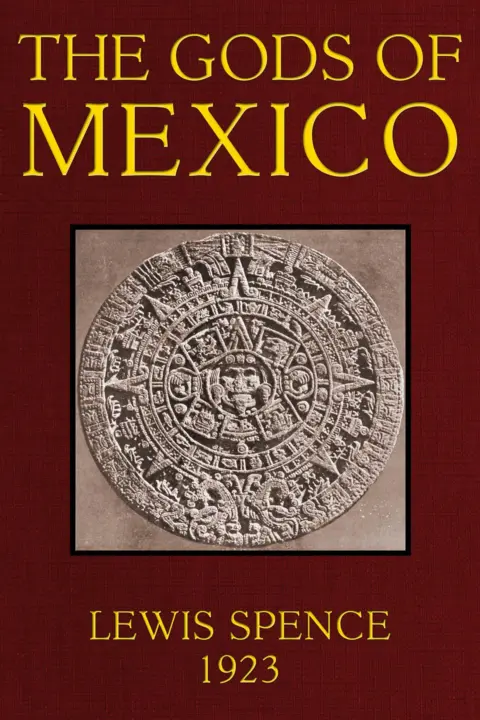
The gods of Mexico
Lewis Spence
THE CLASSIC COLLECTION · 1921
"An Introduction to Mythology" by Lewis Spence is a scholarly examination of mythological principles, likely written in the early 20th century. This comprehensive work explores the evolution, classification, and significance of myths within the context of primitive religion and culture, presenting an overview of the scientific approaches to mythology. Spence aims to illuminate the historical progression of mythic study and its modern applications by synthesizing various theories and presenting definitions that clarify key concepts. The opening of the text introduces the reader to the foundational aspects of mythology, explaining its purpose in understanding the early religious and scientific experiences of humanity. It lays out important definitions distinguishing myths from folklore and legends, suggesting that myths function as explanations for physical and social phenomena. Spence outlines how mythology intersects with folklore, illustrating that myths serve as primitive attempts at rationalizing the universe, while also highlighting significant changes in myth interpretation and classification over time as societies evolve.
Introduction adapted from the source catalogue; source summaries may be automatically generated.
Free to read · English · 115,570 words · No account needed
MAKE TIME FOR A GOOD BOOK
On by default. Untick to stop anonymous reading totals. Each page counts after 10 seconds in view. How this works.
Anonymous counting is on unless you have switched it off.
Iroquois Indians. Enigorio and Enigohatgea (Good Mind
and Bad Mind).
Thlinkeet Indians. Yetl and Khanukh.
Tupi-Guarani (Brazil). Aricoute (darkness) and Tamandare
(light).
Australians. Pund-jel, the eagle-hawk (good) and the
Crow (bad).
Pentecost Islanders. Tagar (good) and Suque (bad).
Banks Islanders. Qat and Tangaro Lologong (the Fool).
DISMEMBERMENT MYTHS. In which a god or demigod is torn
to pieces and the parts widely scattered and afterward
collected.
Egyptians. Osiris and Isis.
Greeks.
Orpheus and Eurydice.
Dionysus and Demeter.
Medea and Pelias.
Finns (Kalevala epic). Lemminkainen and his mother.
Rumanians. Frounse Werdye and Holy Mother Sunday.
Russians. Morevna and Koshchei.
Bushmen. Moon cut down by sun; piece left grows.
Antis Indians (Brazil). See Spence, Dictionary of
Non-Classical Mythology, p. 43.
Algonquins. The demon Lox.
Caribs. Story of their ancestor.
Dindje. Crow killed by the Navigator.
Pawnee Indians. Pa-hu-ka-tawa.
Zuñi Indians. Woman beloved by the sun becomes the
mother of twins.
Madagascar. Ibonia, joiner together and life-giver.
Polynesians. Tangaroa and Mani.
CREATION MYTHS. In these there is nearly always a vast world of waters, over which broods the creative agency, who by a spoken word, force of thought (will-power), or by sheer physical labour creates the earth, or, more often, raises it from the midst of the watery abyss.
Babylonians. Bel or Merodach forms Heaven and earth from the two halves of the body of Tiawath.
Persians. Ormuzd (Ahura Mazda), father and creator.
Greeks. Uranus (Heaven-Father) and Gæa (Earth-Mother)
beget all things.
Teutons (Scandinavia). Ginnungagap, the gulf existent. World made from body of the giant Ymir.
Finns (Kalevala epic). Eagle hatches the land.
Hindus. Brahma, in his avatar as the boar, raised the
earth on his tusks from out the waters and then began his
work of creating.
Japanese. Izanagi and Izanami (creative pair).
Bushmen. Cagn (the praying mantis) created the world.
Zulus. Unkulunkulu (the great ancestor-creator).
Ahts Indians (Vancouver Island). Quawteaht was the
'framer of all things.'
Algonquin Indians. Michabo or Manibozho, the Great Hare,
creates all things.
Arawaks (Guiana). Aluberi (from Alin 'He who makes').
Athapascan Indians. Yetl, the omnipotent raven, descended to the ocean from Heaven, and the earth rose.
Incas (Peru). Ataguju is creator of all things.
Iroquois Indians. Divine woman falls on turtle (earth).
Mexicans. Tonacatecutli breathes and divides the waters
of the heavens and earth.
Navaho Indians. Ahsonnatli 'the Turquoise Hermaphrodite'
creates Heaven and earth.
Oregon Indians. Coyote is creator.
Peruvians. Mama-cocha (the whale), 'Mother Sea,' was the
mother of mankind.
Pawnees. Ti-ra-wa or A-ti-us (Atius Tirawa) is creator.
Papagos Indians (Gulf of California). Coyote or
prairie-wolf acts as creator.
Your reading position is saved on this browser. Take it to another device with a library code. Reading pages adapt to text, rather than matching a printed edition.
BEHIND THE BOOK
This eBook is for the use of anyone anywhere in the United States and most other parts of the world at no cost and with almost no restrictions whatsoever. You may copy it, give it away or re-use it under the terms of the Project Gutenberg License included with this eBook or online at www.gutenberg.org. If you are not located in the United States, you will have to check the laws of the country where you are located before using this eBook. Read the source licence.
The original source file, including credits and licence, is retained by this library. Request an original-format copy at no charge. Please include the book title and Project Gutenberg identifier #45048.
KEEP YOUR CURIOSITY GOING

Maurice Baring
Francis Greenleaf Allinson & Anne C. E. (Anne Crosby Emery) Allinson
Stuart Dodgson Collingwood
Percy Keese Fitzhugh
Mary Macleod & Edmund Spenser

Cooke Don-Carlos