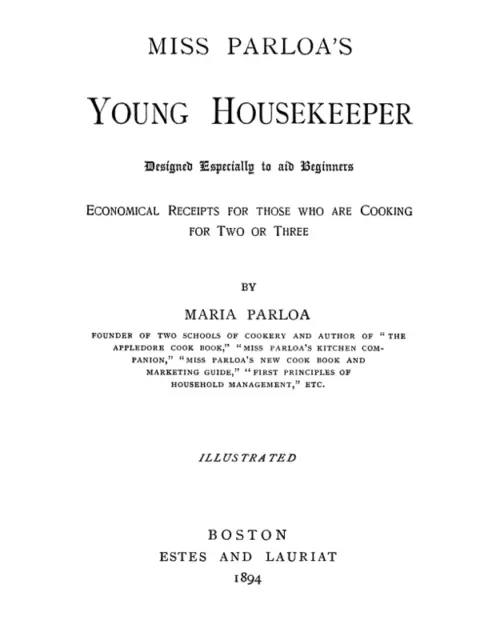
Miss Parloa’s Young Housekeeper Designed Especially to Aid Beginners; Economical Receipts for Those Who Are Cooking for Two or Three
Maria Parloa
THE CLASSIC COLLECTION · 1887
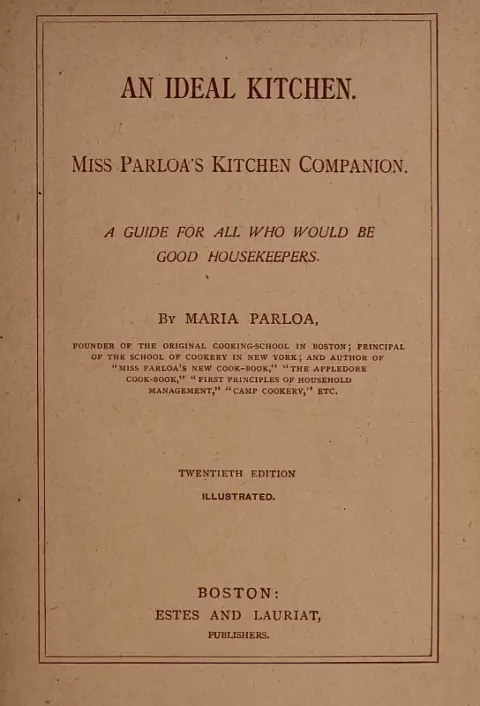
"An Ideal Kitchen: Miss Parloa's Kitchen Companion" by Maria Parloa is a guidebook for aspiring housekeepers written in the late 19th century. The book emphasizes the importance of kitchen design and functionality, providing practical insights into creating an efficient and pleasant cooking environment. As one of the prominent works from an author known for her contributions to cooking and household management, it serves as a valuable resource for anyone interested in domestic organization. In this comprehensive guide, Parloa meticulously details the ideal layout and equipment of a kitchen, pantry, and storage rooms, advocating for considerations that often go overlooked in home design. She discusses essential features like ventilation, lighting, and durable materials, while suggesting specific dimensions for rooms and furniture arrangements to optimize workflow. Parloa also includes practical advice on maintaining cleanliness, organizing utensils, and storing food efficiently. With its practical focus and clear recommendations, the book seeks to empower readers to transform their kitchens into model spaces for cooking and gathering, reflecting her belief that an ideal kitchen is crucial for effective household management.
Introduction adapted from the source catalogue; source summaries may be automatically generated.
Free to read · English · 5,163 words · No account needed
MAKE TIME FOR A GOOD BOOK
On by default. Untick to stop anonymous reading totals. Each page counts after 10 seconds in view. How this works.
Anonymous counting is on unless you have switched it off.
In the list of supplies which follows these remarks are mentioned many things not actually essential, but which are very useful in giving variety to the fare. It may surprise some readers that dried or smoked fish, ham, bacon, salt pork, brown soap, and some other articles are not included in the list. The reason is, that they have moisture or a strong odor, two things to be avoided in a storeroom where delicate groceries are kept. A cold room where there is a free circulation of air is a better place for them.
Experience has proved that tin boxes are the best receptacles for all kinds of food that would attract mice or weevils. Tin boxes are, to be sure, much more expensive than wooden buckets; but as they are lasting and perfectly secure, it is, in the end, economical to buy them. Each box should be labelled; and if they be made to order, it will be well to have the labels painted on them at the time. Such boxes as cracker-manufacturers use will answer for this purpose, and a housekeeper may obtain them through her grocer if no more convenient way presents itself. When made to order, tin boxes are expensive.
First Shelf.—Graham, corn meal, both white and yellow, oatmeal, rye meal, hominy, buckwheat, rice, soda, cream-of-tartar, tapioca, powdered and block sugar, dried peas, beans, barley, picked raisins, currants that have been cleaned, eggs, cheese, gelatine, tea, coffee, chocolate, starch, bluing, candles; all the articles, except the last three and the gelatine, to be kept in tin boxes.
Second Shelf.—Olive oil, vanilla, lemon, orange, and almond extracts, Santa Cruz rum, eau-de-vie de Dantzic, maraschino, brandy, white wine, tarragon vinegar, olives, capers, liquid rennet; table salt, macaroni, spaghetti, vermicelli, crackers, lime-water, stove-polish, Sapolio, Castile soap, toilet soap, chloride of lime.
Preserved ginger, pickles, anchovy paste, chutney sauce, extract of meat in small jars, arrowroot, cornstarch, potted ham, tongue, and chicken, French paste for coloring soups and sauces, devilled ham, anchovies in oil and in salt, Russian caviare, sardines, orange marmalade, jellies, canned and preserved fruits, almonds, citron, candied lemon and orange peel, tomato, walnut, and mushroom ketchup, essence of anchovy, curry-powder, white and red pepper, essence of shrimp, Worcestershire or Leicestershire sauce, and these whole spices,-nutmegs, cloves, cinnamon, mace, allspice, pepper-corns, and ginger; these ground spices,—mace, cinnamon, clove, allspice, ginger; these whole herbs,—sage, savory, thyme, parsley, sweet-marjoram, summer savory, tarragon; these ground herbs,—sage, summer savory, thyme, parsley, sweet-marjoram.
Your reading position is saved on this browser. Take it to another device with a library code. Reading pages adapt to text, rather than matching a printed edition.
Maria Parloa
Maria Parloa & Helen Campbell & Juliet Corson & Marion Harland & Mary J. (Mary Johnson) Lincoln & Catherine Owen & Hester M. (Hester Martha) Poole
Maria Parloa
Maria Parloa
BEHIND THE BOOK
This eBook is for the use of anyone anywhere in the United States and most other parts of the world at no cost and with almost no restrictions whatsoever. You may copy it, give it away or re-use it under the terms of the Project Gutenberg License included with this eBook or online at www.gutenberg.org. If you are not located in the United States, you will have to check the laws of the country where you are located before using this eBook. Read the source licence.
The original source file, including credits and licence, is retained by this library. Request an original-format copy at no charge. Please include the book title and Project Gutenberg identifier #53892.
KEEP YOUR CURIOSITY GOING

Charles G. (Charles Griffith) Ross
Hannah Webster Foster

Emily Lawless
Edwin Hamlin Carr

Charles De Lano Hine
Andrew Ure