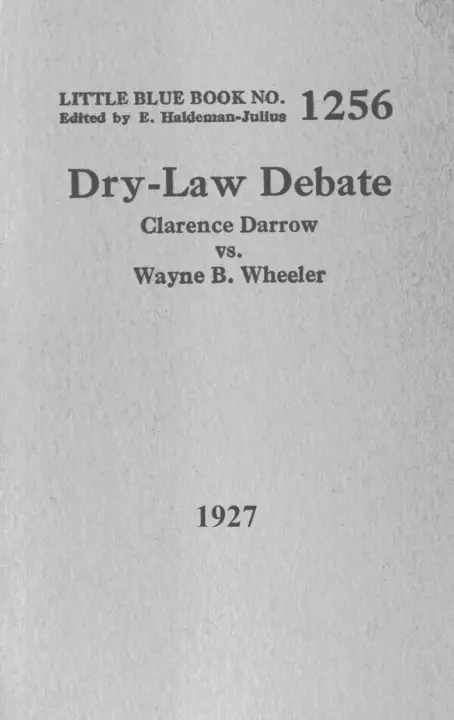
Dry-law debate
Clarence Darrow & Wayne Bidwell Wheeler
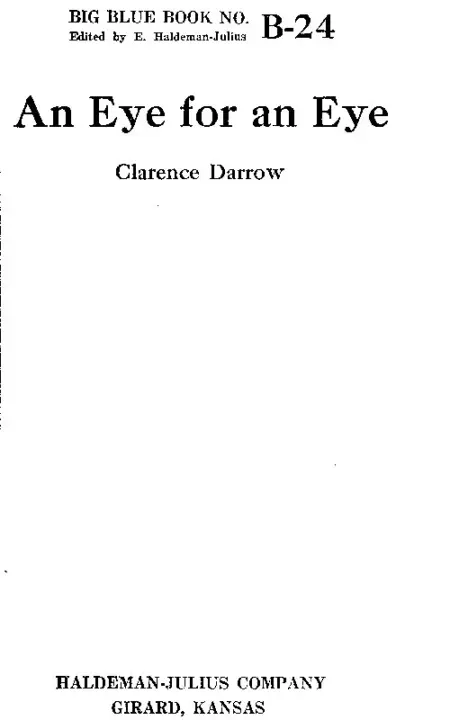
THE CLASSIC COLLECTION · 1905
"An Eye for an Eye" by Clarence Darrow is a novel written in the early 20th century. The story centers around Hank Clery, a switchman in Chicago who visits his old friend, Jim Jackson, in jail as he faces execution for the murder of his wife. Through Hank’s perspective, the narrative explores themes of social justice, poverty, and the circumstances that lead individuals to crime. At the start of the novel, Hank is on his way to the county jail, filled with nervousness and apprehension about visiting Jim, who is set to be hanged for the murder of his wife. Despite his previous association with Jim as a loyal friend, Hank grapples with the reality of Jim's crime, reflecting on their shared past. Once at the jail, Hank encounters a cruel and indifferent system, observing families waiting in despair to see their loved ones, all while he prepares to support Jim in his final moments. The opening effectively sets the stage for a deeper exploration of guilt, morality, and the socio-economic forces that shape human behavior.
Introduction adapted from the source catalogue; source summaries may be automatically generated.
Free to read · English · 59,344 words · No account needed
MAKE TIME FOR A GOOD BOOK
On by default. Untick to stop anonymous reading totals. Each page counts after 10 seconds in view. How this works.
Anonymous counting is on unless you have switched it off.
=B–41= Love’s Coming of Age: A Series of Papers on the Relations of the Sexes. Edward Carpenter. (Chapters include “Sex-Passion,” “Man the Ungrown,” “Woman the Serf,” “Intermediate Sex,” “Note on Preventive Checks to Population,” etc.)
=B–32= The History of a Woman’s Heart (Une Vie). Guy de
Maupassant. (Complete novel by the famous French master of
fiction.)
=B–3= The Love Sorrows of Young Werther. Goethe. (Famous love
story).
=B–6= Zadig, or Destiny; Micromegas and The Princess of Babylon. Voltaire. (Famous satirical fiction.)
=B–30= Candide: A Satire on the Notion That This Is the Best of All Possible Worlds. Voltaire.
=B–12= Grimm’s Famous Fairy Tales.
=B–24= An Eye for an Eye. Clarence Darrow. (Complete Novel.)
=B–33= A Sentimental Journey Through France and Italy. Laurence Sterne. (Intimate notes on travel experiences—one of the most famous books in English literature.)
=B–31= The Sign of the Four (Sherlock Holmes Story). Conan Doyle.
=B–35= A Study in Scarlet (Sherlock Holmes Story). Conan Doyle.
=B–2= The Maid of Orleans: A Romantic Tragedy. Friedrich von Schiller. Adapted from the German by George Sylvester Viereck.
=B–9= Faust (Part I). Goethe. Translated by Anna Swanwick. Edited, with Introduction and Notes, by Margaret Munsterberg.
=B–10= Faust (Part II). Goethe. Translated by Anna Swanwick, etc.
=B–17= William Congreve’s Way of the World (A Comedy). With an essay by Macaulay, extracts from Lamb, Swift and Hazlitt, etc. Edited, with Introduction and Notes, by Lloyd E. Smith.
=B–26= Nathan the Wise (Famous Liberal Play). Gotthold Ephraim Lessing. Translated and Edited by Leo Markun.
=B–19= Persons and Personalities. Paragraphs and Essays. E.
Haldeman-Julius.
=B–8= The Fun I Get Out of Life. E. Haldeman-Julius.
=B–13= John Brown: The Facts of His Life and Martyrdom. E.
Haldeman-Julius.
=B–45= Confessions of a Young Man. George Moore.
=B–28= The Truth About Aimee Semple Mcherson. A Symposium. Louis
Adamic, and Others.
=B–4= The Wisdom of Life. Being the first of Arthur Schopenhauer’s Aphorismen zur Lebensweisheit. Translated with a Preface by T. Bailey Saunders.
=B–5= Counsels and Maxims. Being the second part of Arthur Schopenhauer’s Aphorismen zur Lebensweisheit. Translated by T. Bailey Saunders.
=B–1= On Liberty. John Stuart Mill. (Chapters include “Liberty of Thought and Discussion,” “Individuality,” “Limits to Authority of Society Over the Individual,” etc.)
=B–14= Evolution and Christianity. William M. Goldsmith.
=B–18= Resist Not Evil. Clarence Darrow. (Chapters include “Nature of the State,” “Armies and Navies,” “Crime and Punishment,” “Cause of Crime,” “Law and Conduct,” “Penal Codes and Their Victims,” etc.)
=B–29= Clarence Darrow’s Two Great Trials (Reports of the Scopes Anti-Evolution Case and the Dr. Sweet Negro Trial). Marcet Haldeman-Julius.
Your reading position is saved on this browser. Take it to another device with a library code. Reading pages adapt to text, rather than matching a printed edition.
Clarence Darrow & Wayne Bidwell Wheeler
Clarence Darrow
Clarence Darrow
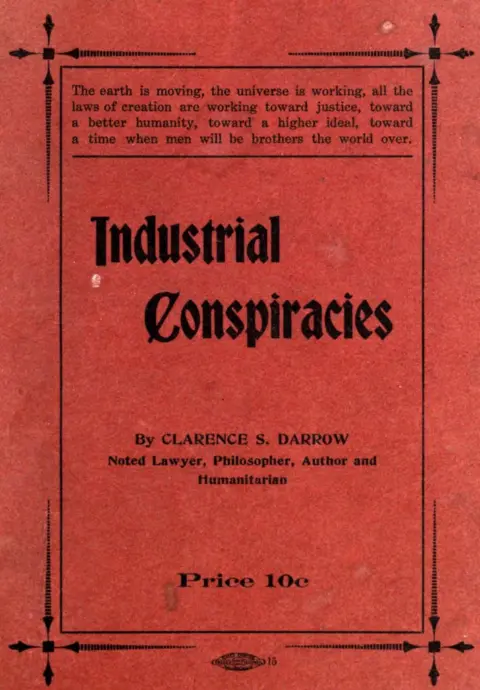
Clarence Darrow
BEHIND THE BOOK
This eBook is for the use of anyone anywhere in the United States and most other parts of the world at no cost and with almost no restrictions whatsoever. You may copy it, give it away or re-use it under the terms of the Project Gutenberg License included with this eBook or online at www.gutenberg.org. If you are not located in the United States, you will have to check the laws of the country where you are located before using this eBook. Read the source licence.
The original source file, including credits and licence, is retained by this library. Request an original-format copy at no charge. Please include the book title and Project Gutenberg identifier #54074.
KEEP YOUR CURIOSITY GOING
Coulson Kernahan

Maurice Baring
Frances Wright
Cécile Tormay

Frederic Jesup Stimson

W. H. P. (William Henry Pope) Jarvis