
Last letters from the living dead man
David Patterson (Spirit) Hatch
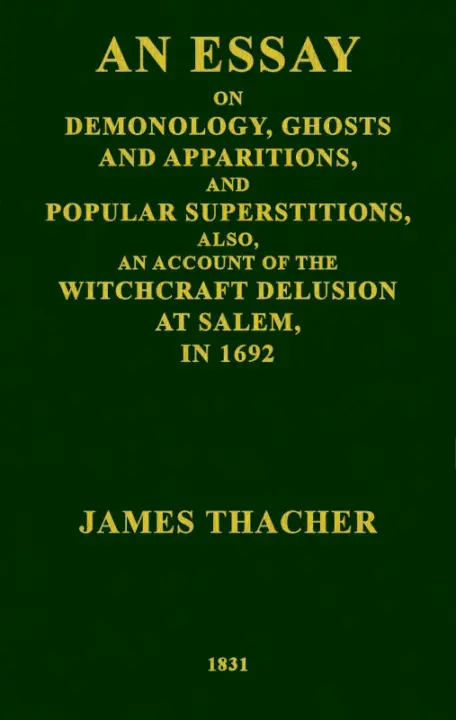
THE CLASSIC COLLECTION · 1831
"An Essay on Demonology, Ghosts and Apparitions, and Popular Superstitions" by James Thacher is a historical treatise written in the early 19th century. This work explores the beliefs surrounding demons, ghosts, witchcraft, and superstitions that have plagued humanity through various ages. Thacher aims to dissect the psychological and societal implications of these phenomena while examining their roots in human imagination and superstition. The opening of the essay outlines the nature of the human mind and its susceptibility to superstition, emphasizing how erroneous beliefs can lead to dire consequences, including violence and persecution. Thacher introduces the concept that apparitions and supernatural experiences can often be explained through natural causes, like the functioning of the nervous system and the power of imagination. He presents various anecdotes and insights to illustrate how perceptions can be distorted by emotional and psychological states, setting the stage for a thorough analysis of the interplay between belief, fear, and rational thought regarding supernatural occurrences.
Introduction adapted from the source catalogue; source summaries may be automatically generated.
Free to read · English · 46,587 words · No account needed
MAKE TIME FOR A GOOD BOOK
On by default. Untick to stop anonymous reading totals. Each page counts after 10 seconds in view. How this works.
Anonymous counting is on unless you have switched it off.
Dr Van Cleve, of Princeton, was lately applied to as a physician on behalf of a man who had reduced himself by intemperance, to a state of very distressing nervous irregularity. He was continually disturbed by visions, sometimes of the most fantastic kind. He often heard strange voices, and would ask and answer questions, as if engaged in conversation with some of his visionary personages. His disorder, the doctor said, was evidently not of that species which is usually denominated mania, but appeared to be wholly the effect of a habit of nervous irregularity, delirium tremens, induced by previous intemperance. But the Baron Von Swedenborg, in his most visionary moments, was never surrounded by more extraordinary assemblages of strange sights. A very striking example of the power of nervous impression, occurred a few years ago in the Rev. James Wilson, formerly assistant minister with Dr Rodgers, in the first Presbyterian Church in New York. He was a native of Scotland, and was a man highly esteemed for his good sense, and the soundness of his judgment; although not distinguished for a warm and popular eloquence. Being obliged for a time to relinquish the exercise of his ministry from a hemorrhage in his breast, he employed himself for several years in different occupations in Scotland and America, but chiefly in presiding over an Academy in Alexandria, in the State of Virginia. The expectoration of blood having ceased for a considerable time, his conscience began to reproach him for indolence and self-indulgence, in not renewing his ministerial functions. In this uneasy state of mind, a vision, as he thought, of a man of very dignified aspect, stood at the foot of his bed in the morning, after he was perfectly awake, and surveying him steadily for some moments, commanded him to resume his duties in the pulpit: but added, that as considerable error had crept into the church, he should undertake to reform it according to the model of the primitive age. Mr Wilson, conscious of his want of eloquent talents, and reforming zeal, reasoned with the supposed apparition, alleging his utter incompetency to the task imposed upon him. The dialogue ended in a repetition of the command, and assurance of ability and success. The good man, wholly unable to explain this clear and palpable vision, on any principles of nature or philosophy with which he was acquainted, was deeply distressed, yet perfectly sensible of his insufficiency for such an undertaking, he neglected attempting to fulfil it. After an interval of two or three years, the vision was repeated, with nearly the same circumstances, except that the aspect of the person who appeared to present himself, was more severe, and expressive of displeasure at his past delinquency. Mr Wilson repeated his former reasonings on his want of health, and want of talents, with other topics. But the answer was still the same; a repetition of the injunction, and assurance of the necessary ability, and ultimate success. His distress was raised to the highest degree in the conflict of his mind between what he thought a sensible demonstration of a supernatural requisition, and an invincible consciousness of his own incompetency, and his fear of doing an injury to true religion by his failure. After consulting several of his friends upon the subject, he at length addressed a letter to the author, stating all the circumstances which have just been detailed. He was answered with the general reasonings contained in this lecture, to convince him that his vision was merely a consequence of nervous affection, resulting from bodily disorder. Three letters passed between Mr Wilson and the author, reasoned on the part of Mr Wilson with great calmness and good sense, admitting all the objections to such an apostolic undertaking as that to which he was urged, both from scripture and from his own peculiar deficiency of power and talents, but pleading the impulse of a sensation as clear and strong, and, to his mind, as real as he had ever felt. But it was replied that there were other considerations combined with the whole system and harmony of nature, which ought to have greater authority with a rational mind than any single and individual impression of sense, which evidently violates its general order. The correspondence came to this issue at last, that, as he agreed with the church as she now exists, in most of her doctrines, and especially in the moral precepts of religion, he should begin his course by inculcating only those principles in which all were agreed, and if he found the promise of his vision verified in his returning strength and successful eloquence, he would then have sufficient encouragement to proceed further. He actually came to New York with the intention to put this experiment into execution, but died in that city shortly after his landing. He published one discourse introductory to the design.
Your reading position is saved on this browser. Take it to another device with a library code. Reading pages adapt to text, rather than matching a printed edition.
BEHIND THE BOOK
This eBook is for the use of anyone anywhere in the United States and most other parts of the world at no cost and with almost no restrictions whatsoever. You may copy it, give it away or re-use it under the terms of the Project Gutenberg License included with this eBook or online at www.gutenberg.org. If you are not located in the United States, you will have to check the laws of the country where you are located before using this eBook. Read the source licence.
The original source file, including credits and licence, is retained by this library. Request an original-format copy at no charge. Please include the book title and Project Gutenberg identifier #49152.
KEEP YOUR CURIOSITY GOING
David Patterson (Spirit) Hatch
Cécile Tormay

Moritz Busch
Coulson Kernahan
John L. Ransom

Ralph Waldo Emerson