
Last letters from the living dead man
David Patterson (Spirit) Hatch
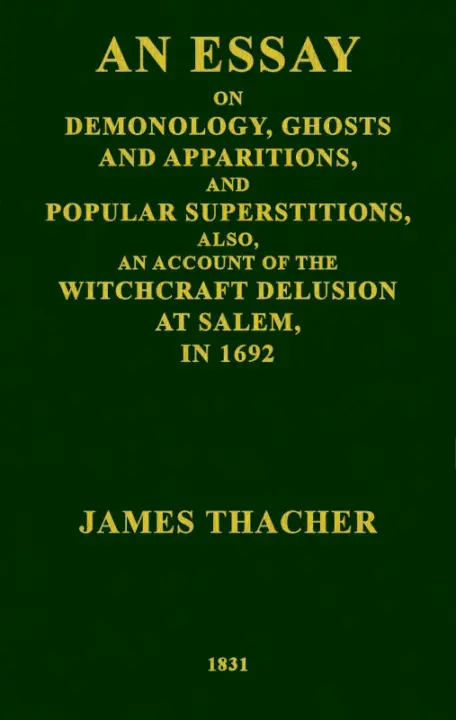
THE CLASSIC COLLECTION · 1831
"An Essay on Demonology, Ghosts and Apparitions, and Popular Superstitions" by James Thacher is a historical treatise written in the early 19th century. This work explores the beliefs surrounding demons, ghosts, witchcraft, and superstitions that have plagued humanity through various ages. Thacher aims to dissect the psychological and societal implications of these phenomena while examining their roots in human imagination and superstition. The opening of the essay outlines the nature of the human mind and its susceptibility to superstition, emphasizing how erroneous beliefs can lead to dire consequences, including violence and persecution. Thacher introduces the concept that apparitions and supernatural experiences can often be explained through natural causes, like the functioning of the nervous system and the power of imagination. He presents various anecdotes and insights to illustrate how perceptions can be distorted by emotional and psychological states, setting the stage for a thorough analysis of the interplay between belief, fear, and rational thought regarding supernatural occurrences.
Introduction adapted from the source catalogue; source summaries may be automatically generated.
Free to read · English · 46,587 words · No account needed
MAKE TIME FOR A GOOD BOOK
On by default. Untick to stop anonymous reading totals. Each page counts after 10 seconds in view. How this works.
Anonymous counting is on unless you have switched it off.
The horrid scourge of witchcraft was, by means of the imprudence, or rather the folly, of an individual, extended to the town of Andover. One Joseph Ballard, of that town, sent to Salem for some of the accusers who pretended to have the spectral sight to tell him who afflicted his wife, who was then sick of a fever. Soon after this, fifty persons at Andover were accused of witchcraft, many of whom were among the most reputable families. Here the nonsensical stories of riding on poles through the air, were circulated. Many parents believed their children to be witches, and many husbands their wives, &c.
The following is the grand jury's bill against Mary Osgood.
'The jurors for our sovereign Lord and Lady the King and Queen present, that Mary Osgood, wife of Captain Joseph Osgood, of Andover, in the county of Essex, about eleven years ago, wickedly, maliciously, and feloniously, a covenant with the devil did make, and signed the devil's book, and took the devil to be her God, and consented to serve and worship him, and was baptized by the devil, and renounced her former christian baptism, and promised to be the devil's, both body and soul, forever, and to serve him; by which diabolical covenant by her made with the devil, she, the said Mary Osgood, is become a detestable witch, against the peace of our sovereign Lord and Lady the King and Queen, their crown and dignity, and the laws in that case made and provided.'
The foregoing bill was grounded principally on her own confession, the purport of which is as follows.--That about eleven years ago, when she was in a melancholy state, upon a certain time while walking in her orchard, she saw the appearance of a cat at the end of her house, which she supposed was a real cat, about this time she made a covenant with the devil, &c. She said further, that about two years agone, she was carried through the air in company with three others, whom she named, to five mile pond, where she was baptized by the devil, and was transported back again through the air in the same manner in which she went, and believes they were carried on a pole. She confesses that she had afflicted three persons, and that she did it by pinching her bed clothes, and giving consent the devil should do it in her shape, and that the devil could not do it without her consent. When in court, she afflicted several persons, as they pretended, and they were as usual restored by her touching their hands. It was not long after, that the said Mary Osgood, with five other women, who had, when in danger, confessed themselves guilty, retraced their confessions, stating that 'they were blind-folded, and their hands were laid on the afflicted persons who fell into fits; others when they felt our hands, said they were well, and that we were guilty of afflicting them, whereupon we were committed to prison. By reason of that sudden surprisal, knowing ourselves perfectly innocent, we were exceedingly astonished and amazed, consternated and afflicted out of our reason. Our nearest and dearest friends and relations, seeing our awful situation, entreated us to make confession, as the only way to save our lives. They, out of tender love and pity, persuaded us to make such confession, telling us we were witches, they knew it, and we knew it, and they knew that we knew it, which made us think it was really so. Our understanding and reasoning faculties almost gone, we were incapable of judging of our condition. Some time after, when we had been better composed, they telling us what we had confessed, we did profess we were innocent, of such things.' The testimonials to these persons' characters, says Governor Hutchinson, by the principal inhabitants of Andover, will outweigh the credulity of the justices who committed, or of the grand jury which found bills against them. Fiftythree reputable inhabitants of Andover, addressed the court, held at Salem, stating that 'they are women of whom we can truly give this character and commendation, that they have not only lived among us so inoffensively as not to give the least occasion to suspect them of witchcraft, but by their sober, godly, and exemplary lives and conversation, have obtained a good report in the place, where they have been well esteemed and approved in the church, of which they are members.'
Your reading position is saved on this browser. Take it to another device with a library code. Reading pages adapt to text, rather than matching a printed edition.
BEHIND THE BOOK
This eBook is for the use of anyone anywhere in the United States and most other parts of the world at no cost and with almost no restrictions whatsoever. You may copy it, give it away or re-use it under the terms of the Project Gutenberg License included with this eBook or online at www.gutenberg.org. If you are not located in the United States, you will have to check the laws of the country where you are located before using this eBook. Read the source licence.
The original source file, including credits and licence, is retained by this library. Request an original-format copy at no charge. Please include the book title and Project Gutenberg identifier #49152.
KEEP YOUR CURIOSITY GOING
David Patterson (Spirit) Hatch
Cécile Tormay

Moritz Busch
Coulson Kernahan
John L. Ransom

Ralph Waldo Emerson