
Last letters from the living dead man
David Patterson (Spirit) Hatch
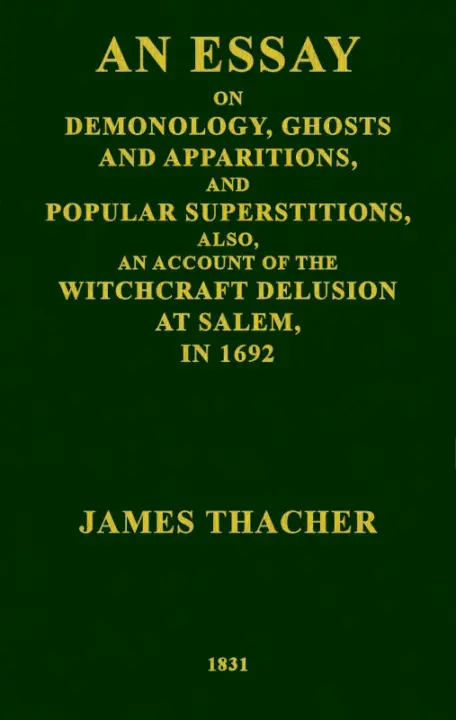
THE CLASSIC COLLECTION · 1831
"An Essay on Demonology, Ghosts and Apparitions, and Popular Superstitions" by James Thacher is a historical treatise written in the early 19th century. This work explores the beliefs surrounding demons, ghosts, witchcraft, and superstitions that have plagued humanity through various ages. Thacher aims to dissect the psychological and societal implications of these phenomena while examining their roots in human imagination and superstition. The opening of the essay outlines the nature of the human mind and its susceptibility to superstition, emphasizing how erroneous beliefs can lead to dire consequences, including violence and persecution. Thacher introduces the concept that apparitions and supernatural experiences can often be explained through natural causes, like the functioning of the nervous system and the power of imagination. He presents various anecdotes and insights to illustrate how perceptions can be distorted by emotional and psychological states, setting the stage for a thorough analysis of the interplay between belief, fear, and rational thought regarding supernatural occurrences.
Introduction adapted from the source catalogue; source summaries may be automatically generated.
Free to read · English · 46,587 words · No account needed
MAKE TIME FOR A GOOD BOOK
On by default. Untick to stop anonymous reading totals. Each page counts after 10 seconds in view. How this works.
Anonymous counting is on unless you have switched it off.
'As to the method which the Salem justices do take in their examinations, it is truly this; a warrant being issued out to apprehend the persons that are charged and complained of by the afflicted children as they are called, said persons are brought before the justices, the afflicted being present. The justices ask the apprehended why they afflict those poor children, to which the apprehended answer, they do not afflict them. The justices order the apprehended to look upon the said children, which, accordingly, they do; and at the time of that look (I dare not say by that look, as the Salem gentlemen do) the afflicted are cast into a fit. The apprehended are then blinded and ordered to touch the afflicted; and at that touch, though not by that touch (as above) the afflicted do ordinarily come out of their fits. The afflicted persons then declare and affirm, that the apprehended have afflicted them; upon which the apprehended persons, though of never so good repute, are forthwith committed to prison on suspicion for witchcraft.'--'Such was the excess of their stupidity, that to the most dubious crime in the world, they joined the most uncertain proofs.'--'A person ought to have been a magician to be able to clear himself from the imputation of magic.'
The first instance of reputed witchcraft in the town of Salem, took place in the family of Mr Parris, minister of Salem, and very soon after, one or two in the neighborhood were afflicted in a similar manner, and a day of prayer was kept on the occasion. The persons who complained of being afflicted, were a daughter and a niece of Mr Parris, girls of ten or eleven years of age; and these were soon followed by two other girls. They made similar complaints, and exhibited antic gestures and tricks, similar to those of Goodwin's children, two or three years before. The physician, unable to account for the complaint, pronounced them bewitched. They named several women whose spectres they saw in their fits, tormenting them, and in particular Tituba, an Indian woman belonging to Mr Parris's family. She had been trying some experiments, which she pretended to be used in her own country, in order to find out the witch; upon this, the children cried out against the poor Indian as appearing to them, pinching, pricking, and tormenting them, and they fell into fits. Tituba acknowledged that she had learned how to find out a witch, but denied that she was one herself. Several private fasts were kept at the minister's house, and several more public by the whole village, and then a general fast through the colony. This probably had a tendency to bring the afflicted into notice; which, with the pity and compassion of those who visited them, encouraged and confirmed them in their designs, and increased their numbers. Tituba, as she said, being beat and threatened by her master to make her confess, and to accuse her sister witches, as he termed them, did confess that the devil urged her to sign a book, which he presented, and also to work mischief with the children, and she was sent to jail. The children complained, likewise, of Sarah Good, who had long been counted a melancholy or distracted woman, and also Sarah Osborn, an old bedridden woman, both of whom being examined by two Salem magistrates, were committed to jail for trial. About three weeks after, two other women of good character, and church members, Corey and Nurse, were complained of and brought to their examination, when these children fell into fits, and the mother of one of them joined with the children and complained of Nurse as tormenting her, and made most terrible shrieks, to the amazement of all the neighborhood. The old women denied everything charged against them, but were sent to prison; and such was the infatuation, that a child of Sarah Good, about four or five years old, was committed also, charged with being a witch and of biting some of the afflicted, who showed the print of small teeth on their arms; and all that the child looked upon, it is said, fell down in fits, complaining that they were in torment. Elizabeth Proctor, being accused and brought to examination, her husband, as every kind husband would have done, accompanied her to her examination; but it cost the poor man his life. Some of the afflicted cried out against him, also, and they both were committed to prison. Instead, says Governor Hutchinson, of suspecting and sifting the witnesses, and suffering them to be cross-examined, the authorities, to say no more, were imprudent in making use of leading questions, and thereby putting words into their mouths, or suffering others to do it. Mr Parris was over-officious; most of the examinations, although in the presence of one or more of the magistrates, were taken by him. They allowed of such as the following trivial replies to their examining questions. John the Indian. 'She hurt me, she choked me, and brought the book a great many times. She took hold of my throat, to stop my breath. She pinched and bit me till the blood came. I saw the witches eat and drink at such a place, and they said it was their sacrament; they said it was our blood, and they had it twice that day.' Upon such kind of evidence, persons of blameless character were committed to prison; and, such was the dreadful infatuation, that the life of no person was secure. The most effectual way to prevent an accusation was to become the accuser; and accordingly the number of the afflicted increased every day, and the number of the accused in proportion; who, in general perished in their innocence. More than a hundred women, many of them of fair characters and of the most reputable families, in the towns of Salem, Beverly, Andover, Billerica, &c, were apprehended, examined, and generally committed to prison. Goodwife[A] Corey, as she was called, was examined before the magistrates, in the meeting-house in the village; the novelty of the case produced a throng of spectators. Mr Noyes, one of the ministers of Salem, began by prayer. Several children and women were present, that pretended to be bewitched by her, and the most of them accused her of biting, pinching, and strangling, and said that they did, in their fits, see her likeness coming to them, and bringing a book for them to sign. She was accused by them, that the black man, meaning the devil, whispered to her now while she was on her examination. The unfortunate woman could only deny all that was laid to her charge, and she was committed to jail. A miserable negro slave was accused by some of the girls, but on examination she extricated herself by her native cunning. Question to Candy. 'Are you a witch?' Answer. 'Candy no witch in her country. Candy's mother no witch. Candy no witch, Barbadoes. This country, mistress give Candy witch.' 'Did your mistress make you a witch in this country?' 'Yes, in this country mistress give Candy witch.' 'What did your mistress do to make you a witch?' 'Mistress bring book, and pen, and ink, make Candy write in it.' From this testimony, Mrs Haskins, the mistress, had no other way to save her life but to make confession.
Your reading position is saved on this browser. Take it to another device with a library code. Reading pages adapt to text, rather than matching a printed edition.
BEHIND THE BOOK
This eBook is for the use of anyone anywhere in the United States and most other parts of the world at no cost and with almost no restrictions whatsoever. You may copy it, give it away or re-use it under the terms of the Project Gutenberg License included with this eBook or online at www.gutenberg.org. If you are not located in the United States, you will have to check the laws of the country where you are located before using this eBook. Read the source licence.
The original source file, including credits and licence, is retained by this library. Request an original-format copy at no charge. Please include the book title and Project Gutenberg identifier #49152.
KEEP YOUR CURIOSITY GOING
David Patterson (Spirit) Hatch
Cécile Tormay

Moritz Busch
Coulson Kernahan
John L. Ransom

Ralph Waldo Emerson