
Last letters from the living dead man
David Patterson (Spirit) Hatch
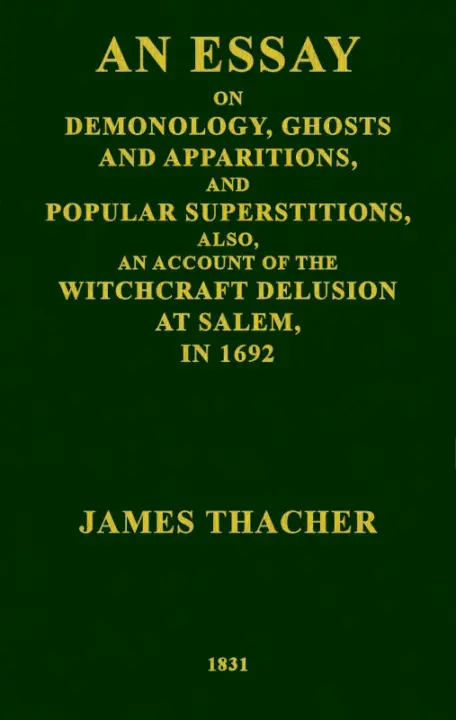
THE CLASSIC COLLECTION · 1831
"An Essay on Demonology, Ghosts and Apparitions, and Popular Superstitions" by James Thacher is a historical treatise written in the early 19th century. This work explores the beliefs surrounding demons, ghosts, witchcraft, and superstitions that have plagued humanity through various ages. Thacher aims to dissect the psychological and societal implications of these phenomena while examining their roots in human imagination and superstition. The opening of the essay outlines the nature of the human mind and its susceptibility to superstition, emphasizing how erroneous beliefs can lead to dire consequences, including violence and persecution. Thacher introduces the concept that apparitions and supernatural experiences can often be explained through natural causes, like the functioning of the nervous system and the power of imagination. He presents various anecdotes and insights to illustrate how perceptions can be distorted by emotional and psychological states, setting the stage for a thorough analysis of the interplay between belief, fear, and rational thought regarding supernatural occurrences.
Introduction adapted from the source catalogue; source summaries may be automatically generated.
Free to read · English · 46,587 words · No account needed
MAKE TIME FOR A GOOD BOOK
On by default. Untick to stop anonymous reading totals. Each page counts after 10 seconds in view. How this works.
Anonymous counting is on unless you have switched it off.
In the year 1427, the famous heroine Joan of Arc, after her glorious military exploit at the siege of Orleans, being taken prisoner by the Earl of Bedford, was cruelly burnt as a witch. In 1488, a violent tempest of thunder and lightning in Spain, having destroyed the corn for some leagues around, the people accused two old women of being the cause. They confessed and were burnt. Other instances, no less preposterous, are recorded about that period. In 1515, five hundred persons were executed at Geneva, in three months, as witches and wizards, and at another place, fortyeight were burnt in five years. Eighteen were condemned in England in 1596; an account of their trials was published, with the names and colors of the spirits. A perusal of that fantastic production must have excited wonder and amazement in any age.
In France, in 1594, the crime of witchcraft had become so common, that the jails were not sufficient to contain the prisoners, nor had they judges enough to try them. In 1595, a woman was hanged in England, for sending an evil spirit into Thomas Darling; and E. Hartley was executed for bewitching seven persons. In the trial, spectral evidence was made use of against him, and the experiment of saying the Lord's prayer, which it was believed a witch is unable to repeat. But that which touched his life, was a deposition that he had made the magic circle for conjuration. In 1612, twelve women were executed at Lancaster. Mary Smith believed herself to be a witch, and died very pious. A learned and eminent clergyman in France, named Grandier, was, in 1634, put to cruel torment on suspicion of an evil spirit, and was adjured to clear himself by shedding tears if innocent. He was tortured till he swooned on the rack, and then inhumanly burnt. From 1634 to 1661, history records accounts of several hundreds executed in England, of both sexes, husband and wife, mother and daughter together, some confessing, others declaring themselves innocent. In Germany, whole counties were depopulated, that no witch might escape. But it was in Scotland that Satan was set at liberty to execute his vengeance. There the floodgates of malice, revenge, and bloodshed, were thrown open, and multitudes were swept away by the dreadful torrent. No less, it is said in history, than 4000 victims were cruelly sacrificed within a short period, for the dubious crime which never has and never can be proved. In 1664, two women were tried before the celebrated Lord Chief Justice Sir Matthew Hale, and were convicted. The evidence against the accused was so trivial, that his Lordship was greatly embarrassed on the occasion, and his scruples were such, that he declined the duty of summing up the evidence. Being willing, however, that the law should have its course, he pronounced sentence, and they were executed. The evidence against them was, partly spells and partly spectral, and one evidence was that a cart run against the cottage of one of the women, by which she was offended, and shortly after the same cart stuck fast in a gate where its wheels touched neither of the posts, and yet was moved easily forward on one of the posts being cut down. A girl, supposed to be bewitched, went into a fit on being touched by one of the accused. But much weight was given to the evidence of Sir Thomas Browne, 'that the fits were natural, but heightened by the power of the devil, cooperating with the malice of witches.' (Sir Walter Scott, page 225.) About this period, seventy persons were condemned in Sweden, and most of them executed. Fifteen children were also executed, thirtysix ran the gauntlet, and twenty were whipped for the same reputed crime. In 1678, six were executed in Scotland for bewitching Sir George Maxwell. The principal evidence in these cases was a deaf and dumb girl, who made signs that there was a picture of wax in one of their houses as an instrument of enchantment, but it was proved afterwards that it was placed there by herself, and she was whipped through the streets of the city and banished. In 1682, three women were hung at Exeter, confessing themselves witches, but died with pious prayers in their mouths. These were the last executed in England for the crime of witchcraft. Some of the accused persons were in their indictments charged with keeping imps, one was said to be like a pole-cat. On one trial several witnesses deposed that the grandmother and aunt of the prisoner were hanged for witches, and that her grandmother had said that she had eight or nine imps, and that she had given two or three to each of her children. In 1697, about twentyeight were accused in Scotland, by a girl eleven years old. Two boys and a girl, and two other persons, saved themselves by confessing, and upon their testimony seven were executed, all denying their guilt.
Your reading position is saved on this browser. Take it to another device with a library code. Reading pages adapt to text, rather than matching a printed edition.
BEHIND THE BOOK
This eBook is for the use of anyone anywhere in the United States and most other parts of the world at no cost and with almost no restrictions whatsoever. You may copy it, give it away or re-use it under the terms of the Project Gutenberg License included with this eBook or online at www.gutenberg.org. If you are not located in the United States, you will have to check the laws of the country where you are located before using this eBook. Read the source licence.
The original source file, including credits and licence, is retained by this library. Request an original-format copy at no charge. Please include the book title and Project Gutenberg identifier #49152.
KEEP YOUR CURIOSITY GOING
David Patterson (Spirit) Hatch
Cécile Tormay

Moritz Busch
Coulson Kernahan
John L. Ransom

Ralph Waldo Emerson