
Last letters from the living dead man
David Patterson (Spirit) Hatch
THE CLASSIC COLLECTION · 1831
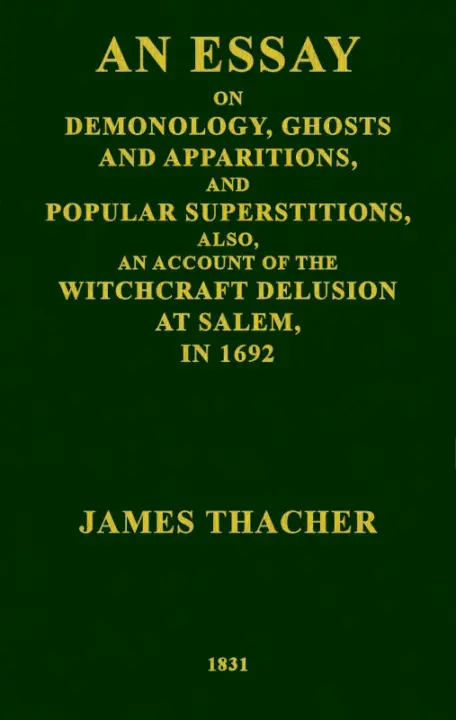
"An Essay on Demonology, Ghosts and Apparitions, and Popular Superstitions" by James Thacher is a historical treatise written in the early 19th century. This work explores the beliefs surrounding demons, ghosts, witchcraft, and superstitions that have plagued humanity through various ages. Thacher aims to dissect the psychological and societal implications of these phenomena while examining their roots in human imagination and superstition. The opening of the essay outlines the nature of the human mind and its susceptibility to superstition, emphasizing how erroneous beliefs can lead to dire consequences, including violence and persecution. Thacher introduces the concept that apparitions and supernatural experiences can often be explained through natural causes, like the functioning of the nervous system and the power of imagination. He presents various anecdotes and insights to illustrate how perceptions can be distorted by emotional and psychological states, setting the stage for a thorough analysis of the interplay between belief, fear, and rational thought regarding supernatural occurrences.
Introduction adapted from the source catalogue; source summaries may be automatically generated.
Free to read · English · 46,587 words · No account needed
MAKE TIME FOR A GOOD BOOK
On by default. Untick to stop anonymous reading totals. Each page counts after 10 seconds in view. How this works.
Anonymous counting is on unless you have switched it off.
AN ESSAY
ON
DEMONOLOGY, GHOSTS AND APPARITIONS,
AND
POPULAR SUPERSTITIONS,
ALSO,
AN ACCOUNT
OF THE
WITCHCRAFT DELUSION AT SALEM,
IN 1682.
By JAMES THACHER, M. D., A. A. S.
'With spells and charms I break the viper's jaw, Cleave solid rocks, oaks from their fissures draw, Whole woods remove, the airy mountains shake, Earth forced to groan, and ghosts from graves awake.' Ovid's Metamor.
There are mysteries even in nature, which we cannot investigate, paradoxes which we can never resolve.
ENTERED, according to Act of Congress, in the year 1831, by CARTER & HENDEE, in the Clerk's Office of the District Court of Massachusetts.
The following pages were in substance composed to be read before the Plymouth Lyceum, in 1829. When it was understood that Rev. CHARLES W. UPHAM was about to favor the public with a work on the same subject, it was determined that this little performance should be suppressed. The Rev. Author observed in a letter, 'that although we may traverse the same field, it is highly probable that we pursue different tracks. The subject is so various, ample and abundant in instruction, that good rather than evil would result from the application of more than one mind to its discussion.' Since therefore, in the deeply interesting work referred to, the learned author has not particularly discussed the subjects of Ghosts, Apparitions, Mental Illusions, &c, there may be no impropriety in submitting the following imperfect production to the public, with the hope that it will not be considered as altogether superfluous.
J. T.
Plymouth, Nov. 1831.
Such is the constitution of the human mind, that it never attains to perfection; it is constantly susceptible of erroneous impressions and perverse propensities. The faculties of the soul are bound in thraldom by superstition, and the intellect, under its influence, is scarcely capable of reflecting on its divine origin, its nobleness and dignity. The mind that is imbued with a superstitious temperament, is liable to incessant torment, and is prepared to inflict the most atrocious evils on mankind; even murder, suicide, and merciless persecution, have proceeded from, and been sanctioned by a superstitious spirit. It is this, in its most appalling aspect, which impels the heathen to a life of mutilation and perpetual pain and torment of body, which degrades the understanding below that of a brute. The superstitions practised by the devotees to the Roman Catholic Church, if less horrible, are equally preposterous and pernicious. The popular belief in supernatural visitations in the form of apparitions and spectres, is fostered and encouraged by the baneful influence of superstition and prejudice. So universal has been the prevalence of the belief that those conversant with history can resort to the era when every village had its ghost or witch, as, in more ancient times, every family had its household gods. Superstition, is a word of very extensive signification, but for the purpose of this work, the word applies to those who believe in witchcraft, magic, and apparitions, or that the divine will is decided by omens or auguries; that the fortune of individuals can be affected by things indifferent, by things deemed lucky or unlucky, or that disease can be cured by words, charms, and incantations. It means, in short, the belief of what is false and contrary to reason. Superstition arises from, and is sustained by ignorance and credulity in the understanding. The subject of supernatural agency and the reality of witchcraft, has been the occasion of unbounded speculation, and of much philosophical disquisition, in almost all nations and ages. While some of the wisest of men have assented to their actual existence and visible appearance, others equally eminent have maintained the opinion that the supposed apparitions are to be accounted for on the principle of feverish dreams and disturbed imaginations. That our Creator has power to employ celestial spirits as instruments and messengers, and to create supernatural visions on the human mind, it would be impious to deny. But we can conceive of no necessity, at the present day, for the employment of disembodied spirits in our world; we can hold no intercourse with them, nor realize the slightest advantage by their agency. To believe in apparitions is to believe that God suspends the law of nature for the most trivial purposes, and that he would communicate the power of doing mischief, and of controling his laws to beings, merely to gratify their own passions, which is inconsistent with the goodness of God. We are sufficiently aware that the sacred spirits of our fathers have ascended to regions prepared for their reception, and there may they remain undisturbed till the mighty secrets now concealed shall be revealed for our good. The soul or spirit of man is immaterial, of course intangible and invisible. If it is not recognisable by our senses, how can the dead appear to the living? That disembodied spirits should communicate with surviving objects on earth, that the ghosts of the murdered should appear to disclose the murderer, or that the spirit of the wise and good should return to proffer instructions to the vile and ignorant, must be deemed unphilosophical.
Your reading position is saved on this browser. Take it to another device with a library code. Reading pages adapt to text, rather than matching a printed edition.
BEHIND THE BOOK
This eBook is for the use of anyone anywhere in the United States and most other parts of the world at no cost and with almost no restrictions whatsoever. You may copy it, give it away or re-use it under the terms of the Project Gutenberg License included with this eBook or online at www.gutenberg.org. If you are not located in the United States, you will have to check the laws of the country where you are located before using this eBook. Read the source licence.
The original source file, including credits and licence, is retained by this library. Request an original-format copy at no charge. Please include the book title and Project Gutenberg identifier #49152.
KEEP YOUR CURIOSITY GOING
David Patterson (Spirit) Hatch
Cécile Tormay

Moritz Busch
Coulson Kernahan
John L. Ransom

Ralph Waldo Emerson