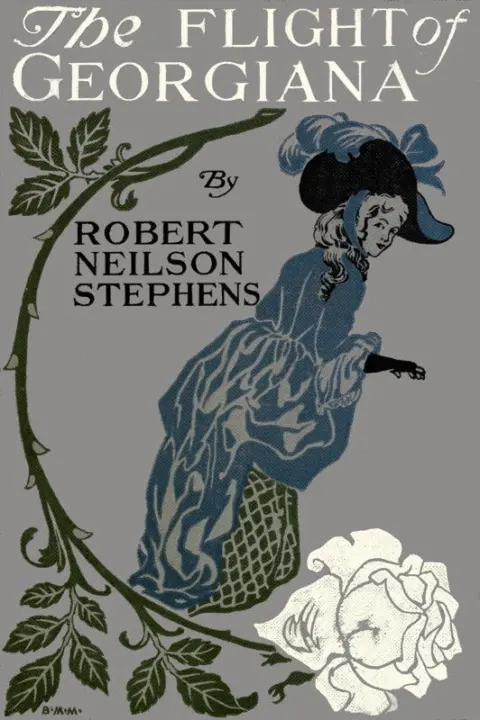
The Flight of Georgiana: A Story of Love and Peril in England in 1746
Robert Neilson Stephens
THE CLASSIC COLLECTION · 1897
"An Enemy to the King" by Robert Neilson Stephens is a historical novel written in the late 19th century. The story follows Ernanton de Launay, Sieur de la Tournoire, a young Huguenot gentleman who embarks on a journey to Paris filled with ambition and dreams of adventure, excitement, and romance amid the political intrigues of the late 16th century. The narrative is deeply rooted in the historical context of civil strife in France, particularly the tumultuous rivalry between Huguenots and Catholics, with significant figures like the Duke of Guise and King Henri III playing prominent roles. At the start of the book, we meet Ernanton as he sets out from his childhood home in Anjou to explore the bustling and vibrant life of Paris. In his quest for exploration, he encounters a mysterious gentleman and has a tense confrontation with Bussy d’Amboise, a renowned swordsman, showcasing his youthful bravado. Throughout these early chapters, Ernanton's motivations are not solely political; he is also driven by the desire for love and adventure. His romantic aspirations lead him to cross paths with various notable characters, including the enigmatic Mlle. d'Arency, who remains central to his growing obsession. As he navigates through challenges, duels, and encounters, readers can sense a brewing conflict that will shape both his destiny and the historical tensions of the era.
Introduction adapted from the source catalogue; source summaries may be automatically generated.
Free to read · English · 104,031 words · No account needed
MAKE TIME FOR A GOOD BOOK
On by default. Untick to stop anonymous reading totals. Each page counts after 10 seconds in view. How this works.
Anonymous counting is on unless you have switched it off.
"Let us argue the matter, monsieur!" said I.
"Peste!" he hissed. "I fight not lackeys!"
"You will fight me," I said, "or leave the presence of this lady at
once!"
Impelled by uncontrollable wrath, he thrust at me furiously. With a timely twist, I sent his sword flying from his hand to the door. I motioned him to follow it.
Completely astonished, he obeyed my gesture, went and picked up his sword, opened the door, and then turned to Blaise and spoke these words, in a voice that trembled with rage:
"Monsieur, since you let your menial handle your sword for you, I cannot hope for satisfaction. But though I am no great prophet, I can predict that both you and your cur shall yet feel the foot of my lackey on your necks. And, mademoiselle," he added, removing his look to the lady, "this is not the end of it with you!"
With which parting threats, he strode out of the inn, closing the door
after him.
Blaise, deprived by his false position of the power of speech, stood with frowning brow and puffed-out cheeks, nervously clutching at his sword-hilt. The lady and her maid looked at him with curiosity, as if a gentleman who would stand idly and speechlessly by, while his servant resented an insult to a lady, was a strange being, to be viewed with wonder.
"Mademoiselle," said I, laying my sword on a table, "heaven is kind to me in having led me where I might have the joy of serving you."
The lady, whose musical voice had the sound of sadness in it, answered with the graciousness warranted by the occasion:
"My good man, your sword lifts you above your degree, even," and here she glanced at Blaise, and continued in a tone of irrepressible contempt, "as the tameness of some gentlemen lowers them beneath theirs."
Blaise, from whose nature tameness was the attribute farthest removed, looked first at the lady, in helpless bewilderment, then at me, with mute reproach for having placed him in his ridiculous position, and lastly at the maid, who regarded him with open derision. To be laughed at by this piquant creature, to whose charms he had been so speedily susceptible, was the crowning misery. His expression of woe was such that I could not easily retain my own serious and respectful countenance.
Having to make some answer to the lady, I said:
"An opportunity to defend so fair a lady would elevate the most ignoble."
The lady, not being accustomed to exchanging compliments with a man-servant, went to her maid and talked with her in whispers, the two both gazing at Blaise with expressions of mirth.
Your reading position is saved on this browser. Take it to another device with a library code. Reading pages adapt to text, rather than matching a printed edition.
Robert Neilson Stephens
Robert Neilson Stephens
Robert Neilson Stephens
Robert Neilson Stephens
BEHIND THE BOOK
This eBook is for the use of anyone anywhere in the United States and most other parts of the world at no cost and with almost no restrictions whatsoever. You may copy it, give it away or re-use it under the terms of the Project Gutenberg License included with this eBook or online at www.gutenberg.org. If you are not located in the United States, you will have to check the laws of the country where you are located before using this eBook. Read the source licence.
The original source file, including credits and licence, is retained by this library. Request an original-format copy at no charge. Please include the book title and Project Gutenberg identifier #9965.
KEEP YOUR CURIOSITY GOING
Cécile Tormay

Moritz Busch
Coulson Kernahan
John L. Ransom

Maurice Baring
Frances Wright