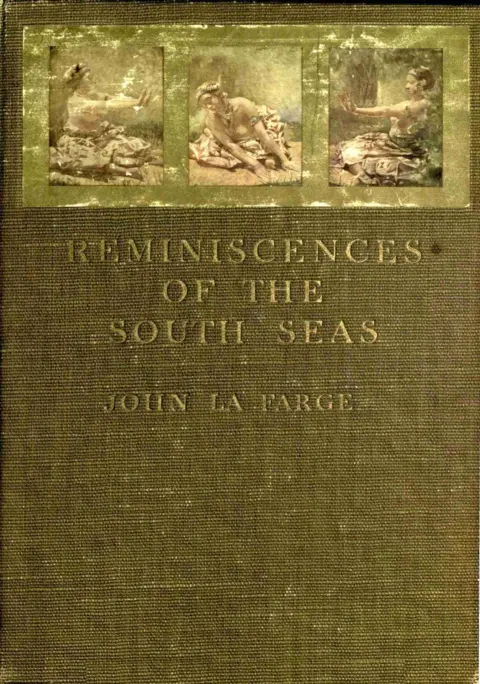
Reminiscences of the South Seas
John La Farge

THE CLASSIC COLLECTION · 1890
"An Artist's Letters from Japan" by John La Farge is a collection of personal letters written in the late 19th century. The book captures the author's impressions and observations of Japan during his travels, delving into various aspects of Japanese culture, art, architecture, and natural beauty. Through his detailed descriptive prose, La Farge provides a vivid account of his experiences, including encounters with local people, exploration of temples, and reflection on the aesthetics of the Japanese landscape. The opening of the work sets a captivating tone, as La Farge recounts his arrival in Yokohama after a long sea journey. He marvels at the beauty of the bay and the lively atmosphere created by Japanese boatmen and the picturesque scenery. His eagerness to explore the unfamiliar environment is evident, as he details the intricate sights and sounds he encounters, from bustling streets to the serene presence of nature. La Farge's letters serve as both a personal narrative and an artistic exploration, aiming to convey the profound cultural richness and sumptuous beauty he finds in Japan. Through carefully crafted imagery and thoughtful reflection, the opening chapters invite readers to join him on a fascinating journey of discovery.
Introduction adapted from the source catalogue; source summaries may be automatically generated.
Free to read · English · 73,278 words · No account needed
MAKE TIME FOR A GOOD BOOK
On by default. Untick to stop anonymous reading totals. Each page counts after 10 seconds in view. How this works.
Anonymous counting is on unless you have switched it off.
We climbed up the side of the big steamer and found the Doctor there, who told us that he had been expecting us for a whole month; so that he soon took possession of us, and we found ourselves in the hotel launch, and at the wharf, and passing the custom house and its officers, who let everything go through quickly except my suspicious water-color blocks. Outside of the gate, in the street, we found the long-expected jinrikisha, an arrangement that you know probably as well as I do--a two-wheeled perambulator or gig, very small, with a hood that is usually lowered, and with a man in the shafts. Our fellows were in blue-black clothes, a big inscription on their backs; and they wore apron-like vests, close-fitting trousers, and broad straw hats poised on their heads. But you know all about these; and I have only to add that we were trundled off to our hotel, along the pretty quay which edges that part of the town, past European houses, unlike ours, and having a certain character which will probably appear very commonplace later, because it is not beautiful, but which is novel yet to us. Our hotel is also on the quay, just at a corner where a canal breaks in, and where we can see big walls and trees on the other side. Our rooms open on the water--that same blue water spangled with sunshine and fading into sky. There men-of-war and steamers far out; picturesque junks sailing past rapidly, flattened out into mere edges of shadow and light against the sea and the sky, their great hollow sterns with the rudder far inboard, and sails which are open at the seams. Not far from us was a little sharp-pointed boat with a man fishing, his big round hat as important as any part of the boat. It was already late in the day. European children were out with their Japanese nurses; from time to time a phaeton or a curricle passed with European occupants, and even in this tremendous heat ladies rode out on horseback. But the human beings are not the novelty, not even the Japanese; what is absorbingly new is the light, its whiteness, its silvery milkiness. We have come into it as through an open door after fourteen gray days of the Pacific which ended only at sunrise this very morning. And we looked again at all the light outside, from the dining-room, where we lunched, where the waiters slipped about in black clothes like those of the runners, and where we were joined at table by a foreign gentleman with high cheek-bones, yellow face, and slanting eyes, and dressed in the latest European fashion with high collar, four-in-hand scarf, and pointed shoes. He was very courteous, and managed what little English he used as skilfully as he dresses. And he gave me a touch of the far East in the story of his being here; for he is under a cloud, an amiable exile whose return to his native land might involve his being boiled in oil, or other ingenious form of death. For well as he figured at luncheon with us, I hear that he has been obliged to leave because of his having poisoned too many of his guests one day at table,--former enemies of his,--and because of his having despatched with the sword those whose digestion had resisted his efforts at conciliation. However this may be, his extradition is demanded; to which he objects, invoking Western ideas of civilization, and protesting that his excesses have been merely political. Then, late in the afternoon, we sauntered out into the Japanese quarter--walking, so that we might mingle with the gray, black, and blue crowd, and respectfully followed by our jinrikisha men, who slowly dragged our carriages behind them, like grooms following their masters. We stopped at little curio shops and bargained over miserable odds and ends, calling up, I feel sure, the unexpressed contempt of the Doctor, the great collector of precious lacquers; but it is so amusing to see things as they are, and not as they should be. We went into a show which had an enormous draped sign outside, and where, in uncertain darkness, an old, miserable, distorted dwarf played the part of a spider in a web, to the accompaniment of fiendish music and the declamation of the showman. Then we lingered outside of a booth in which a wrestling match was going on, but did not enter, and we saw the big wrestlers go in or come out, their shoulders far above the heads of a smaller race of men, and we turned at every moment to look at the children, many of whom are so pretty, and who seem to have an easy time of it. Men carry them in their arms as women do with us, and many a little elder sister walks about with the infant of the family slung behind her maternal shoulders. And then there are curious combinations of Western and Eastern dress--rarely successful. Our hats and shoes and umbrellas--all made here, are used, and our ugly shirts stiffen out the folds of the soft Japanese robes; but the multitude wear their usual dress and make no abuse of hats.
Your reading position is saved on this browser. Take it to another device with a library code. Reading pages adapt to text, rather than matching a printed edition.
John La Farge
BEHIND THE BOOK
This eBook is for the use of anyone anywhere in the United States and most other parts of the world at no cost and with almost no restrictions whatsoever. You may copy it, give it away or re-use it under the terms of the Project Gutenberg License included with this eBook or online at www.gutenberg.org. If you are not located in the United States, you will have to check the laws of the country where you are located before using this eBook. Read the source licence.
The original source file, including credits and licence, is retained by this library. Request an original-format copy at no charge. Please include the book title and Project Gutenberg identifier #43160.
KEEP YOUR CURIOSITY GOING
Wilfrid Scawen Blunt
Wilfrid Scawen Blunt

E. W. (Edgar Watson) Howe

David Patterson (Spirit) Hatch

David Patterson (Spirit) Hatch

David Patterson (Spirit) Hatch