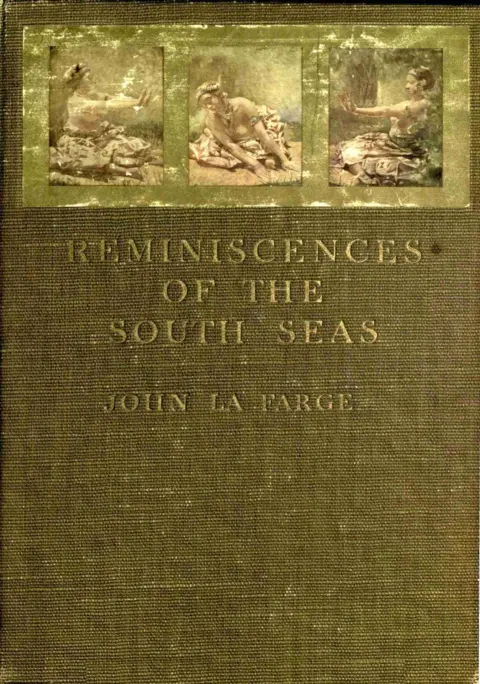
Reminiscences of the South Seas
John La Farge

THE CLASSIC COLLECTION · 1890
"An Artist's Letters from Japan" by John La Farge is a collection of personal letters written in the late 19th century. The book captures the author's impressions and observations of Japan during his travels, delving into various aspects of Japanese culture, art, architecture, and natural beauty. Through his detailed descriptive prose, La Farge provides a vivid account of his experiences, including encounters with local people, exploration of temples, and reflection on the aesthetics of the Japanese landscape. The opening of the work sets a captivating tone, as La Farge recounts his arrival in Yokohama after a long sea journey. He marvels at the beauty of the bay and the lively atmosphere created by Japanese boatmen and the picturesque scenery. His eagerness to explore the unfamiliar environment is evident, as he details the intricate sights and sounds he encounters, from bustling streets to the serene presence of nature. La Farge's letters serve as both a personal narrative and an artistic exploration, aiming to convey the profound cultural richness and sumptuous beauty he finds in Japan. Through carefully crafted imagery and thoughtful reflection, the opening chapters invite readers to join him on a fascinating journey of discovery.
Introduction adapted from the source catalogue; source summaries may be automatically generated.
Free to read · English · 73,278 words · No account needed
MAKE TIME FOR A GOOD BOOK
On by default. Untick to stop anonymous reading totals. Each page counts after 10 seconds in view. How this works.
Anonymous counting is on unless you have switched it off.
As I rode along, so neat and clean was each picture, framed in sunlight if we were in shadow, or in clear shade when we were in sunlight, that I thought I could remember enough small facts for sketches and notes when I should get to Gifu. We reached Gifu in the early twilight, and had no special one impression; we were framed in by the streets, and confused by turning corners, and disturbed by anxiety to get in. But we had one great triumph. Our guide was new to the place--as we were; and we chose our inn at our own sweet will, with a feeling of authority and personal responsibility delicious to experience after such ignominy of guidance. Up we went to our rooms, and opening the shojis[12] looked out upon the river, which seemed broad as a great lake. Our house was right upon it, and the open casement framed nothing but water and pointed mountains, stealing away in the obscure clearness of a colorless twilight. The running of the river, sloping down from the hills on a bed of pebbles, cut off the noises of the town, if there were any, and the silence was like that of far-away country heights. In this semi-painful tension the day's pictures disappeared from my mind. I was all prepared to have something happen, for which I should have been listening, when suddenly our host appeared, to say that the boats were coming down the river. The chilly evening air gave us new freshness, and off we started, deaf to the remonstrances of Hakodate, who had prepared and set out his very best for supper. We rushed past the artist in cookery, whose feelings I could yet appreciate, and plunged after our host into the dark streets. In a few minutes we were by the riverside, and could see far off what we took for our boat, with its roof and lanterns. The proffered backs of our lantern-bearing attendants gave the solution of how we were to get to it. Straddling our human nags, we were carried far out into the shallow, pebbly river, landed into the boat, and poled out into deeper water, nothing to be seen but the night and the conical hills, one of which I fancied to be Inaba, where was once Nobunaga's castle. Some faint mists were white in the distance, as if lighted by a rising moon. At no great distance from us, perhaps at a quarter of a mile, a light flickered over the water. On our approach we could distinguish a man connected with it, who apparently walked on the dark surface. He was evidently a fisherman or a shrimper, and his movements had all the strangeness of some long-legged aquatic bird. He knew his path, and, far out, followed some track or ford, adding to the loneliness as does a crane in a marshy landscape. Then I saw him no more, for he headed up the river toward an opening between the hills. Suddenly a haze of light rounded the corner of the nearest mountain, then grew into a line of fire coming toward us. Above the rustle of the river's course, and our own against it, came the beating of a cry in unison. The line of flame broke into many fires, and we could see the boats rushing down upon us. As quickly as I can write it, they came in an even line, wide apart--perhaps fifty feet or so--enough for us to pass between, whereupon we reversed our movement and drifted along with them. In the front of each boat, hung upon a bent pole, blazed a large cresset filled with pine knots, making above a cloud of smoke, starred with sparks and long needles of red cinders. Below, in the circle of each light, and on its outer rim, swam many birds, glossy black and white cormorants, straining so at the cords that held them that they appeared to be dragging the boats. As they spread like a fan before the dark shadow of the bows, the cords which fastened them glistened or were black in the night. Each string ran through the fingers of the master-fisher at the bows, and was fastened to his waist and lost in the glittering straw of his rain-skirt. Like a four-in-hand driver, he seemed to feel his birds' movements. His fingers loosened or tightened, or, as suddenly, with a clutch pulled back. Then came a rebellious fluttering, and the white glitter of fish in the beaks disappeared--unavailingly; each bird was forcibly drawn up to the gunwale, and seized by the neck encircled by its string-bearing collar. Then a squeeze--a white fish glittered out again and was thrown back into the boat. The bird scuttled away, dropped back into the water, and, shaking itself, was at work again. They swam with necks erect, their eyes apparently looking over everything, and so indifferent to small matters as to allow the big cinders to lie unnoticed on their oily, flat heads. But, every few seconds, one would stoop down, then throw back its head wildly with a fish crosswise in its mouth. When that fish was a small one it was allowed by the master of the bird to remain in the capacious gullet. Each pack guided by a master varied in numbers, but I counted thirteen fastened to the waist of the fisherman nearest to us. Behind him stood another poling: then farther back an apprentice, with a single bird, was learning to manage his feathered tools. In the stern stood the steersman, using a long pole. Every man shouted, as huntsmen encouraging a pack, "Hoo! Hoo! Hoo!"--making the cry whose rhythm we had heard when the flotilla bore down upon us.
Your reading position is saved on this browser. Take it to another device with a library code. Reading pages adapt to text, rather than matching a printed edition.
John La Farge
BEHIND THE BOOK
This eBook is for the use of anyone anywhere in the United States and most other parts of the world at no cost and with almost no restrictions whatsoever. You may copy it, give it away or re-use it under the terms of the Project Gutenberg License included with this eBook or online at www.gutenberg.org. If you are not located in the United States, you will have to check the laws of the country where you are located before using this eBook. Read the source licence.
The original source file, including credits and licence, is retained by this library. Request an original-format copy at no charge. Please include the book title and Project Gutenberg identifier #43160.
KEEP YOUR CURIOSITY GOING
Wilfrid Scawen Blunt
Wilfrid Scawen Blunt

E. W. (Edgar Watson) Howe

David Patterson (Spirit) Hatch

David Patterson (Spirit) Hatch

David Patterson (Spirit) Hatch