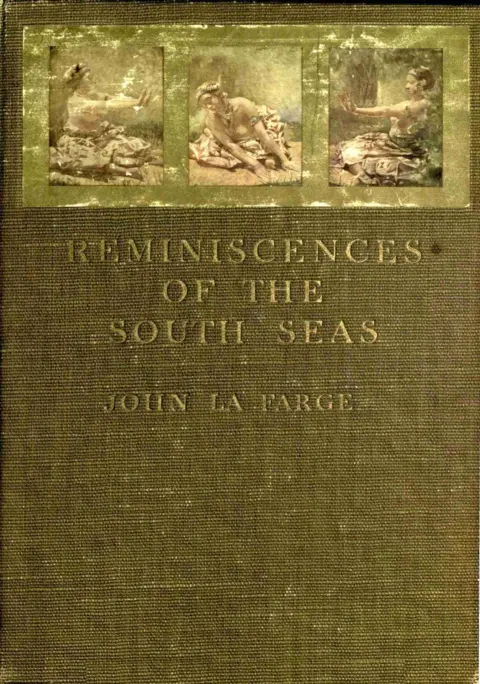
Reminiscences of the South Seas
John La Farge

THE CLASSIC COLLECTION · 1890
"An Artist's Letters from Japan" by John La Farge is a collection of personal letters written in the late 19th century. The book captures the author's impressions and observations of Japan during his travels, delving into various aspects of Japanese culture, art, architecture, and natural beauty. Through his detailed descriptive prose, La Farge provides a vivid account of his experiences, including encounters with local people, exploration of temples, and reflection on the aesthetics of the Japanese landscape. The opening of the work sets a captivating tone, as La Farge recounts his arrival in Yokohama after a long sea journey. He marvels at the beauty of the bay and the lively atmosphere created by Japanese boatmen and the picturesque scenery. His eagerness to explore the unfamiliar environment is evident, as he details the intricate sights and sounds he encounters, from bustling streets to the serene presence of nature. La Farge's letters serve as both a personal narrative and an artistic exploration, aiming to convey the profound cultural richness and sumptuous beauty he finds in Japan. Through carefully crafted imagery and thoughtful reflection, the opening chapters invite readers to join him on a fascinating journey of discovery.
Introduction adapted from the source catalogue; source summaries may be automatically generated.
Free to read · English · 73,278 words · No account needed
MAKE TIME FOR A GOOD BOOK
On by default. Untick to stop anonymous reading totals. Each page counts after 10 seconds in view. How this works.
Anonymous counting is on unless you have switched it off.
Then the rose-color deepens and dulls, the upper sky becomes colorless; all floats in unreal space, and Kioto disappears from before my eyes: forever, I suppose--as the charm of this scene, which will never come again; as the little maiden whom I met to-day, only for an eternal good-by.
NAGOYA, September.
Notwithstanding the long parting, which kept us up very late, the same courteous Japanese friends were at the hotel in the morning to bid us a still more final good-by. Oye-San alone remained faithful to his self-intrusted care of us, and determined to see us as far as the land would allow,--that is to say, to the shores of Biwa Lake.
The caravan was smaller now, diminished by our parting with Awoki, the interpreter, and the men necessary to trundle him about. Still we were a goodly company,--nineteen men in all, of whom two were masters, one the servant, and the rest the runners who were to get us and our baggage to Otzu on Biwa Lake long before noon. There was to be no novelty on our road, it being merely the highway from the capital to the lake. It was a lovely morning, the sun long risen, and all the places and buildings now a part of our memories glistening in the shadow and the dew. We turned our backs for the last time on Kiyomidzu, and ran through the great gate of the temple near us; then, bumping down the steep steps under it, skirted the great wall of Dai Butzu and the interminable side of the Sanjiu sangendo (the hall of the thirty-three spaces),[10] along which in old times the archers used to shoot. Then we gradually got out of the city, into the road filled with traffic going both ways. There seemed to be no break between town and country. Here and there the mountain side, covered with trees, descended to the road. But the effect was that of a long street, deep among hills, and continuously spotted with buildings. Long trains of beautiful black bulls, drawing lumber or merchandise, or carrying straw-covered bales, streamed peacefully along. We passed peasant women,--hardy, tall, sometimes handsome, with scarlet undergowns held up; occasionally one riding on a pack-horse, or in her place a child perched on the hump of the wooden saddle. Or, again, peasants bearing loads on their backs, or carriers with weighty merchandise swung between them on poles; priests, young and old, stepping gravely in their white, or yellow, or black dresses--some with umbrellas open, others, whose quicker step meant that they had not far to go (perhaps only to some wayside temple), protecting their shaven heads with outspread fan. Or a kuruma, usually with one runner, taking into town, economically, two women together, one old, one young, and followed by another kuruma carrying some old gentleman, very thin or very fat, the head of a family. Kurumas carrying Japanese tourists or travelers, with hideous billycock hats, or Anglo-Indian helmets, or wide straw hats à la mode de Third Avenue, these abominable head-pieces contrasting with their graceful gowns, as did their luggage, wrapped up in silk handkerchiefs with their European traveling rugs. Or, again, other kurumas carrying unprotected females in pairs, with the usual indifferent or forlorn look; or couples of young girls more gaily dressed, with flowery hairpins, the one evidently a chaperon to the other; then a Government official, all European, with hurrying runners; sometimes, but rarely, the Japanese litter, or kago, or several if for a party, their occupants lying at their ease as to their backs, but twisted into knots as to their feet, and swaying with the movement of the trotting carriers. Bent to one side by the heavy ridgepole, which passes too low to allow the head to lie in the axis of the body, sweet-eyed women's faces, tea-rose or peach-colored, looked up from the bamboo basket of the litter. With proper indifference their lords and masters looked at us obliquely. On the roofs was spread a miscellaneous quantity of luggage.
Your reading position is saved on this browser. Take it to another device with a library code. Reading pages adapt to text, rather than matching a printed edition.
John La Farge
BEHIND THE BOOK
This eBook is for the use of anyone anywhere in the United States and most other parts of the world at no cost and with almost no restrictions whatsoever. You may copy it, give it away or re-use it under the terms of the Project Gutenberg License included with this eBook or online at www.gutenberg.org. If you are not located in the United States, you will have to check the laws of the country where you are located before using this eBook. Read the source licence.
The original source file, including credits and licence, is retained by this library. Request an original-format copy at no charge. Please include the book title and Project Gutenberg identifier #43160.
KEEP YOUR CURIOSITY GOING
Wilfrid Scawen Blunt
Wilfrid Scawen Blunt

E. W. (Edgar Watson) Howe

David Patterson (Spirit) Hatch

David Patterson (Spirit) Hatch

David Patterson (Spirit) Hatch