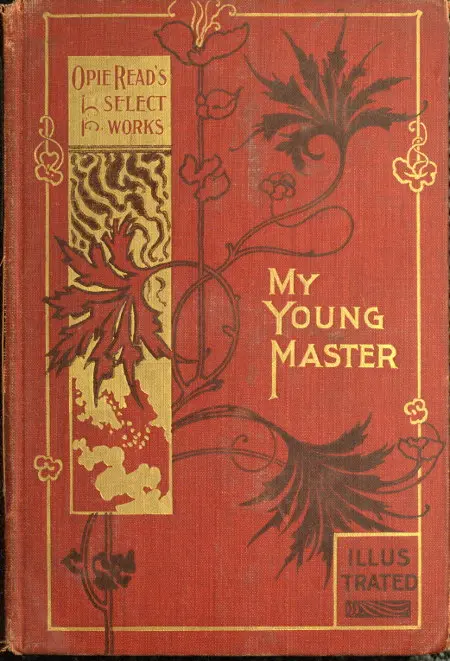
My Young Master: A Novel
Opie Percival Read
THE CLASSIC COLLECTION · 1896
"An Arkansas Planter" by Opie Percival Read is a novel written in the late 19th century. The story dives into the life of a prominent Arkansas plantation owner, Major John Cranceford, and his lengthy discussions and conflicts regarding his daughter, Louise, who has fallen in love with a man of questionable health and reputation, Carl Pennington. The narrative explores themes of love, family loyalty, and the complex dynamics of social class in a post-Civil War Southern setting. At the start of the novel, the reader is introduced to the life of the Arkansas planter and the scenic yet troubled backdrop of Reconstruction-era Arkansas. The focus quickly shifts to the Cranceford family, particularly Major Cranceford's struggles as he confronts his daughter’s desire to marry a man he views as unfit due to his deteriorating health and familial history. The opening chapters vividly illustrate the Major's authoritative yet caring nature and offer insight into Louise's passionate defiance against her father's wishes, creating a tension that sets the stage for the unfolding drama in their lives against the backdrop of societal expectations. The characters are richly drawn, reflecting the complexities of their relationships and the era in which they live.
Introduction adapted from the source catalogue; source summaries may be automatically generated.
Free to read · English · 67,324 words · No account needed
MAKE TIME FOR A GOOD BOOK
On by default. Untick to stop anonymous reading totals. Each page counts after 10 seconds in view. How this works.
Anonymous counting is on unless you have switched it off.
"No, not to-day, John. Fact is I'm not feeling very well. Head's all stopped up with a cold, and these summer colds are awful, I tell you. It was a summer cold that took my father off."
"How's your cotton in that low strip along the bayou?"
"Tolerable, John; tolerable."
"Come in. I want to talk to you about it."
"Don't believe I can stand the air in there, John. Head all stopped up. Don't believe I'm going to live very long."
"Nonsense. You are as strong as a buck."
"You may think so, John, but I'm not. I thought father was strong, too, but a summer cold got him. I am getting along in years, John, and I find that I have to take care of myself. But if you really want to talk to me about that piece of cotton, come out under the trees where it's cool."
The Major shoved back his papers and arose, but hesitated; and Gid stood looking on, fanning himself. The Major stepped out and Gid's face was split asunder with a broad smile.
"I gad. I've been up town and had a set-to with old Baucum and the rest of them. Pulled up fifty winner at poker and jumped. Devilish glad to see you; miss you every minute of the time I'm away. Let's go over there and sit down on that bench."
They walked toward a bench under a live-oak tree, and upon Gid's shoulder the Major's hand affectionately rested. They halted to laugh, and old Gid shoved the Major away from him, then seized him and drew him back. They sat down, still laughing, but suddenly the Major became serious.
"Gid, I'm in trouble," he said.
"Nonsense, my boy, there is no such thing as trouble. Throw it off. Look at me. I've had enough of what the world calls trouble to kill a dozen ordinary men, but just look at me--getting stronger every day. Throw it off. What is it, anyway?"
"Louise declares that she is going to marry Pennington!"
"What!" old Gid exclaimed, turning with a bouncing flounce and looking straight at the Major. "Marry Pennington! Why, she shan't, John. That's all there is of it. We object and that settles it. Why, what the deuce can she be thinking about?"
"Thinking about him," the Major answered.
"Yes, but she must quit it. Why, it's outrageous for as sensible a girl as she is to think of marrying that fellow. You leave it to me; hear what I said? Leave it to me."
This suggested shift of responsibility did not remove the shadow of sadness that had fallen across the Major's countenance.
Your reading position is saved on this browser. Take it to another device with a library code. Reading pages adapt to text, rather than matching a printed edition.
Opie Percival Read
Opie Percival Read
Opie Percival Read
Opie Percival Read
BEHIND THE BOOK
This eBook is for the use of anyone anywhere in the United States and most other parts of the world at no cost and with almost no restrictions whatsoever. You may copy it, give it away or re-use it under the terms of the Project Gutenberg License included with this eBook or online at www.gutenberg.org. If you are not located in the United States, you will have to check the laws of the country where you are located before using this eBook. Read the source licence.
The original source file, including credits and licence, is retained by this library. Request an original-format copy at no charge. Please include the book title and Project Gutenberg identifier #19107.
KEEP YOUR CURIOSITY GOING
Coulson Kernahan

Maurice Baring
Frances Wright
Cécile Tormay

Frederic Jesup Stimson

W. H. P. (William Henry Pope) Jarvis