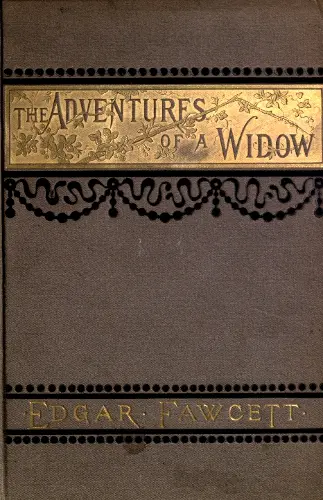
The Adventures of a Widow: A Novel
Edgar Fawcett
THE CLASSIC COLLECTION · 1888
"An Ambitious Woman: A Novel" by Edgar Fawcett is a fiction work written in the late 19th century. The book explores the life of Claire Twining, a young woman caught between her ambitions and the grim realities of her upbringing in a dreary suburb of Brooklyn. The narrative conveys themes of aspiration, social struggles, and familial dynamics, particularly focusing on Claire's relationship with her parents and her yearning for a better life. The opening of the novel introduces Greenpoint, a monotonous and dismal area near Brooklyn, setting the tone for Claire's challenging upbringing. Her father, Francis Twining, is depicted as an optimistic yet unfortunate man, struggling to provide for his family despite his potential and gentle nature. Claire's mother, Jane, is portrayed as coarse and critical, contributing to a tense home environment. As the scene unfolds, Claire's characters emerge as she grapples with feelings of discontentment, influenced by her mother's unyielding ambition and her father's gentle but defeated spirit. The juxtaposition of Claire's aspirations against the backdrop of her household's despair foregrounds her journey of self-discovery and the societal constraints she seeks to transcend.
Introduction adapted from the source catalogue; source summaries may be automatically generated.
Free to read · English · 126,602 words · No account needed
MAKE TIME FOR A GOOD BOOK
On by default. Untick to stop anonymous reading totals. Each page counts after 10 seconds in view. How this works.
Anonymous counting is on unless you have switched it off.
It was the first time she had ever made a resolve whose fulfillment she felt sure would displease her father. The certainty that he would not sanction her going in companionship of this proposed sort made Claire's decision a sacrilege to herself, even while she perversely took it. She trampled on her own filial loyalty, and she seemed to feel it tremble in pained protest under the outrage. It was in vain that a troop of self-excusing pleas sprang to battle against her shamed afterthought. She knew that remorse was already whetting for her its poniard. The gloom of her father's future rebuke had already made itself a part of the increasing nightfall.
"Oh, ain't I glad, though!" Josie broke forth, gleefully. Her triumph was one of pure good-natured impulse, but at the same time she had a flattered sense that her evening's amusement would now gain a stamp of distinction. One or two girls in Greenpoint had derided her for encouraging Mr. MacNab as a devotee. She herself secretly derided the young man in that same tender office. For this reason she had arranged that they should meet here to-night at the foot of the little hillock near the river, and invest their purposed trip with enough clandestine association to defeat the couchant raillery of certain unsparing neighbors.
Almost immediately Mr. MacNab made his appearance below, and Josie tripped lightly down toward him, followed by Claire at a much more sober pace. The introduction promptly followed, and Josie's glib, matter-of-course explanation soon succeeded that. The reason of Claire's presence was given Mr. MacNab by Josie with a handsome, off-hand patronage. "It's awful nice o' Miss Twining to consent to go along with us," she ended. "Aint it, now?"
"Oh, yes, indeed," said Mr. MacNab.
The young man was inwardly tortured by this abrupt announcement. He was very much in love with Josie, and he had felt deeper and deeper thrills of anticipation all day long, as the hour of their rendezvous drew near. He was a youth of about two-and-twenty. His stature was so low as to be almost dwarfish; both Claire's and Josie's well overtopped it. He was very stout, however; the breadth of his shoulders and the solid girth of his limbs might have suited six feet of clean height. He had a large, smooth, moon-like face, a pair of little black eyes, and a pair of huge red ears. He was immoderately ugly, but with an expression so simply amiable as quite to escape repulsiveness. You felt that his ready smile possessed vast hidden funds of geniality; there was no telling what supple resources that long slit of big-lipped mouth might draw upon, at a really mirthful emergency. One glance at his abnormal hands, where every joint was an uncouth protuberance and every nail a line of inky darkness, left it certain that they held no dainty share of the world's manual requirements. Mr. James MacNab was an oyster-opener for about eight months in the year, and a clam-opener through the remaining four. The narrow window of his employer's shop looked upon Greenpoint Avenue, wedged between the stores of a butcher and a candy-seller. Like Josie Morley, James was of Irish parentage; like her, he abjured the accent of his ancestors, having been born here, and having breathed into his being at an early age that peculiar shame of Celtic origin which belongs among our curiosities of immigration. His wages were meagre, and his hours of work numerous. To-night was a precious interval of relaxation. He had been released at three o'clock that afternoon, and had gone heavy-lidded to a tiny cot in a garret-room, where he had slept the exhausted sleep of one who is always in arrears to the drowsy god. Not long ago he had waked, highly refreshed, and pierced with the expectation of soon meeting his beloved Josie. He had four dollars and seventy-five cents in his pocket, and the possession of this sum gave him a firm sense of pecuniary security. The strong faith that he was finely dressed, too, increased his confidence. He had a little low hat of black felt, tipped sideways on his ungainly head; an overcoat of muddy cinnamon-brown, with broad black binding along its lappels and edges; and a pair of boots so capably polished that their lustre dissuaded you from too close scrutiny of the toe-joint bulging from either clumsy foot. He was entirely satisfied with his general effect. He knew that nature had not made him comely, but he felt complete repose of conscience in the matter of having atoned artistically for this personal slight.
Your reading position is saved on this browser. Take it to another device with a library code. Reading pages adapt to text, rather than matching a printed edition.
Edgar Fawcett
Frank R. Stockton & Edgar Fawcett & Franklin Fyles & Anna Katharine Green & Henry Harland & Ingersoll Lockwood & Joaquin Miller & Kirk Munroe & Brainard Gardner Smith & Maurice Thompson & A. C. (Andrew Carpenter) Wheeler
Edgar Fawcett
BEHIND THE BOOK
This eBook is for the use of anyone anywhere in the United States and most other parts of the world at no cost and with almost no restrictions whatsoever. You may copy it, give it away or re-use it under the terms of the Project Gutenberg License included with this eBook or online at www.gutenberg.org. If you are not located in the United States, you will have to check the laws of the country where you are located before using this eBook. Read the source licence.
The original source file, including credits and licence, is retained by this library. Request an original-format copy at no charge. Please include the book title and Project Gutenberg identifier #38075.
KEEP YOUR CURIOSITY GOING
Coulson Kernahan

Maurice Baring
Frances Wright
Cécile Tormay

Frederic Jesup Stimson

W. H. P. (William Henry Pope) Jarvis