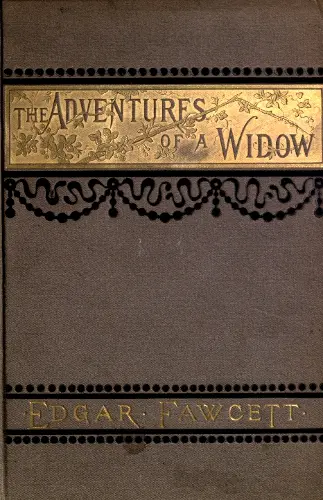
The Adventures of a Widow: A Novel
Edgar Fawcett
THE CLASSIC COLLECTION · 1888
"An Ambitious Woman: A Novel" by Edgar Fawcett is a fiction work written in the late 19th century. The book explores the life of Claire Twining, a young woman caught between her ambitions and the grim realities of her upbringing in a dreary suburb of Brooklyn. The narrative conveys themes of aspiration, social struggles, and familial dynamics, particularly focusing on Claire's relationship with her parents and her yearning for a better life. The opening of the novel introduces Greenpoint, a monotonous and dismal area near Brooklyn, setting the tone for Claire's challenging upbringing. Her father, Francis Twining, is depicted as an optimistic yet unfortunate man, struggling to provide for his family despite his potential and gentle nature. Claire's mother, Jane, is portrayed as coarse and critical, contributing to a tense home environment. As the scene unfolds, Claire's characters emerge as she grapples with feelings of discontentment, influenced by her mother's unyielding ambition and her father's gentle but defeated spirit. The juxtaposition of Claire's aspirations against the backdrop of her household's despair foregrounds her journey of self-discovery and the societal constraints she seeks to transcend.
Introduction adapted from the source catalogue; source summaries may be automatically generated.
Free to read · English · 126,602 words · No account needed
MAKE TIME FOR A GOOD BOOK
On by default. Untick to stop anonymous reading totals. Each page counts after 10 seconds in view. How this works.
Anonymous counting is on unless you have switched it off.
"No," replied Thurston, who had already exchanged a nod of greeting with Goldwin. He lowered his voice so that Claire alone could hear it. "I arrived but a few minutes ago. I have been talking seriously with my sister. You were quite right. She has withdrawn her disapprobation. You have conquered her, as you conquer everybody."
He saw the faint yet meaning flash that left her dark-blue eyes, and he read clearly, too, the significance of her bright smile, as she said:--
"Ah, you reassure me. For I had my doubts; I confess it, now."
"So had I," he returned. "But they are at rest forever, as I want yours
to be." ...
At an early hour, the next morning, Mrs. Van Horn surprised her friend and kinswoman, Mrs. Ridgeway Lee, in the latter's pretty and quaint boudoir, that was Japanese enough, as regarded hangings and adornments, to have been the sacred retreat of some almond-eyed Yeddo belle.
Mrs. Lee had had her coffee, and was deep in one of Zola's novels when her friend was announced. Her coupe would appear at twelve, and take her to a certain small religious hospital of which she was one of the most assiduous patrons; but she always read Zola, or some author of a similar Gallic intensity, while she digested her coffee.
She had concealed the novel, however, by the time that Mrs. Van Horn had swept her draperies between the Oriental jars and screens.
"I have come to talk with you about that affair--that plan, Sylvia," said her visitor, dropping into a chair.
"You mean ... to-morrow, Cornelia?"
"Yes.... By the way, have you seen the morning papers?"
"I glanced over one of them--the 'Herald,' I think. It said, in the society column, that I wore magenta at the Charity Ball last night. As if I would disgrace myself with that hideous color! These monsters of the newspapers ought to be suppressed in some way."
"You didn't think so when they described your flame-colored plush gown so accurately last Tuesday. However, you deserve to be ridiculed for going to those vulgar public balls."
"But this was for charity, and"--
"Yes, I know. Don't let us talk of it. If you had read the paper more closely you would have seen the statement, given with a great air of truth, that Herbert Hollister's millions are flowing away from him at a terrible rate, and that to-night may see him almost ruined."
"How dreadful!" said Mrs. Lee, in her slow way, but noticeably changing
color.
Mrs. Van Horn gave a high, hard laugh. "Of course you are sorry."
Your reading position is saved on this browser. Take it to another device with a library code. Reading pages adapt to text, rather than matching a printed edition.
Edgar Fawcett
Frank R. Stockton & Edgar Fawcett & Franklin Fyles & Anna Katharine Green & Henry Harland & Ingersoll Lockwood & Joaquin Miller & Kirk Munroe & Brainard Gardner Smith & Maurice Thompson & A. C. (Andrew Carpenter) Wheeler
Edgar Fawcett
BEHIND THE BOOK
This eBook is for the use of anyone anywhere in the United States and most other parts of the world at no cost and with almost no restrictions whatsoever. You may copy it, give it away or re-use it under the terms of the Project Gutenberg License included with this eBook or online at www.gutenberg.org. If you are not located in the United States, you will have to check the laws of the country where you are located before using this eBook. Read the source licence.
The original source file, including credits and licence, is retained by this library. Request an original-format copy at no charge. Please include the book title and Project Gutenberg identifier #38075.
KEEP YOUR CURIOSITY GOING
Coulson Kernahan

Maurice Baring
Frances Wright
Cécile Tormay

Frederic Jesup Stimson

W. H. P. (William Henry Pope) Jarvis