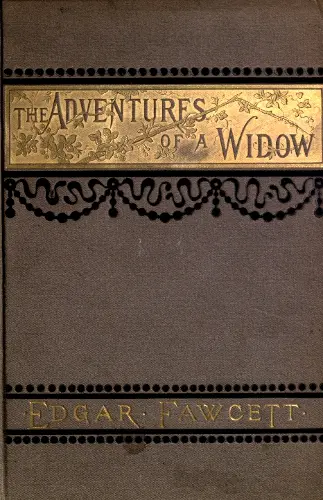
The Adventures of a Widow: A Novel
Edgar Fawcett
THE CLASSIC COLLECTION · 1888
"An Ambitious Woman: A Novel" by Edgar Fawcett is a fiction work written in the late 19th century. The book explores the life of Claire Twining, a young woman caught between her ambitions and the grim realities of her upbringing in a dreary suburb of Brooklyn. The narrative conveys themes of aspiration, social struggles, and familial dynamics, particularly focusing on Claire's relationship with her parents and her yearning for a better life. The opening of the novel introduces Greenpoint, a monotonous and dismal area near Brooklyn, setting the tone for Claire's challenging upbringing. Her father, Francis Twining, is depicted as an optimistic yet unfortunate man, struggling to provide for his family despite his potential and gentle nature. Claire's mother, Jane, is portrayed as coarse and critical, contributing to a tense home environment. As the scene unfolds, Claire's characters emerge as she grapples with feelings of discontentment, influenced by her mother's unyielding ambition and her father's gentle but defeated spirit. The juxtaposition of Claire's aspirations against the backdrop of her household's despair foregrounds her journey of self-discovery and the societal constraints she seeks to transcend.
Introduction adapted from the source catalogue; source summaries may be automatically generated.
Free to read · English · 126,602 words · No account needed
MAKE TIME FOR A GOOD BOOK
On by default. Untick to stop anonymous reading totals. Each page counts after 10 seconds in view. How this works.
Anonymous counting is on unless you have switched it off.
She was undoubtedly up and doing. She carried her large frame with a more assertive majesty; she aired one or two fresh gowns with a loud ostentation; she had a little quarrel with a fellow-lodger of her own sex about the prevailing fashion in bonnets, and said so many personal things during the contest that her adversary, who was a person with nerves, retired in tearful disarray. On more than one Sunday morning she induced her husband to walk with her along Fifth Avenue and "see the churches come out." At such times she would lean upon his arm, grandly indifferent to the fact that her stature overtopped his own, and stare with her severe black eyes at all the passing phases of costume. It is probable that the pair made a very grotesque picture on these occasions, since all that implied refinement in the man's face and demeanor must have acquired a fatal stamp of insignificance beside the woman's pretension of carriage and raw spruceness of apparel. But Mrs. Twining was making her hay, as she has told us, while the sun shone, and it is hardly strange that she should not be critical as to the exact quality of her crop. A good deal of rough experience in the woes of dearth and drouth had, naturally, not made her a fastidious harvester.
Claire, meanwhile, had begun to feel as if she dwelt on quite a new sort of planet. Her environment had lost every trace of its former dullness. Its neutral shades had freshened into brilliant and exciting tints. Little Mrs. Carmichael, with her hoard of memories stowed away like old brocades in a scented chest, had herself faded off into a memory as dim as these. Claire had of late become one of the pupils in a large, well-reputed school, where she met girls of all ages and characters, but seemingly of only a single social rank. The academy was superintended by a magnificent lady in chronic black corded-silk, whose rich rustle was heard for a half minute before she entered each of her various class-rooms and held bits of whispered converse with the instructresses under her serene sway. Her name was Mrs. Arcularius, and its fine rhythmical polysyllable seemed to symbolize the dignity of its owner's slow walk, the majesty of her arched nose and gold eye-glasses, and the white breadth of her forehead, from which the gray tresses were rolled backward in high solidness, with quite a regal effect of hair-dressing. This lady was the direct contra-type of Mrs. Carmichael. It was widely recorded of her that she had once been a gentlewoman of independent wealth, had chanced upon adverse times, and had for this reason become the proprietress of a school. But she had made her grand friends pay the penalty of her misfortunes; she had acquired the skill of using them as an advertisement of her venture at self-support. She had not gone up to One-Hundred-and-Twelfth Street and mourned their loss; she had stayed in Twenty-Third Street, and suffered their children, little and big, to come unto her. She had at first graciously allowed herself to be pitied for her reverses, but she had always possessed the art of handing back their patronage to those who proffered it, in the wholly altered form of a gracious condescension from herself. This is a very clever thing to do; it is a thing which they alone know how to do who know how to fall from high places with a self-saving rebound; and Mrs. Arcularius, who was a decidedly ignorant woman, was also a marvelously clever one. She knew rather less, in a strictly educational sense, than poor, unsuccessful Mrs. Carmichael. She had been a friend of Mrs. Carmichael's in the latter's gladsome days, but she was now not even aware that her old associate was teaching school anywhere. Everybody was aware, on the other hand, that Mrs. Arcularius was teaching school, and just where she was teaching it. Poverty had crushed one; it had stimulated the other. Mrs. Arcularius was now exceedingly particular as regarded her visiting-book. She was a conspicuous figure at the most select receptions. Whether the fact that she presided over a fashionable school had made her lose caste or no, she chose secretly to believe that it had, and for this reason let her voluminous black silk robes rustle only in the most irreproachable assemblages.
Your reading position is saved on this browser. Take it to another device with a library code. Reading pages adapt to text, rather than matching a printed edition.
Edgar Fawcett
Frank R. Stockton & Edgar Fawcett & Franklin Fyles & Anna Katharine Green & Henry Harland & Ingersoll Lockwood & Joaquin Miller & Kirk Munroe & Brainard Gardner Smith & Maurice Thompson & A. C. (Andrew Carpenter) Wheeler
Edgar Fawcett
BEHIND THE BOOK
This eBook is for the use of anyone anywhere in the United States and most other parts of the world at no cost and with almost no restrictions whatsoever. You may copy it, give it away or re-use it under the terms of the Project Gutenberg License included with this eBook or online at www.gutenberg.org. If you are not located in the United States, you will have to check the laws of the country where you are located before using this eBook. Read the source licence.
The original source file, including credits and licence, is retained by this library. Request an original-format copy at no charge. Please include the book title and Project Gutenberg identifier #38075.
KEEP YOUR CURIOSITY GOING
Coulson Kernahan

Maurice Baring
Frances Wright
Cécile Tormay

Frederic Jesup Stimson

W. H. P. (William Henry Pope) Jarvis