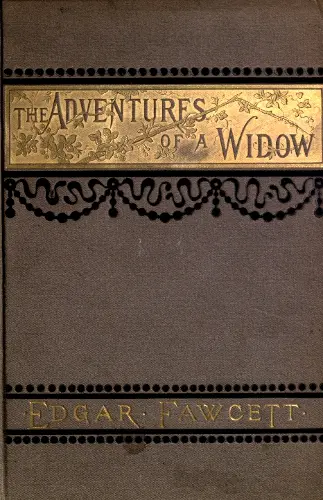
The Adventures of a Widow: A Novel
Edgar Fawcett
THE CLASSIC COLLECTION · 1888
"An Ambitious Woman: A Novel" by Edgar Fawcett is a fiction work written in the late 19th century. The book explores the life of Claire Twining, a young woman caught between her ambitions and the grim realities of her upbringing in a dreary suburb of Brooklyn. The narrative conveys themes of aspiration, social struggles, and familial dynamics, particularly focusing on Claire's relationship with her parents and her yearning for a better life. The opening of the novel introduces Greenpoint, a monotonous and dismal area near Brooklyn, setting the tone for Claire's challenging upbringing. Her father, Francis Twining, is depicted as an optimistic yet unfortunate man, struggling to provide for his family despite his potential and gentle nature. Claire's mother, Jane, is portrayed as coarse and critical, contributing to a tense home environment. As the scene unfolds, Claire's characters emerge as she grapples with feelings of discontentment, influenced by her mother's unyielding ambition and her father's gentle but defeated spirit. The juxtaposition of Claire's aspirations against the backdrop of her household's despair foregrounds her journey of self-discovery and the societal constraints she seeks to transcend.
Introduction adapted from the source catalogue; source summaries may be automatically generated.
Free to read · English · 126,602 words · No account needed
MAKE TIME FOR A GOOD BOOK
On by default. Untick to stop anonymous reading totals. Each page counts after 10 seconds in view. How this works.
Anonymous counting is on unless you have switched it off.
Hollister, who had received a brief, polite bow of adieu, and risen as he returned it, broke the ensuing silence.
"Didn't she go away quite in a hurry?" he asked. "I hope you haven't offended her," he added, jocosely, to his wife.
"Cornelia didn't look a bit offended," said Mrs. Diggs, regarding Claire, or rather her continued blush. "But that means nothing. You didn't quarrel, now, did you, Mrs. Hollister?"
"Oh, no," said Claire, still dazed and demoralized. "She asked me to visit her in town; she was very urgent that I should do so."
"You don't really tell me such a thing!" exclaimed Mrs. Diggs. "You've no idea how prodigious an honor she was conferring. It's like decorating you with the order of St. Something--actually it is."
"I'm afraid I failed to value it in that way," replied Claire, who was
recovering herself.
"Of course you did. You haven't yet taken in the full enormity of Cornelia's importance. You can't do it until you see her surrounded by her own proper atmosphere--with her foot on her native heath, so to speak. Then you'll understand the massive condescension of to-night."
"I think I would just as lief not understand it," laughed Hollister, with his characteristic play of gentle humor. "It doesn't repay you to climb these very big mountains. Everybody says that there's very little to see after you've got to the tops of them."
Mrs. Diggs echoed his laugh. She was looking at Claire, however, with her bright, black, restless eyes. "I think your wife may want to climb," she said. "I'll be her guide, if she'll let me. There's a very good view from the summit of cousin Cornelia. You can look down on a lot of smaller peaks."
Claire shook her head. She had got her natural color again, but not her natural manner; she spoke in a tone of preoccupied seriousness that did not harmonize with her light words.
"I shouldn't like to fall down one of her glaciers and be lost," she
said.
"Oh, there's no fear of that," cried Mrs. Diggs. "You're too
sure-footed."
Somewhat later that evening, when they were alone together, Hollister
asked his wife:
"Did that Mrs. Van Horn say anything that hurt you, Claire?"
"Oh, no. What made you think so, Herbert?"
"I.... Well, perhaps I only fancied it.... You had known her brother,
hadn't you?"
"Yes. He was a good deal at the Bergemanns' last Spring. He went to Europe afterward. I suppose that was why she wanted to know me better."
Your reading position is saved on this browser. Take it to another device with a library code. Reading pages adapt to text, rather than matching a printed edition.
Edgar Fawcett
Frank R. Stockton & Edgar Fawcett & Franklin Fyles & Anna Katharine Green & Henry Harland & Ingersoll Lockwood & Joaquin Miller & Kirk Munroe & Brainard Gardner Smith & Maurice Thompson & A. C. (Andrew Carpenter) Wheeler
Edgar Fawcett
BEHIND THE BOOK
This eBook is for the use of anyone anywhere in the United States and most other parts of the world at no cost and with almost no restrictions whatsoever. You may copy it, give it away or re-use it under the terms of the Project Gutenberg License included with this eBook or online at www.gutenberg.org. If you are not located in the United States, you will have to check the laws of the country where you are located before using this eBook. Read the source licence.
The original source file, including credits and licence, is retained by this library. Request an original-format copy at no charge. Please include the book title and Project Gutenberg identifier #38075.
KEEP YOUR CURIOSITY GOING
Coulson Kernahan

Maurice Baring
Frances Wright
Cécile Tormay

Frederic Jesup Stimson

W. H. P. (William Henry Pope) Jarvis