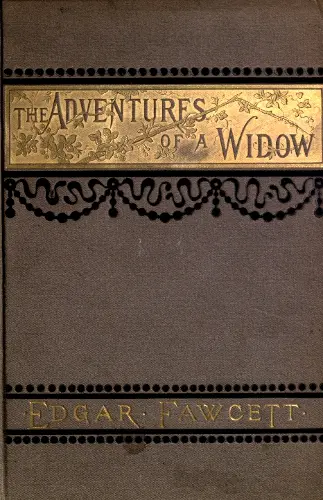
The Adventures of a Widow: A Novel
Edgar Fawcett
THE CLASSIC COLLECTION · 1888
"An Ambitious Woman: A Novel" by Edgar Fawcett is a fiction work written in the late 19th century. The book explores the life of Claire Twining, a young woman caught between her ambitions and the grim realities of her upbringing in a dreary suburb of Brooklyn. The narrative conveys themes of aspiration, social struggles, and familial dynamics, particularly focusing on Claire's relationship with her parents and her yearning for a better life. The opening of the novel introduces Greenpoint, a monotonous and dismal area near Brooklyn, setting the tone for Claire's challenging upbringing. Her father, Francis Twining, is depicted as an optimistic yet unfortunate man, struggling to provide for his family despite his potential and gentle nature. Claire's mother, Jane, is portrayed as coarse and critical, contributing to a tense home environment. As the scene unfolds, Claire's characters emerge as she grapples with feelings of discontentment, influenced by her mother's unyielding ambition and her father's gentle but defeated spirit. The juxtaposition of Claire's aspirations against the backdrop of her household's despair foregrounds her journey of self-discovery and the societal constraints she seeks to transcend.
Introduction adapted from the source catalogue; source summaries may be automatically generated.
Free to read · English · 126,602 words · No account needed
MAKE TIME FOR A GOOD BOOK
On by default. Untick to stop anonymous reading totals. Each page counts after 10 seconds in view. How this works.
Anonymous counting is on unless you have switched it off.
"No," stated Claire, keenly interested by this nimble monologue. "As I said, Mr. Thurston scarcely did more than mention his sister's name."
Mrs. Diggs applied herself actively to a fragment of cold chicken, which she had left neglected through all these elucidating items. Claire watched her, thinking how clever she was and yet how uncircumspect. With what slight incentive had been roused this actual whirlwind of family confidences!
"She perfectly adores Beverley," Mrs. Diggs presently continued. "I have an idea that she does so because he's a Thurston--or rather because she's one. She has contrived to make it appear very exceptional to be a Thurston. The Thurstons have never been anything whatever. Her mother married into the family, and cast a spell of aristocracy over them. But Cornelia never alludes to the Van Kortlandt connection. She knows that can take care of itself. I believe her grandfather, on the other side, was a saddler. But she has managed to have it seriously disputed whether he was a saddler or a landed Knickerbocker grandee. The panels of her carriage bear a Thurston crest. It is a very pretty one; I am quite sure she invented it. I once told Beverley so, and he laughed. He has never used it, though he has never denounced it as spurious. The joke is that she ignores the Van Horn crest entirely, which is the only one she has any right to air. Cornelia is a great leader, as I said. She has Thursday evenings in the big old house on Washington Square which her late husband left her. Lots of people have struggled to go to Cornelia's Thursdays, and not gone, after all. It's absolutely funny to observe what a vogue she has got. She could make anybody whom she chose to take up a social somebody by merely lifting her finger. But she never lifts her finger. That is why she is so run after. You can't get her to use the power she possesses. It yearly grows more of a power, don't you know, on this very account. It's like a big deposit in a bank, that gets bigger through lying there untouched. She won't spend a penny; she lets it grow. The women of New York are becoming a good deal less flippant, some of them, than they used to be. Clubs and receptions have come into fashion, where intellectual matters are seriously, even capably discussed. Somebody will read a paper on something sensible and literary, and a little debate will follow. At one of these clubs--composed strictly of women--it is forbidden to mention the last ball, though this may have occurred on the preceding night and everybody may have seen everybody else there, talking the usual gay nonsense. The whole thing is a kind of 'movement,' don't you know? It's very picturesque and it's extremely in earnest. It makes one think a little of the old historical French salons. It has laid bare some charming and surprising discoveries. It has shown how many women have been reading and thinking in secret, during those long intervals of leisure that have occurred between their opportunities for being publicly silly, inane, flirtatious, and hence of correct form. On the other hand it has led certain women to cultivate their minds as they would a new style of dressing their hair. All that we used to satirize in former entertainments of this kind fails to exist in those I am describing. Pipe-stem curls and blue spectacles are replaced by the most Parisian felicities of costume. A delightful-looking creature in a Worth dress that fits her like a glove will give us her 'views' on the Irish land-question or the persecution of the Jews in Russia.... And now I come to the real object of my digression, as the long-winded orators say. Cornelia Van Horn frowns upon all this. She has gathered about her a little faction, too, which frowns obediently in her defense. You must not fancy for a moment that Cornelia could not shine in these assemblies if she chose to favor them. She has brains enough to outshine nearly all their supporters. But she condemns the intellectual tendency in women when thus openly exhibited. If they want to read and think, they should do it in the quiet of their closets, and in the same way that they write their letters, or glance over their accounts, or distribute their household orders. There is no objection to philosophy, science, belles-lettres, so long as these are not made to interfere with the general dignified commonplace of the higher social life. To be individual, argumentative, reformatory, is to be professional. To be professional is not to be 'good form.' The moment that a drawing-room is made to resemble a lecture-room or a seminary it becomes odious from a patrician stand-point. Only queens and duchesses can afford to paint pictures or to write books, without loss of caste. A consistent aristocracy never discovers new ideas; it accepts old ones. Agitators are the enemies of repose, and repose is the soul of refinement."
Your reading position is saved on this browser. Take it to another device with a library code. Reading pages adapt to text, rather than matching a printed edition.
Edgar Fawcett
Frank R. Stockton & Edgar Fawcett & Franklin Fyles & Anna Katharine Green & Henry Harland & Ingersoll Lockwood & Joaquin Miller & Kirk Munroe & Brainard Gardner Smith & Maurice Thompson & A. C. (Andrew Carpenter) Wheeler
Edgar Fawcett
BEHIND THE BOOK
This eBook is for the use of anyone anywhere in the United States and most other parts of the world at no cost and with almost no restrictions whatsoever. You may copy it, give it away or re-use it under the terms of the Project Gutenberg License included with this eBook or online at www.gutenberg.org. If you are not located in the United States, you will have to check the laws of the country where you are located before using this eBook. Read the source licence.
The original source file, including credits and licence, is retained by this library. Request an original-format copy at no charge. Please include the book title and Project Gutenberg identifier #38075.
KEEP YOUR CURIOSITY GOING
Coulson Kernahan

Maurice Baring
Frances Wright
Cécile Tormay

Frederic Jesup Stimson

W. H. P. (William Henry Pope) Jarvis