
Lucia in London
E. F. (Edward Frederic) Benson
THE CLASSIC COLLECTION · 1903
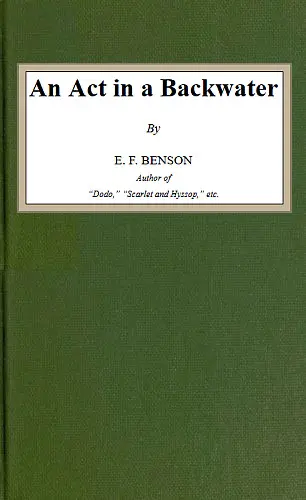
"An Act in a Backwater" by E. F. Benson is a novel written in the early 20th century. The story unfolds in a small English town and introduces Colonel Raymond, a retired military man with a penchant for pompousness and a desire to associate with the aristocracy. As events begin to unfold following the death of a noble relative, the narrative explores themes of class, the absurdities of social pretensions, and family dynamics. At the start of the story, Colonel Raymond diligently follows his routine as he heads to the Wroxton County Club, where his eccentricities and overbearing personality become evident. The narrative humorously illustrates his interactions with other characters, particularly his obsession with status and his noble relative, Lord Avesham. Following the announcement of Avesham's death, Colonel Raymond's thoughts reveal his anxieties regarding the implications for his own standing in the town, setting the stage for conflicts and encounters that will arise as the Avesham family moves into the area, complicating his efforts to maintain his perceived superiority. The opening chapters lay an intriguing foundation for exploring the interplay of social class and personal ambition in this seemingly idyllic backwater.
Introduction adapted from the source catalogue; source summaries may be automatically generated.
Free to read · English · 63,744 words · No account needed
MAKE TIME FOR A GOOD BOOK
On by default. Untick to stop anonymous reading totals. Each page counts after 10 seconds in view. How this works.
Anonymous counting is on unless you have switched it off.
“Poor planet!” said Jeannie. “How the people in Mars must look down on
us.”
“And rightly,” sighed Miss Fortescue. “How many Philistines one sees.”
“I’m one,” said Arthur, cheerfully. “Philistia, be thou glad of me!”
Miss Fortescue shook her head.
“Tell me any one you know who is not a Philistine,” said Jack.
Miss Fortescue raised her eyes to the ceiling, but Jack did not
understand the signal.
“Can’t you think of one?” he repeated.
“When Aunt Em raises her eyes,” said Jeannie, “we talk of something else. Don’t apologize, Mr. Collingwood; you couldn’t have known.”
“A little more hare, Arthur,” said Aunt Em; “about as much as you gave
me before.”
Frank Bennett, Jack, and Arthur had all been up at Magdalen together, and when the two were left in the smoking-room together Arthur, who only knew vaguely the story, asked Jack about it.
“You wrote to me, I remember, after his death in May, and told me about the woman he had lived with. What happened further?”
Jack got up.
“It is all very terrible,” he said. “The girl died only about ten days ago, in giving birth to a baby. The baby is living. It was about that that I went to see my mother this afternoon.”
“What did she suggest?”
“An orphanage,” said Jack. “It had been suggested before, and I think it is quite out of the question. The case is not an orphanage case. There is plenty of money. I hoped--no, I hardly hoped--that my mother would suggest that the baby should be brought up in her house, for I owe a great deal to Frank, and as he is dead without my being able to pay it, I owe it to his memory. But she did not suggest it. So I think I shall take the child and bring it up myself.”
He paused.
“Yes, I know there are objections,” he said. “To begin with, people will talk. Luckily, however, there is nothing in the world which matters so little as what such people say. The other objections are more important. It would be better for the child not to be in London. But I dare say things will work out somehow. For the present, at any rate, I shall certainly do that. It is bad enough for a child to be fatherless and nameless. What an ass poor Frank was! And what a good one!”
“What was the girl like?” asked Arthur. “Did you know her?”
“Yes, but very slightly. Oh, I can’t talk about it. She was nice. Frank meant to marry her--that I know.”
“One means so much,” said Arthur.
Your reading position is saved on this browser. Take it to another device with a library code. Reading pages adapt to text, rather than matching a printed edition.
E. F. (Edward Frederic) Benson

E. F. (Edward Frederic) Benson

E. F. (Edward Frederic) Benson

E. F. (Edward Frederic) Benson
BEHIND THE BOOK
This eBook is for the use of anyone anywhere in the United States and most other parts of the world at no cost and with almost no restrictions whatsoever. You may copy it, give it away or re-use it under the terms of the Project Gutenberg License included with this eBook or online at www.gutenberg.org. If you are not located in the United States, you will have to check the laws of the country where you are located before using this eBook. Read the source licence.
The original source file, including credits and licence, is retained by this library. Request an original-format copy at no charge. Please include the book title and Project Gutenberg identifier #56465.
KEEP YOUR CURIOSITY GOING
Coulson Kernahan

Maurice Baring
Frances Wright
Cécile Tormay

Frederic Jesup Stimson

W. H. P. (William Henry Pope) Jarvis