
Lucia in London
E. F. (Edward Frederic) Benson
THE CLASSIC COLLECTION · 1903
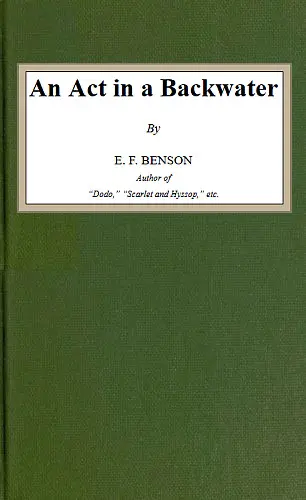
"An Act in a Backwater" by E. F. Benson is a novel written in the early 20th century. The story unfolds in a small English town and introduces Colonel Raymond, a retired military man with a penchant for pompousness and a desire to associate with the aristocracy. As events begin to unfold following the death of a noble relative, the narrative explores themes of class, the absurdities of social pretensions, and family dynamics. At the start of the story, Colonel Raymond diligently follows his routine as he heads to the Wroxton County Club, where his eccentricities and overbearing personality become evident. The narrative humorously illustrates his interactions with other characters, particularly his obsession with status and his noble relative, Lord Avesham. Following the announcement of Avesham's death, Colonel Raymond's thoughts reveal his anxieties regarding the implications for his own standing in the town, setting the stage for conflicts and encounters that will arise as the Avesham family moves into the area, complicating his efforts to maintain his perceived superiority. The opening chapters lay an intriguing foundation for exploring the interplay of social class and personal ambition in this seemingly idyllic backwater.
Introduction adapted from the source catalogue; source summaries may be automatically generated.
Free to read · English · 63,744 words · No account needed
MAKE TIME FOR A GOOD BOOK
On by default. Untick to stop anonymous reading totals. Each page counts after 10 seconds in view. How this works.
Anonymous counting is on unless you have switched it off.
“But it seems so strange,” said Clara. “I know my poor mother saw a clergyman every day for six weeks before she died. And when I suggested this morning to Phœbe that I should ask Mr. Crawshaw to call she got quite angry, and said, ‘What for?’ So as any agitation, Dr. Maitland told me, is bad for her, I didn’t urge it. But my conscience has pricked me ever since.”
Jeannie smiled.
“Put it in a pin-cushion, then,” she said. “Oh, how little I should want to see a clergyman if I was going to die soon. Fancy wanting a clergyman when you were dying,” she said, half to herself.
For a moment Miss Clara looked shocked, but any opinion expressed by her idol demanded unusual thought before it was condemned. And, after a little reflection:
“I think I see what you mean,” she said. “But it seems so odd.”
“Well, I must go,” said Jeannie; “and I think it would be wise of you to let your sister do as she likes and to encourage her in anything she may wish.”
Clara sighed.
“I am sure you must be right,” she said. “Dear Miss Avesham, there is one thing more I wanted to ask you. You do not think, do you, that if Phœbe had seen a doctor sooner it would have been more hopeful?”
“I am sure it would have made no difference,” said Jeannie, with assurance. Then, seeing that doubt still lingered on Miss Clara’s face:
“I happened to ask Dr. Maitland that myself,” she added, which happened
to be quite true.
Clara looked inexpressibly relieved.
“You can’t think how I worried about it since Phœbe told me last night,” she said. “I was afraid it might have been, however indirectly, my fault.”
“Well, anyhow, you needn’t worry about that any more,” said Jeannie.
She went down the steps and turned homeward, a little shocked at herself at the ease with which what Miss Phœbe had called “the little fib” had been spoken. No one had practised the difficult art of lying less than she, but it seemed to come quite naturally. And not for a moment did she repent it. “If it was wrong,” she said to herself, “God will understand.”
Clara stayed for a moment looking after Jeannie and composing herself. Then she nailed a smile to her face and went back into the drawing-room.
Phœbe was still sitting in her chair strumming to herself on the mandolin, but she stopped as Clara entered.
“I wonder if you could play that accompaniment,” she said; “I want to try the song that comes next, Amore Mysterio.”
Your reading position is saved on this browser. Take it to another device with a library code. Reading pages adapt to text, rather than matching a printed edition.
E. F. (Edward Frederic) Benson

E. F. (Edward Frederic) Benson

E. F. (Edward Frederic) Benson

E. F. (Edward Frederic) Benson
BEHIND THE BOOK
This eBook is for the use of anyone anywhere in the United States and most other parts of the world at no cost and with almost no restrictions whatsoever. You may copy it, give it away or re-use it under the terms of the Project Gutenberg License included with this eBook or online at www.gutenberg.org. If you are not located in the United States, you will have to check the laws of the country where you are located before using this eBook. Read the source licence.
The original source file, including credits and licence, is retained by this library. Request an original-format copy at no charge. Please include the book title and Project Gutenberg identifier #56465.
KEEP YOUR CURIOSITY GOING
Coulson Kernahan

Maurice Baring
Frances Wright
Cécile Tormay

Frederic Jesup Stimson

W. H. P. (William Henry Pope) Jarvis