
Lucia in London
E. F. (Edward Frederic) Benson
THE CLASSIC COLLECTION · 1903
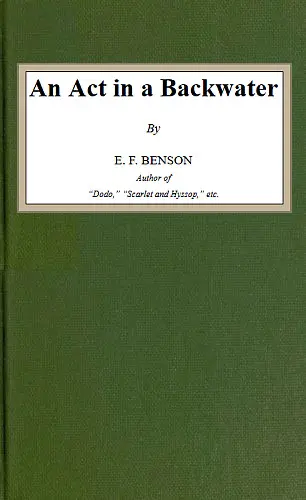
"An Act in a Backwater" by E. F. Benson is a novel written in the early 20th century. The story unfolds in a small English town and introduces Colonel Raymond, a retired military man with a penchant for pompousness and a desire to associate with the aristocracy. As events begin to unfold following the death of a noble relative, the narrative explores themes of class, the absurdities of social pretensions, and family dynamics. At the start of the story, Colonel Raymond diligently follows his routine as he heads to the Wroxton County Club, where his eccentricities and overbearing personality become evident. The narrative humorously illustrates his interactions with other characters, particularly his obsession with status and his noble relative, Lord Avesham. Following the announcement of Avesham's death, Colonel Raymond's thoughts reveal his anxieties regarding the implications for his own standing in the town, setting the stage for conflicts and encounters that will arise as the Avesham family moves into the area, complicating his efforts to maintain his perceived superiority. The opening chapters lay an intriguing foundation for exploring the interplay of social class and personal ambition in this seemingly idyllic backwater.
Introduction adapted from the source catalogue; source summaries may be automatically generated.
Free to read · English · 63,744 words · No account needed
MAKE TIME FOR A GOOD BOOK
On by default. Untick to stop anonymous reading totals. Each page counts after 10 seconds in view. How this works.
Anonymous counting is on unless you have switched it off.
“Dr. Maitland is in the next ward,” she said; “go and tell him at once. It may be perforation. Then, when you have finished your round, if all the rest are doing well, I wish you would come here while I finish. I can’t leave this man alone. You can hear any sound in your ward from his bed.”
Jeannie hurried on and told Dr. Maitland. He came at once, looked at the girl, and shook his head.
“You did quite right to send for me, Miss Avesham,” he said. “Yes, she is as bad as she can be. I can do nothing.”
At moments like these Jeannie felt sick and utterly helpless, and almost inclined to say that she could bear it no longer. But she said nothing, and went on to the next bed.
The next patient was a robust woman of about thirty with a baritone voice. She proclaimed loudly that she was perfectly well, and was being starved. Her gray Irish eyes used to plead with Jeannie for something to eat, and she badly resented being washed. But this morning she took it in silence, and thanked Jeannie.
“She’s bad?” she asked, looking hard to the next bed.
“Yes, very bad,” said Jeannie, hardly able to speak. She took the woman’s chart down from the wall and indicated the ten-o’clock temperature on it.
“You’re nearly through, I hope,” she said. “Yes, quite normal this morning. Now all you have to do is to lie very quiet, and you will get stronger every day. The doctor said you might have beef-tea this morning instead of milk.”
She smiled at her rather sadly, and was passing on, but the woman seized
her hand.
“It’s cruel hard on ye,” said she; “but don’t mind so, don’t mind so. An’ me worrying you and all. I’ll bite out me tongue before I say another hasty word to ye.”
Then came two or three very bad cases. One was a frail, tired-looking woman, who glanced at Jeannie wistfully as she examined the thermometer.
“I’m no better?” she asked.
Jeannie smiled, but with a heavy heart. The woman, she felt sure, could not last through very many days of this.
“How do you feel?” she said.
“Weak and tired--oh, so tired! And I have a pain in my back.”
“Do you cough at all?” asked Jeannie.
“I couldn’t sleep for it last night,” said the woman, “and that makes a
body weary.”
“Keep yourself warm, then,” she said, “and lie still.”
“But I’m no better?” she asked again.
Your reading position is saved on this browser. Take it to another device with a library code. Reading pages adapt to text, rather than matching a printed edition.
E. F. (Edward Frederic) Benson

E. F. (Edward Frederic) Benson

E. F. (Edward Frederic) Benson

E. F. (Edward Frederic) Benson
BEHIND THE BOOK
This eBook is for the use of anyone anywhere in the United States and most other parts of the world at no cost and with almost no restrictions whatsoever. You may copy it, give it away or re-use it under the terms of the Project Gutenberg License included with this eBook or online at www.gutenberg.org. If you are not located in the United States, you will have to check the laws of the country where you are located before using this eBook. Read the source licence.
The original source file, including credits and licence, is retained by this library. Request an original-format copy at no charge. Please include the book title and Project Gutenberg identifier #56465.
KEEP YOUR CURIOSITY GOING
Coulson Kernahan

Maurice Baring
Frances Wright
Cécile Tormay

Frederic Jesup Stimson

W. H. P. (William Henry Pope) Jarvis