
Lucia in London
E. F. (Edward Frederic) Benson
THE CLASSIC COLLECTION · 1903
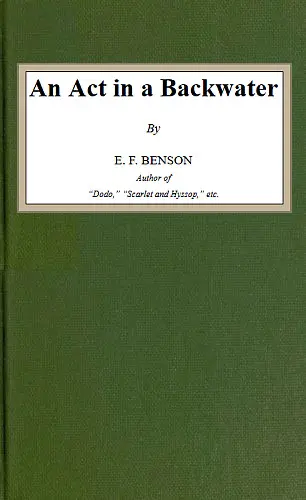
"An Act in a Backwater" by E. F. Benson is a novel written in the early 20th century. The story unfolds in a small English town and introduces Colonel Raymond, a retired military man with a penchant for pompousness and a desire to associate with the aristocracy. As events begin to unfold following the death of a noble relative, the narrative explores themes of class, the absurdities of social pretensions, and family dynamics. At the start of the story, Colonel Raymond diligently follows his routine as he heads to the Wroxton County Club, where his eccentricities and overbearing personality become evident. The narrative humorously illustrates his interactions with other characters, particularly his obsession with status and his noble relative, Lord Avesham. Following the announcement of Avesham's death, Colonel Raymond's thoughts reveal his anxieties regarding the implications for his own standing in the town, setting the stage for conflicts and encounters that will arise as the Avesham family moves into the area, complicating his efforts to maintain his perceived superiority. The opening chapters lay an intriguing foundation for exploring the interplay of social class and personal ambition in this seemingly idyllic backwater.
Introduction adapted from the source catalogue; source summaries may be automatically generated.
Free to read · English · 63,744 words · No account needed
MAKE TIME FOR A GOOD BOOK
On by default. Untick to stop anonymous reading totals. Each page counts after 10 seconds in view. How this works.
Anonymous counting is on unless you have switched it off.
“I’m not good at speaking,” he said; “but if you insist--well, it’s just this. Harry, you’re a brick to suggest that we should all live here, but I think you’re wrong about it. In the first place, we’re poor, and if you keep Morton open we shall be all tied here, and we sha’n’t be able to fill the house with people, and we shall not be able to keep up the shooting; and here we shall be with this great shell over our heads, like bluebottles or some other mean insect which lives in palaces. In the second place, you will probably marry, and that will cramp you still further. In the third--this is from my own point of view, purely--if I live here, I know perfectly well that, with the best intentions in the world, on wet mornings when I don’t want to go out, and on fine ones when I do, I shall persuade myself that I am far from well, and not go to Wroxton and the brewery. Fourthly, you yourself will miss not being in London horribly. You’d bore yourself to death here. But you’re a brick for suggesting it. And--and that’s all.”
There was a moment’s silence.
“So the sheep has spoken,” said Jeannie. “Well done, sheep. But I thought you said you were wholly indifferent?”
“I know I did. But you drove me into a corner.”
Miss Fortescue looked at Arthur approvingly.
“For so stupid a boy, you have glimmerings of sense,” she said.
“Oh, I’m a sharp fellow,” said Arthur.
“Really, Arthur, I think you are,” said Harry. “Mind, my offer holds perfectly good, but I do think there is something in what you say.”
Arthur stood looking from one to the other, with his head a little on one side, like a dog who has done its trick. Unlike Jeannie and his brother, he was fair, with blue eyes and an extraordinarily pleasant face.
“Well, them’s my sentiments,” he said. “Your turn, Jeannie.”
“I know it is,” said Jeannie. “And what’s to happen to me, Arthur?” she
demanded.
Arthur groaned slightly.
“I’ve done all that can be expected of me,” he said. “My turn is over.”
Jeannie jumped up.
“Oh, I know,” she said. “I’ll come and keep house for you in Wroxton, Arthur, and Harry shall come down to stay with us from Saturday till Monday, and we’ll go up to stay with him from--from Monday till Saturday.”
“A lot of beer shall I brew,” remarked Arthur. “Why, you could swim in
it.”
Your reading position is saved on this browser. Take it to another device with a library code. Reading pages adapt to text, rather than matching a printed edition.
E. F. (Edward Frederic) Benson

E. F. (Edward Frederic) Benson

E. F. (Edward Frederic) Benson

E. F. (Edward Frederic) Benson
BEHIND THE BOOK
This eBook is for the use of anyone anywhere in the United States and most other parts of the world at no cost and with almost no restrictions whatsoever. You may copy it, give it away or re-use it under the terms of the Project Gutenberg License included with this eBook or online at www.gutenberg.org. If you are not located in the United States, you will have to check the laws of the country where you are located before using this eBook. Read the source licence.
The original source file, including credits and licence, is retained by this library. Request an original-format copy at no charge. Please include the book title and Project Gutenberg identifier #56465.
KEEP YOUR CURIOSITY GOING
Coulson Kernahan

Maurice Baring
Frances Wright
Cécile Tormay

Frederic Jesup Stimson

W. H. P. (William Henry Pope) Jarvis