READ · DISCOVER · ENJOYClassic literature · Always free
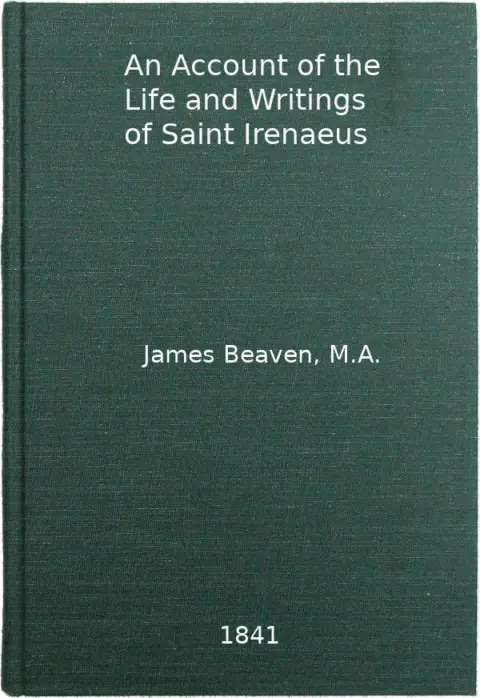
An Account of the Life and Writings of S. Irenæus, Bishop of Lyons and Martyr Intended to Illustrate the Doctrine, Discipline, Practices, and History of the Church, and the Tenets and Practices of the Gnostic Heretics During the Second Century — digital edition cover

THE CLASSIC COLLECTION · 1841

An Account of the Life and Writings of S. Irenæus, Bishop of Lyons and Martyr Intended to Illustrate the Doctrine, Discipline, Practices, and History of the Church, and the Tenets and Practices of the Gnostic Heretics During the Second Century

"An Account of the Life and Writings of S. Irenæus, Bishop of Lyons and Martyr" by James Beaven, M.A. is a historical account written in the early 19th century. The book provides an overview of the significant contributions of Irenæus, a church father recognized for his opposition to Gnostic heresies and for his role in the early Christian Church. It aims to illuminate the doctrines, practices, and historical context of the Church during the second century, intertwining Irenæus's life with discussions about theological principles and controversies. The opening portion of this work introduces the life of S. Irenæus, emphasizing his upbringing under the tutelage of Polycarp and his subsequent leadership as Bishop of Lyons. It discusses Irenæus's connections to other early Christian figures and highlights his commitment to preserving and articulating Christian doctrine amidst various heretical movements, particularly Gnosticism. Furthermore, this section sets the stage for understanding his theological writings, which sought to unify the Church and clarify its teachings against emerging false doctrines. Overall, it depicts Irenæus as a pivotal figure whose legacy influenced the development of early Christianity.

Introduction adapted from the source catalogue; source summaries may be automatically generated.

Start reading ↓

Free to read · English · 77,785 words · No account needed

MAKE TIME FOR A GOOD BOOK

An Account of the Life and Writings of S. Irenæus, Bishop of Lyons and Martyr Intended to Illustrate the Doctrine, Discipline, Practices, and History of the Church, and the Tenets and Practices of the Gnostic Heretics During the Second Century

On by default. Untick to stop anonymous reading totals. Each page counts after 10 seconds in view. How this works.

Anonymous counting is on unless you have switched it off.

An Account of the Life and Writings of S. Irenæus, Bishop of Lyons and Martyr Intended to Illustrate the Doctrine, Discipline, Practices, and History of the Church, and the Tenets and Practices of the Gnostic Heretics During the Second Century

81 Contra Julianum Pelagianum, I. c. 3. he has quoted the last clause of IV. ii. 7; and c. 7. the last paragraph of V. xvii. 1.

82 Eusebius indeed says (V. xxiii. 1) that the Churches of all Asia were united in differing from the rest of the world; but it is evident, from chap. xxv. that he means Asia Minor; for he mentions the bishops of Jerusalem, Cæsarea, Tyre, and Ptolemais, as asserting that the Church of Alexandria agreed with them in their present practice, which was the same as that of the West.

Τῆς Ἀσίας ἁπάσης αἱ παροικίαι, ὡς ἐκ παραδόσεως ἀρχαιοτέρας, σελήνης τὴν τεσσαρεσκαιδεκάτην ᾥοντο δεῖν ἐπὶ τῆς τοῦ σωτηρίου πάσχα ἑορτῆς παραφυλάττειν, ἐν ᾗ θύειν τὸ πρόβατον Ἰουδαίοις προηγόρευτο· ὡς δέον ἐκπαντὸς κατὰ ταύτην, ὁποίᾳ δ᾽ ἂν ἡμέρᾳ τῆς ἑβδομάδος περιτυγχάνοι, τὰς τῶν ἀσιτιῶν ἐπιλύσεις ποιεῖσθαι· οὐκ ἔθους ὄντος τοῦτον ἐπιτελεῖν τὸν τρόπον ταῖς ἀνὰ τήν λοιπὴν ἄπασαν οἰκουμένην ἐκκλησίαις, ἐξ ἀποστολικῆς παραδόσεως τὸ καὶ εἰς δεῦρο κρατῆσαν ἔθος φυλαττούσαις· ὡς μηδ᾽ ἑτέρᾳ προσήκειν παρὰ τὴν τῆς ἀναστάσεως τοῦ Σωτῆρος ἡμῶν ἡμέραν τὰς νηστείας ἐπιλύεσθαι.

83 As appears by the following Fragment of Irenæus’s Epistle to Victor, quoted by Euseb. V. xxiv. 5. Καὶ οἱ πρὸ Σωτῆρος πρεσβύτεροι οἱ προστάντες τῆς ἐκκλησίας, ἧς νῦν ἀφηγῇ, Ἀνίκητον λέγομεν καὶ Πίον, Ὕγῖνόν τε καὶ Τελεσφόρον, καὶ Ξύστον, οὔτε αὐτοὶ ἐτήρησαν, οὔτε τοῖς μετ᾽ αὐτοὺς ἐπέτρεπον. καὶ οὐδὲν ἔλαττον αὐτοὶ μὴ τηροῦντες, εἰρήνευον τοῖς ἀπὸ τῶν παροικιῶν, ἐν αἷς ἐτηρεῖτο, ἐρχομένοις πρὸς αὐτοὺς, καίτοι μᾶλλον ἐνάντιον ἦν τὸ τηρεῖν τοῖς μὴ τηροῦσι· καὶ οὐδέποτε διὰ τὸ εἶδος τοῦτο ἀπεβλήθησάν τινες. ἀλλ᾽ αὐτοὶ μὴ τηροῦντες, οἱ πρὸ σοῦ πρεσβύτεροι, τοῖς ἀπὸ τῶν παροικιῶν τηροῦσιν ἔπεμπον εὐχαριστίαν. Καὶ τοῦ μακαρίου Πολυκάρπου ἐπιδημήσαντος τῇ Ῥώμῃ ἐπὶ Ἀνικήτου, καὶ περὶ ἄλλων τινῶν μικρὰ σχόντες πρὸς ἀλλήλους, εὐθὺς εἰρήνευσαν, περὶ τούτου τοῦ κεφαλαίου μὴ φιλεριστήσαντες ἑαυτούς. οὔτε γὰρ ὁ Ἀνίκητος τὸν Πολύκαρπον πεῖσαι ἐδύνατο μὴ τηρεῖν, ἅτε μετὰ Ἰωάννου τοῦ μαθητοῦ Κυρίου ἡμῶν, καὶ λοιπῶν ἀποστόλων οἷς συνδιέτριψεν, ἀεὶ τετηρηκότα· οὔτε μὴν ὁ Πολύκαρπος τὸν Ἀνίκητον ἔπεισε τηρεῖν, λέγοντα τὴν συνήθειαν τῶν πρὸ αὑτοῦ πρεσβυτέρων ὀφείλειν κατέχειν. καὶ τούτων οὔτως ἐχόντων, ἐκοινὼνησαν ἑαυτοῖς· καὶ ἐν τῇ ἐκκλησίᾳ παρεχώρησεν ὁ Ἀνίκητος τὴν εὐχαριστίαν τῷ Πολυκάρπῳ, κατ᾽ ἐντροπὴν δηλονότι, καὶ μετ᾽ εἰρήνης απ‘ ἀλλήλων ἀπηλλάγησαν, πάσης τῆς ἐκκλησίας εἰρήνην ἐχόντων, καὶ τῶν τηρούντων καὶ τῶν μὴ τηρούντων.

84 See p. 23. above.

85 We know that he wrote to Polycrates of Ephesus, and therefore probably to the rest. Euseb. Hist. Eccl. V. xxiv. 3.—Ἐδυνάμην δὲ τῶν ἐπισκόπων τῶν συμπαρόντων μνημονεῦσαι, οὓς ὑμεῖς ἠξιώσατε μετακληθῆναι ὑπ᾽ ἐμοῦ, καὶ μετεκαλεσάμην.

86 Hist. Eccl. V. xxiii. 2. Σύνοδοι δὴ καὶ συγκροτήσεις ἐπισκόπων ἐπὶ ταὐτὸν ἐγίνοντο. πάντες τε μιᾷ γνώμῃ δι᾽ ἐπιστολῶν ἐκκλησιαστικὸν δόγμα τοῖς πανταχόσε διετυποῦντο, ὡς ἂν μηδ᾽ ἐν ἄλλῃ ποτε τῆς Κυριακῆς ἡμέρᾳ τὸ τῆς ἐκ νεκρῶν ἀναστάσεως ἐπιτελοῖτο τοῦ Κυρίου μυστήριον, καὶ ὄπως ἐν ταύτῃ μόνῃ τῶν κατὰ τὸ πάσχα νηστειῶν φυλαττοίμεθα τας ἐπιλύσεις. Φέρεται δ᾽ εἰσέτι νῶν τῶν κατὰ Παλαιστίνην τηνικάδε συγκεκροτημένων γραφὴ, ὧν προὐτέτακτο Θεέφιλος τῆς ἐν Καισαρείᾳ παροικίας ἐπίσκοπος, καὶ Νάρκισσος τῆς ἐν Ἱεροσολύμοις· καὶ τῶν ἐπὶ Ῥώμης δὲ ὁμοίως ἄλλη περὶ τοῦ αὐτοῦ ζητήματος, ἐπίσκοπον Βίκτορα δηλοῦσα· τῶν τε κατὰ Πόντον ἐπισκόπων, ὧν Πάλμας ὡς ἀρχαιότατος προὐτέτακτο· καὶ τῶν κατὰ Γαλλίαν δὲ παροικιῶν, ἃς Εἰρηναῖος ἐπεσκόπει· ἔτι δὲ τῶν κατὰ τὴν Ὀσροηνὴν καὶ τὰς ἐκεῖσε πόλεις· καὶ ἰδίως Βακχύλλου τῆς Κορινθίων ἐκκλησίας ἐπισκόπου, καὶ πλείστων ὅσων ἄλλων, οἱ μίαν καὶ τὴν αὐτην δόξαν τε καὶ κρίσιν ἐξενεγκόμενοι, τὴν αὐτὴν τέθεινται ψῆφον.... 24. Τῶν δὲ ἐπὶ τῆς Ἀσίας ἐπισκόπων τὸ πάλαι πρότερον αὐτοῖς παραδοθὲν διαφυλάττειν ἔθος χρῆναι διϊσχυριζομένων ἡγεῖτο Πολυκράτης.

87 Hist. Eccl. V. xxiv. 2. Ἐγὼ οὖν, ἀδελφοὶ, ἑξήκοντα καὶ πέντε ἔτη ἔχων ἐν Κυρίῳ, καὶ συμβεβληκὼς τοῖς ἀπὸ τῆς οἰκουμένης ἀδελφοῖς, καὶ πᾶσαν ἁγίαν γραφὴν διεληλυθὼς, οὐ πτύρομαι ἐπὶ τοῖς καταπλησσομένοις.

88 Euseb. V. xxiv. 3. Ἐπὶ τούτοις ὁ μὲν τῆς Ῥωμαίων προεστὼς Βίκτωρ, ἀθρόως τῆς Ἀσίας πάσας ἅμα ταῖς ὁμόροις ἐκκλησίαις τὰς παροικίας ἀποτέμνειν, ὡς ἑτεροδοξούσας, τῆς κοινῆς ἑνώσεως πειρᾶται· καὶ στηλιτεύει γε διὰ γραμμάτων, ἀκοινωνήτους ἄρδην πάντας τοὺς ἐκεῖσε ἀκακηρύττων ἀδελφούς.

89 Ibid. Ἀλλ᾽ οὺ πᾶσί γε τοῖς ἐπισκόποις ταῦτ᾽ ἠρέσκετο· ἀντιπαρακελεύονται δῦτα αὐτῷ, τὰ τῆς εἰρήνης καὶ τῆς πρὸς τοὺς πλησίον ἑνώσεως καὶ ἀγάπης φρονεῖν. Φέρονται δὲ καὶ αἱ τούτων φωναὶ, πληκτικώτερον καθαπτομένων τοῦ Βίκτορος· ἐν οἷς καὶ ὁ Εἰρηναῖος ἐκ προσώπου ὧν ἡγεῖτο κατὰ τὴν Γαλλίαν ἀδελφῶν ἐπιστείλας, παρίσταται μὲν τῷ δεῖν ἐν μόνῃ τῇ τῆς κυριακῆς ἡμέρᾳ τὸ τῆς τοῦ Κυρίου ἀναστάσεως ἐπιτελεῖσθαι μυστήριον· τῷ γε μὴν Βίκτορι προσηκόντως, ὡς μὴ ἀποκόπτοι ὅλας ἐκκλησίας Θεοῦ ἀρχαίου ἔθους παράδοσιν ἐπιτηρούσας, πλεῖστα ἕτερα παραινεῖ, καὶ αὐτοῖς δὲ ῥήμασι τάδε ἐπιλέγων· Then follows the fragment Οὐ γὰρ μόνον ... συνίστησι, extracted in the chapter on the Forms and Ceremonies of the Church, and that quoted above, p. 45, note 4.—Ibid. xxiv. 6. Ὁ δ᾽ αύτὸς οὐ μόνον τῷ Βίκτορι, ἀλλὰ και διαφόροις πλείστοις ἄρχουσιν ἐκκλησιῶν, τὰ κατάλληλα δι᾽ ἐπιστολῶν περὶ τοῦ κεκινημένου ζητήματος ὡμίλει.

90 Anatolius, apud Bucher. de Cycl. Vict. p. 444. ed. Antwerp, 1633.

91 Firmilian, bishop of Cæsarea in Cappadocia, in a letter addressed to Cyprian, preserved amongst those of Cyprian (Epist. 75. ed. Potter. p. 220.), says, in reference to the diversity of customs “circa celebrandos dies paschæ, et circa multa alia divinæ rei sacramenta,” “Nec tamen propter hoc ab ecclesiæ Catholicæ pace atque unitate aliquando discessum est.”

Athanasius, (de Synodis Arimini et Seleuciæ, § 5.), says, that before the Council of Nice, οἱ μὲν ἀπὸ τῆς Συρίας καὶ Κιλικίας καὶ Μεσοποταμίας ἐχώλευον περὶ τὴν ἑορτὴν, καὶ μετὰ τῶν Ἰουδαίων ἐποιοῦντο πάσχα.

Chrysostom, in his Discourses against the Jews, in that one in which he dissuades the Christians of Antioch from joining in their observances, (tom. v. Hom. 55. p. 608. ed. Benedict.) reminds them that the Church of Antioch once universally kept the ante‐paschal fast with the Jews, although they had, since the Council of Nice, given up that practice: Καὶ ἡμεῖς οὕτως ἐνηστεύομεν πρότερον, ἀλλ᾽ ὄμως προετιμήσαμεν τὴν συμφωνίαν τῆς τῶν χρόνων παρατηρήσεως.

92 Theodoret. Hist. I. 9. Euseb. de Vit. Const. 19.

93 See Massuet, Diss. Præv. II. § 21.

94 Euseb. Hist. Eccl. V. xxiv. 3. quoted p. 47, note 9.

95 Jerome in Catal. quoted p. 8, note 7.

96 Euseb. as quoted p. 47, note 1.

97 See note 3, p. 48.

98 Hist. Eccl. v. 26. Ἀλλὰ γὰρ πρὸς τοῖς ἀποδοθεῖσιν Εἰρηναίου συγγράμμασι καὶ ταῖς ἐπιστολαῖς, φέρεταί τις αὐτοῦ πρὸς Ἕλληνας λόγος συντομώτατος καὶ ταμάλιστα ἀναγκαιότατος, Περὶ ἐπιστήμης ἐπιγεγραμμένος· καὶ ἄλλος, ὃν ἀνατέθεικεν ἀδελφῷ Μαρκιανῷ τοὔνομα, εἰς ἐπίδειξιν τοῦ ἀποστολικοῦ κηρύγματος· καὶ βιβλίον τι Διαλέξεων διαφόρων, ἐν ᾧ τῆς πρὸς Ἐβραίους ἐπιστολῆς καὶ τῆς λεγομένης σοφίας Σολωμῶντος μνημονεύει, ῥητά τινα ἐξ αὐτῶν παραθέμενος.

99 See p. 2, note 7.

100 In the Answer to Question 115. Ὁ μακάριος Εἰρηναῖος, ὁ μάρτυρ καὶ ἐπίσκοπος Λουγδούνου, ἐν τῷ περὶ τοῦ Πάσχα λόγῳ κ. τ. λ.

101 Tom. II. p. 152, ed. Combefis.

102 On Isaiah, lxiv. 4, 5. in vol. iv. p. 761 of his Works.

103 Hist. Franc. x. 27. Veniente persecutione, talia ibidem diabolus bella per tyrannum exercuit, et tanta ibi multitudo Christianorum ob confessionem divini nominis est jugulata, ut per plateas flumina currerent de sanguine Christiano; quorum nec numerum nec nomina colligere potuimus: Dominus enim eos in libro vitæ conscripsit. Beatum Irenæum, diversis in sua carnifex præsentia pœnis affectum, Christo Domino per martyrium dedicavit.

104 Tillemont, Mémoires, tom. iii. part. 1. S. Irenée, Art. x.

Your reading position is saved on this browser. Take it to another device with a library code. Reading pages adapt to text, rather than matching a printed edition.

BEHIND THE WORDS

About James Beaven

James Beaven (1801–1875). Explore An Account of the Life and Writings of S. Irenæus, Bishop of Lyons and Martyr Intended to Illustrate the Doctrine, Discipline, Practices, and History of the Church, and the Tenets and Practices of the Gnostic Heretics During the Second Century in this collection. These books span history, religion & spirituality.

Explore this author’s books →

THE READERS’ VERDICT

How did this story stay with you?

Not rated yet
Your rating for An Account of the Life and Writings of S. Irenæus, Bishop of Lyons and Martyr Intended to Illustrate the Doctrine, Discipline, Practices, and History of the Church, and the Tenets and Practices of the Gnostic Heretics During the Second Century

Be the first to share your verdict.

One rating per browser, which you can change or remove. A necessary browser identifier remembers your vote. How ratings work

A GOOD STORY DESERVES COMPANY

Pass this book along.

A great read is even better when it’s shared.

SEND A LITTLE INSPIRATION

Share this book

BEHIND THE BOOK

Edition & source details.

Title
An Account of the Life and Writings of S. Irenæus, Bishop of Lyons and Martyr Intended to Illustrate the Doctrine, Discipline, Practices, and History of the Church, and the Tenets and Practices of the Gnostic Heretics During the Second Century
Author
James Beaven
First publication (Open Library catalogue match)
1841
Digital edition publisher
Project Gutenberg
Gutenberg release date
2018-05-08
Language
English
Source edition imprint
Not stated in source catalogue
Source identifier
Project Gutenberg #57119
Contributors
No additional named contributors in source metadata

Public-domain source & licence

This eBook is for the use of anyone anywhere in the United States and most other parts of the world at no cost and with almost no restrictions whatsoever. You may copy it, give it away or re-use it under the terms of the Project Gutenberg License included with this eBook or online at www.gutenberg.org. If you are not located in the United States, you will have to check the laws of the country where you are located before using this eBook. Read the source licence.

Full source licence and obtaining an original copy

The original source file, including credits and licence, is retained by this library. Request an original-format copy at no charge. Please include the book title and Project Gutenberg identifier #57119.

the full Project Gutenberg License must appear
prominently whenever any copy of a Project Gutenberg work (any work
on which the phrase “Project Gutenberg” appears, or with which the
phrase “Project Gutenberg” is associated) is accessed, displayed,
performed, viewed, copied or distributed:

This eBook is for the use of anyone anywhere in the United States and most
other parts of the world at no cost and with almost no restrictions
whatsoever. You may copy it, give it away or re-use it under the terms
of the Project Gutenberg™ License included with this eBook or online
at www.gutenberg.org. If you
are not located in the United States, you will have to check the laws
of the country where you are located before using this eBook.

1.E.2. If an individual Project Gutenberg electronic work is
derived from texts not protected by U.S. copyright law (does not
contain a notice indicating that it is posted with permission of the
copyright holder), the work can be copied and distributed to anyone in
the United States without paying any fees or charges. If you are
redistributing or providing access to a work with the phrase “Project
Gutenberg” associated with or appearing on the work, you must comply
either with the requirements of paragraphs 1.E.1 through 1.E.7 or
obtain permission for the use of the work and the Project Gutenberg
trademark as set forth in paragraphs 1.E.8 or 1.E.9.

1.E.3. If an individual Project Gutenberg electronic work is posted
with the permission of the copyright holder, your use and distribution
must comply with both paragraphs 1.E.1 through 1.E.7 and any
additional terms imposed by the copyright holder. Additional terms
will be linked to the Project Gutenberg License for all works
posted with the permission of the copyright holder found at the
beginning of this work.

1.E.4. Do not unlink or detach or remove the full Project Gutenberg
License terms from this work, or any files containing a part of this
work or any other work associated with Project Gutenberg.

1.E.5. Do not copy, display, perform, distribute or redistribute this
electronic work, or any part of this electronic work, without
prominently displaying the sentence set forth in paragraph 1.E.1 with
active links or immediate access to the full terms of the Project
Gutenberg License.

1.E.6. You may convert to and distribute this work in any binary,
compressed, marked up, nonproprietary or proprietary form, including
any word processing or hypertext form. However, if you provide access
to or distribute copies of a Project Gutenberg work in a format
other than “Plain Vanilla ASCII” or other format used in the official
version posted on the official Project Gutenberg website
(www.gutenberg.org), you must, at no additional cost, fee or expense
to the user, provide a copy, a means of exporting a copy, or a means
of obtaining a copy upon request, of the work in its original “Plain
Vanilla ASCII” or other form. Any alternate format must include the
full Project Gutenberg License as specified in paragraph 1.E.1.

1.E.7. Do not charge a fee for access to, viewing, displaying,
performing, copying or distributing any Project Gutenberg works
unless you comply with paragraph 1.E.8 or 1.E.9.

1.E.8. You may charge a reasonable fee for copies of or providing
access to or distributing Project Gutenberg electronic works
provided that:

• You pay a royalty fee of 20% of the gross profits you derive from
the use of Project Gutenberg works calculated using the method
you already use to calculate your applicable taxes. The fee is owed
to the owner of the Project Gutenberg trademark, but he has
agreed to donate royalties under this paragraph to the Project
Gutenberg Literary Archive Foundation. Royalty payments must be paid
within 60 days following each date on which you prepare (or are
legally required to prepare) your periodic tax returns. Royalty
payments should be clearly marked as such and sent to the Project
Gutenberg Literary Archive Foundation at the address specified in
Section 4, “Information about donations to the Project Gutenberg
Literary Archive Foundation.”

• You provide a full refund of any money paid by a user who notifies
you in writing (or by e-mail) within 30 days of receipt that s/he
does not agree to the terms of the full Project Gutenberg™
License. You must require such a user to return or destroy all
copies of the works possessed in a physical medium and discontinue
all use of and all access to other copies of Project Gutenberg™
works.

• You provide, in accordance with paragraph 1.F.3, a full refund of
any money paid for a work or a replacement copy, if a defect in the
electronic work is discovered and reported to you within 90 days of
receipt of the work.

• You comply with all other terms of this agreement for free
distribution of Project Gutenberg™ works.


1.E.9. If you wish to charge a fee or distribute a Project
Gutenberg™ electronic work or group of works on different terms than
are set forth in this agreement, you must obtain permission in writing
from the Project Gutenberg Literary Archive Foundation, the manager of
the Project Gutenberg™ trademark. Contact the Foundation as set
forth in Section 3 below.

1.F.

1.F.1. Project Gutenberg volunteers and employees expend considerable
effort to identify, do copyright research on, transcribe and proofread
works not protected by U.S. copyright law in creating the Project
Gutenberg™ collection. Despite these efforts, Project Gutenberg™
electronic works, and the medium on which they may be stored, may
contain “Defects,” such as, but not limited to, incomplete, inaccurate
or corrupt data, transcription errors, a copyright or other
intellectual property infringement, a defective or damaged disk or
other medium, a computer virus, or computer codes that damage or
cannot be read by your equipment.

1.F.2. LIMITED WARRANTY, DISCLAIMER OF DAMAGES - Except for the “Right
of Replacement or Refund” described in paragraph 1.F.3, the Project
Gutenberg Literary Archive Foundation, the owner of the Project
Gutenberg™ trademark, and any other party distributing a Project
Gutenberg™ electronic work under this agreement, disclaim all
liability to you for damages, costs and expenses, including legal
fees. YOU AGREE THAT YOU HAVE NO REMEDIES FOR NEGLIGENCE, STRICT
LIABILITY, BREACH OF WARRANTY OR BREACH OF CONTRACT EXCEPT THOSE
PROVIDED IN PARAGRAPH 1.F.3. YOU AGREE THAT THE FOUNDATION, THE
TRADEMARK OWNER, AND ANY DISTRIBUTOR UNDER THIS AGREEMENT WILL NOT BE
LIABLE TO YOU FOR ACTUAL, DIRECT, INDIRECT, CONSEQUENTIAL, PUNITIVE OR
INCIDENTAL DAMAGES EVEN IF YOU GIVE NOTICE OF THE POSSIBILITY OF SUCH
DAMAGE.

1.F.3. LIMITED RIGHT OF REPLACEMENT OR REFUND - If you discover a
defect in this electronic work within 90 days of receiving it, you can
receive a refund of the money (if any) you paid for it by sending a
written explanation to the person you received the work from. If you
received the work on a physical medium, you must return the medium
with your written explanation. The person or entity that provided you
with the defective work may elect to provide a replacement copy in
lieu of a refund. If you received the work electronically, the person
or entity providing it to you may choose to give you a second
opportunity to receive the work electronically in lieu of a refund. If
the second copy is also defective, you may demand a refund in writing
without further opportunities to fix the problem.

1.F.4. Except for the limited right of replacement or refund set forth
in paragraph 1.F.3, this work is provided to you ‘AS-IS’, WITH NO
OTHER WARRANTIES OF ANY KIND, EXPRESS OR IMPLIED, INCLUDING BUT NOT
LIMITED TO WARRANTIES OF MERCHANTABILITY OR FITNESS FOR ANY PURPOSE.

1.F.5. Some states do not allow disclaimers of certain implied
warranties or the exclusion or limitation of certain types of
damages. If any disclaimer or limitation set forth in this agreement
violates the law of the state applicable to this agreement, the
agreement shall be interpreted to make the maximum disclaimer or
limitation permitted by the applicable state law. The invalidity or
unenforceability of any provision of this agreement shall not void the
remaining provisions.

1.F.6. INDEMNITY - You agree to indemnify and hold the Foundation, the
trademark owner, any agent or employee of the Foundation, anyone
providing copies of Project Gutenberg™ electronic works in
accordance with this agreement, and any volunteers associated with the
production, promotion and distribution of Project Gutenberg™
electronic works, harmless from all liability, costs and expenses,
including legal fees, that arise directly or indirectly from any of
the following which you do or cause to occur: (a) distribution of this
or any Project Gutenberg work, (b) alteration, modification, or
additions or deletions to any Project Gutenberg work, and (c) any
Defect you cause.

Section 2. Information about the Mission of Project Gutenberg

Project Gutenberg is synonymous with the free distribution of
electronic works in formats readable by the widest variety of
computers including obsolete, old, middle-aged and new computers. It
exists because of the efforts of hundreds of volunteers and donations
from people in all walks of life.

Volunteers and financial support to provide volunteers with the
assistance they need are critical to reaching Project Gutenberg’s
goals and ensuring that the Project Gutenberg collection will
remain freely available for generations to come. In 2001, the Project
Gutenberg Literary Archive Foundation was created to provide a secure
and permanent future for Project Gutenberg and future
generations. To learn more about the Project Gutenberg Literary
Archive Foundation and how your efforts and donations can help, see
Sections 3 and 4 and the Foundation information page at www.gutenberg.org.

Section 3. Information about the Project Gutenberg Literary Archive Foundation

The Project Gutenberg Literary Archive Foundation is a non-profit
501(c)(3) educational corporation organized under the laws of the
state of Mississippi and granted tax exempt status by the Internal
Revenue Service. The Foundation’s EIN or federal tax identification
number is 64-6221541. Contributions to the Project Gutenberg Literary
Archive Foundation are tax deductible to the full extent permitted by
U.S. federal laws and your state’s laws.

The Foundation’s business office is located at 41 Watchung Plaza #516,
Montclair NJ 07042, USA, +1 (862) 621-9288. Email contact links and up
to date contact information can be found at the Foundation’s website
and official page at www.gutenberg.org/contact

Section 4. Information about Donations to the Project Gutenberg
Literary Archive Foundation

Project Gutenberg™ depends upon and cannot survive without widespread
public support and donations to carry out its mission of
increasing the number of public domain and licensed works that can be
freely distributed in machine-readable form accessible by the widest
array of equipment including outdated equipment. Many small donations
($1 to $5,000) are particularly important to maintaining tax exempt
status with the IRS.

The Foundation is committed to complying with the laws regulating
charities and charitable donations in all 50 states of the United
States. Compliance requirements are not uniform and it takes a
considerable effort, much paperwork and many fees to meet and keep up
with these requirements. We do not solicit donations in locations
where we have not received written confirmation of compliance. To SEND
DONATIONS or determine the status of compliance for any particular state
visit www.gutenberg.org/donate.

While we cannot and do not solicit contributions from states where we
have not met the solicitation requirements, we know of no prohibition
against accepting unsolicited donations from donors in such states who
approach us with offers to donate.

International donations are gratefully accepted, but we cannot make
any statements concerning tax treatment of donations received from
outside the United States. U.S. laws alone swamp our small staff.

Please check the Project Gutenberg web pages for current donation
methods and addresses. Donations are accepted in a number of other
ways including checks, online payments and credit card donations. To
donate, please visit: www.gutenberg.org/donate.

Section 5. General Information About Project Gutenberg electronic works

Professor Michael S. Hart was the originator of the Project
Gutenberg concept of a library of electronic works that could be
freely shared with anyone. For forty years, he produced and
distributed Project Gutenberg eBooks with only a loose network of
volunteer support.

Project Gutenberg eBooks are often created from several printed
editions, all of which are confirmed as not protected by copyright in
the U.S. unless a copyright notice is included. Thus, we do not
necessarily keep eBooks in compliance with any particular paper
edition.

Most people start at our website which has the main PG search
facility: www.gutenberg.org.

This website includes information about Project Gutenberg,
including how to make donations to the Project Gutenberg Literary
Archive Foundation, how to help produce our new eBooks, and how to
subscribe to our email newsletter to hear about new eBooks.


KEEP YOUR CURIOSITY GOING

Your next chapter awaits.

Your privacy choices

Reading is always free. You can change these settings at any time.

Book banners link to our books on simonward.net. They do not use advertising cookies or tracking.

Privacy & cookie policy · Reading data and privacy controls